The unreasonable effectiveness of pattern matching
Keywords
Summary
170 words
Critical Evaluation
Value of the Information & Strength of the Argument
The talk provides a valuable counterpoint to common critiques of LLMs by reframing pattern matching as a sophisticated cognitive ability rather than a limitation. The argument is well-structured, moving from historical conceptions of reasoning to empirical demonstrations. Lupyan effectively uses the Jabberwocky and Gostak examples to make the phenomenon intuitive. He acknowledges limitations, such as the role of pre-training and the informal nature of some demonstrations, which strengthens the credibility of his claims. However, the argument would benefit from more rigorous quantitative comparisons and a deeper discussion of the mechanisms underlying pattern matching.
Scientific Rigor, Source Quality, Title Accuracy
The talk references several key sources, including Wigner’s classic paper, the stochastic parrots critique, and recent work by Mitchell and others. Lupyan also cites his own preprint and a related paper. The sources are relevant and appropriately used to support the argument. The title is apt and captures the central thesis. The talk does not explicitly address the quality of sources, but the references appear credible. The adequacy between title and content is strong, as the talk consistently focuses on the effectiveness of pattern matching.
193 words
Title / Content Match
The title accurately reflects the central thesis that pattern matching is a powerful and underappreciated mechanism in both LLMs and human cognition.
Quality & Reliability
8/10
The talk presents a coherent argument supported by recent empirical demonstrations, references to peer-reviewed literature, and a preprint by the author. The methodology is transparent, and the claims are appropriately hedged. However, the preprint is not yet peer-reviewed, and some demonstrations are informal.
Key Moments
Markers derived by PSI from the transcript: the creator did not define chapters.
- Introduction and reference to Wigner's paper
- Discussion of critiques of LLMs as stochastic parrots and approximate retrieval
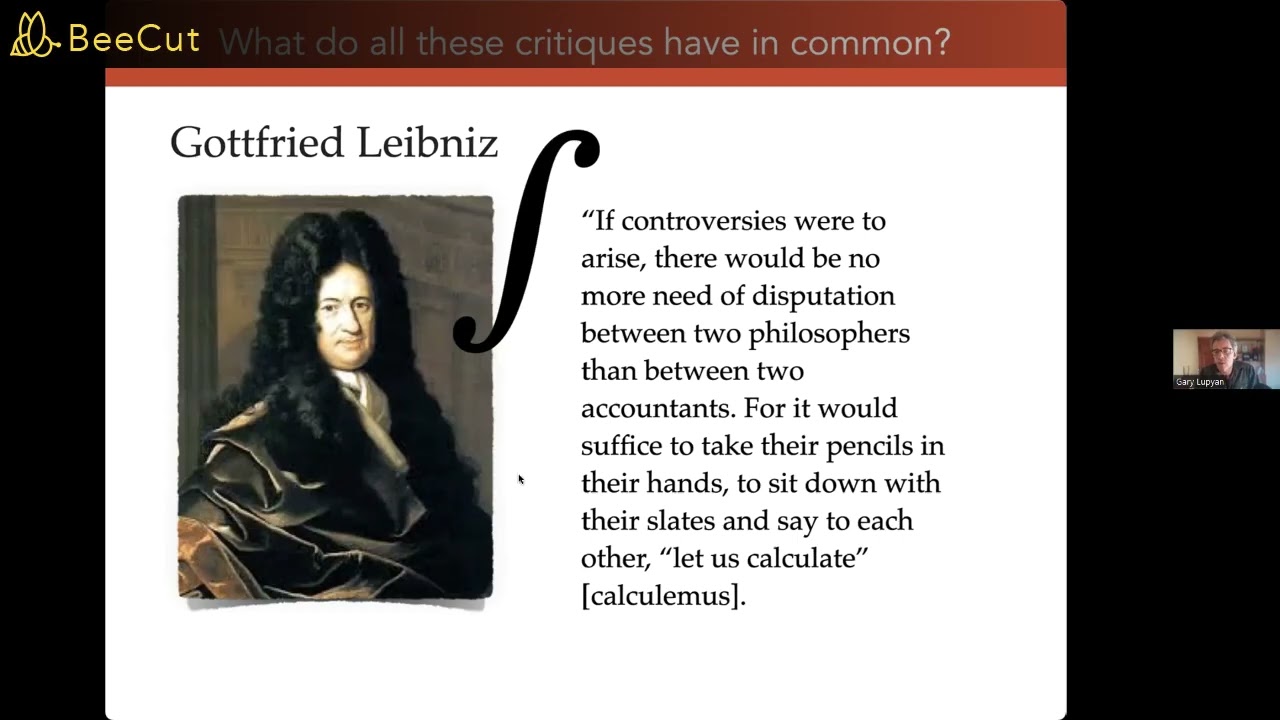
- Historical context: Boole and Leibniz on laws of thought
- Human reasoning is not sound: examples from syllogistic reasoning and Tower of Hanoi
- Introduction to Jabberwocky and Gostak examples
- Experiments with LLMs translating jabberwockified texts
- Results: models can recover meaning even for unseen texts
- Discussion of pre-training and model performance
- Conclusion: pattern matching as central to intelligence
Cited Sources
- The unreasonable effectiveness of pattern matching — Preprint by Lupyan and Agüera y Arcas, central to the talk
- Large language models have learned to use language — Related paper by Lupyan
- The Unreasonable Effectiveness of Mathematics in the Natural Sciences — Classic paper by Wigner, referenced in the title
Concurring Sources
- The Unreasonable Effectiveness of Mathematics in the Natural Sciences — Supports the idea of unexpected effectiveness in pattern matching
Dissenting Sources
- On the Dangers of Stochastic Parrots — Bender et al. argue that LLMs are stochastic parrots, which contrasts with Lupyan's view
Contribution & Novelties
The talk offers a novel perspective on LLM capabilities by demonstrating their ability to reconstruct meaning from heavily degraded texts, challenging the notion that they are merely stochastic parrots. It connects this to human cognition, arguing that pattern matching is a fundamental cognitive process. The empirical demonstrations with jabberwockified texts provide concrete evidence for this claim.
Pour aller plus loin :
- Construction grammar — Relevant to the linguistic framework mentioned.
- Stochastic parrots — The critique Lupyan addresses.
- Syllogistic reasoning — Classic reasoning tasks discussed.
84 words
Radar Profile
The radar profile shows high scores in information quantity and quality, indicating a well-supported and informative talk. The technical level is moderate, suitable for a general scientific audience. The overall reliability is high, though the reliance on a preprint and informal demonstrations slightly lowers it.
💬 No comments were provided for analysis.