Language: In search of neural code
Keywords
Summary
150 words
Critical Evaluation
Value of the Information & Strength of the Argument
The presentation provides valuable insights into the alignment between deep learning models and brain activity, supported by multiple studies and clear explanations of the methodology. The argumentation is solid, with careful consideration of limitations and alternative interpretations. The speaker demonstrates a deep understanding of both neuroscience and AI, and the discussion with the audience adds depth to the presentation.
Scientific Rigor, Source Quality, Title Accuracy
The scientific rigor is high, with references to peer-reviewed and preprint studies. The sources are credible, and the methodology is well-described. The title accurately reflects the content. The presentation is a seminar, so it is not a formal publication, but it is based on original research. The speaker acknowledges limitations and discusses potential biases.
128 words
Title / Content Match
The title accurately reflects the content: the search for the neural code of language through comparisons with deep learning models.
Quality & Reliability
8/10
Presentation by a CNRS researcher at ENS and Meta AI, based on peer-reviewed and preprint studies, with rigorous methodology (encoding models, comparisons across modalities and ages). Limitations are acknowledged. The content is technical and detailed, but the video is a seminar recording with limited production quality.
Key Moments
Markers derived by PSI from the transcript: the creator did not define chapters.
- Introduction and welcome
- Introduction to the topic: language and the brain
- Encoding models: comparing AI and brain activations
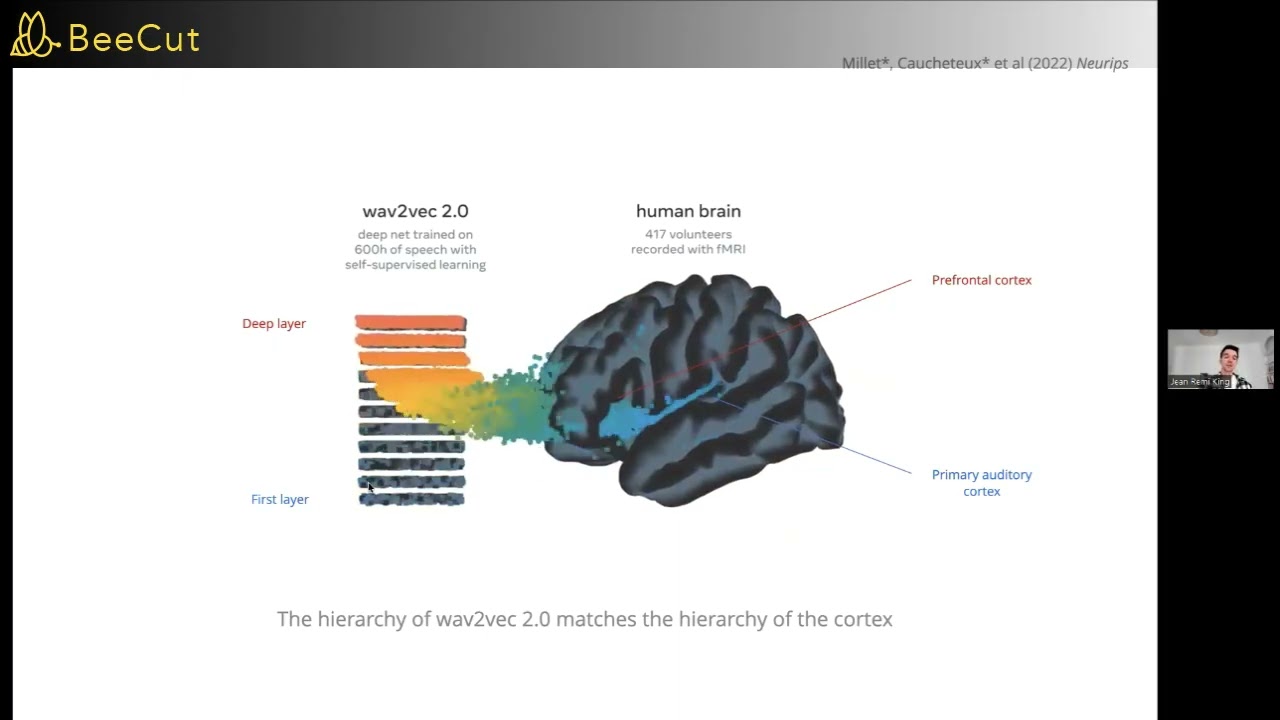
- Layer-wise analysis: hierarchy of representations
- MEG study: temporal dynamics of alignment
- Benchmarking models and effects of context and size
- Transfer across languages and modalities
- Children study: development of language representations
- Limitations and future directions
- Q&A and discussion
Cited Sources
- Evanson, L., et al. (2025). Emergence of language in the developing brain. arXiv. — Referenced as a study on language development in children.
- Lévy, J., et al. (2025). Brain-to-text decoding: A non-invasive approach via typing. arXiv preprint arXiv:2502.17480. — Referenced as a study on decoding brain activity to text.
- Banville, H., et al. (2025). Scaling laws for decoding images from brain activity. arXiv preprint arXiv:2501.15322. — Referenced as a study on scaling laws for brain decoding.
Concurring Sources
- Schrimpf, M., et al. (2021). The neural architecture of language: Integrative modeling converges on predictive processing. PNAS. — Similar findings that language models align with brain activity.
Dissenting Sources
- Bowers, J. S., et al. (2023). Deep problems with neural network models of human vision. Behavioral and Brain Sciences. — Raises concerns about the biological plausibility of deep learning models as models of human cognition.
Contribution & Novelties
The presentation offers a comprehensive overview of recent work in neuroAI, demonstrating that deep learning models can serve as powerful tools to understand the neural basis of language. The key novelty is the systematic comparison of model layers and brain regions, revealing a convergence of representations. The inclusion of developmental data from children is particularly novel. The speaker also discusses the concept of convergence and its implications.
Pour aller plus loin :
- Encoding models in neuroscience — Provides background on the methodology used.
- Large language models — Context on the AI models used.
- Convergent evolution — The concept discussed in the presentation.
102 words
Radar Profile
The radar profile shows high scores in information quantity, quality, and technical level, with a slightly lower but still high reliability score. This indicates a dense, technically rigorous presentation with strong scientific backing.