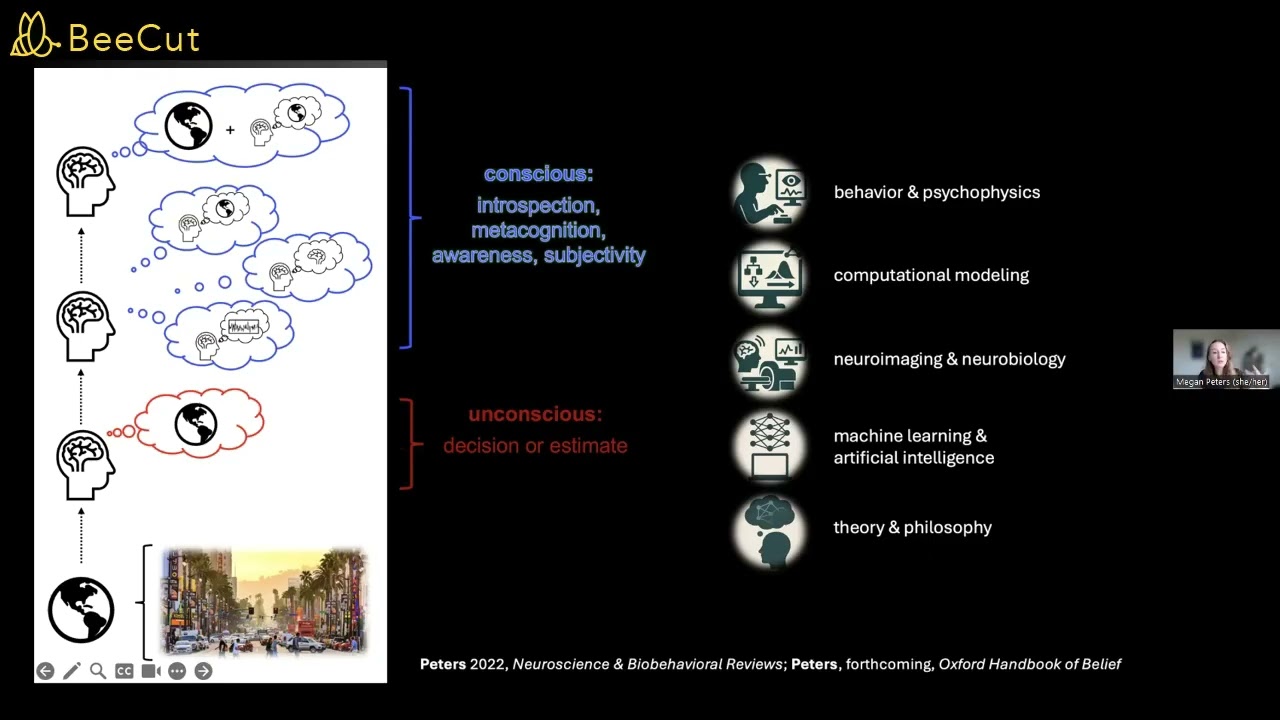
Confiance, métacognition et le « problème difficile » de la conscience
Keywords
Summary
206 words
Critical Evaluation
Value of the Information & Strength of the Argument
The talk provides valuable insights into the empirical study of metacognition and its relevance to consciousness. Peters presents a coherent argument that introspection is not a monolithic phenomenon but varies systematically with stimulus and task conditions. The use of introspective psychometric functions is a novel methodological contribution that allows for the isolation of subjective experience from objective performance. The argumentation is solid, grounded in multiple experiments and computational models, though some conclusions are speculative. The speaker acknowledges the limitations and open questions, which enhances the credibility of the presentation.
Scientific Rigor, Source Quality, Title Accuracy
The talk demonstrates scientific rigor through the use of established psychophysical methods and computational modeling. Peters cites several of her own peer-reviewed publications, including a 2015 eLife paper and a 2025 Cerebral Cortex paper, which are relevant to the content. The title accurately reflects the content, focusing on confidence, metacognition, and the hard problem. The presentation is well-structured and the claims are supported by data. However, as a seminar, it does not provide the full methodological details, and some references are mentioned but not fully elaborated.
190 words
Title / Content Match
The title accurately reflects the content, which explores the relationship between confidence, metacognition, and the hard problem of consciousness.
Quality & Reliability
8/10
The talk is given by a recognized expert in cognitive neuroscience, presenting a coherent overview of her research program with references to peer-reviewed publications. The claims are grounded in empirical studies and computational modeling, though the presentation is a seminar rather than a peer-reviewed article, and some speculative elements are acknowledged.
Key Moments
Markers derived by PSI from the transcript: the creator did not define chapters.
- Introduction: Megan Peters introduces the talk and the hard problem of consciousness.
- Motivating example: visual periphery and subjective experience.
- Hierarchy of representations: world models, metacognitive evaluations.
- Introspective psychometric functions: definition and importance.
- Blindsight and visual masking experiments.
- TMS experiment: paradoxical increase in confidence.
- Dot density and attention manipulations: effects on confidence.
- Loss functions and confidence reporting policies.
- Summary: introspection is not constant.
- Neural basis: ECoG study decoding evidence and confidence.
Cited Sources
- Peters & Azimi Asrari (2025). How brains build higher order representations of uncertainty. arXiv. — Mentioned as a recent paper on higher-order representations of uncertainty.
- Peters (2025). Introspective psychophysics for the study of subjective experience. Cerebral Cortex. — Cited as a methodological paper on introspective psychophysics.
- Peters (2022). Towards characterizing the canonical computations generating phenomenal experience. Neuroscience & Biobehavioral Reviews. — Cited as a theoretical paper on canonical computations for phenomenal experience.
- Peters & Lau (2015). Human observers have optimal introspective access to perceptual processes even for visually masked stimuli. eLife. — Cited as the empirical study on masking and introspection.
Concurring Sources
- Fleming, S. M., & Dolan, R. J. (2012). The neural basis of metacognitive ability. Philosophical Transactions of the Royal Society B. — Supports the idea that metacognition involves distinct neural mechanisms.
- Lau, H., & Rosenthal, D. (2011). Empirical support for higher-order theories of conscious awareness. Trends in Cognitive Sciences. — Provides theoretical background for higher-order representations in consciousness.
Dissenting Sources
Contribution & Novelties
The talk contributes to the field by systematically demonstrating that introspection is not a fixed function of objective performance, but varies with stimulus properties, attention, and decision policies. It introduces the concept of introspective psychometric functions as a tool to isolate subjective experience. The findings challenge previous assumptions about visual masking and blindsight, and suggest that confidence may be biased by evidence supporting the decision. The talk also bridges empirical work with philosophical questions about consciousness, proposing that understanding metacognitive computations might offer a new angle on the hard problem.
Pour aller plus loin :
- Higher-order theories of consciousness — Stanford Encyclopedia of Philosophy entry on higher-order theories, relevant to the discussion of metacognition and consciousness.
- Signal detection theory — Wikipedia article on SDT, foundational to the psychophysical methods used.
- Blindsight — Wikipedia article on blindsight, providing background on the condition discussed.
142 words
Radar Profile
The radar profile shows high scores in information quantity, quality, and technical level, indicating a dense and well-supported presentation. The fiabilite_globale is also high, reflecting the speaker's expertise and the use of peer-reviewed references. The overall profile suggests a scientifically rigorous talk that is accessible to a specialized audience.
💬 No comments were provided for analysis.