Affective Computing and Emotional Understanding: Beyond the Cold Logic of the Turing Test
Keywords
Summary
163 words
Critical Evaluation
Value of the Information & Strength of the Argument
The talk provides valuable insights into the importance of affective computing and the limitations of the Turing Test. Clavel’s argumentation is solid, grounded in her extensive research and references to established theories. She effectively demonstrates the need for transparency in AI systems, both in data annotation and model design. The examples from her work, such as annotation schemes for trust and stopping points, illustrate the practical challenges and solutions. However, the talk is more of an overview of her research program rather than a deep dive into specific methodologies, which limits the depth of argumentation for a technical audience.
Scientific Rigor, Source Quality, Title Accuracy
The talk demonstrates high scientific rigor, with references to peer-reviewed publications and established theories. Clavel cites specific works, such as the paper by Kovi and Prau Mor on bias in NLP, and her own publications. The sources are credible and relevant. The title accurately reflects the content, which focuses on affective computing and emotional understanding. The talk does not include any promotional content. The presentation is well-structured and the arguments are coherent.
186 words
Title / Content Match
The title accurately reflects the content, which discusses affective computing and emotional understanding in AI, moving beyond the traditional Turing Test.
Quality & Reliability
8/10
The talk is given by a senior researcher (Directrice de recherche) at INRIA, with a strong academic background and multiple peer-reviewed publications. The content is grounded in established theories from social sciences and NLP, and references specific studies. However, it is a seminar presentation, not a peer-reviewed article, and some claims are presented without detailed evidence.
Key Moments
Markers derived by PSI from the transcript: the creator did not define chapters.
- Introduction by Stephen, welcoming Chloe Clavel.
- Chloe Clavel begins her talk, introducing the topic of affective computing and social interactions.
- Discussion on the origins of affective computing and the importance of social emotional level in human-computer interaction.
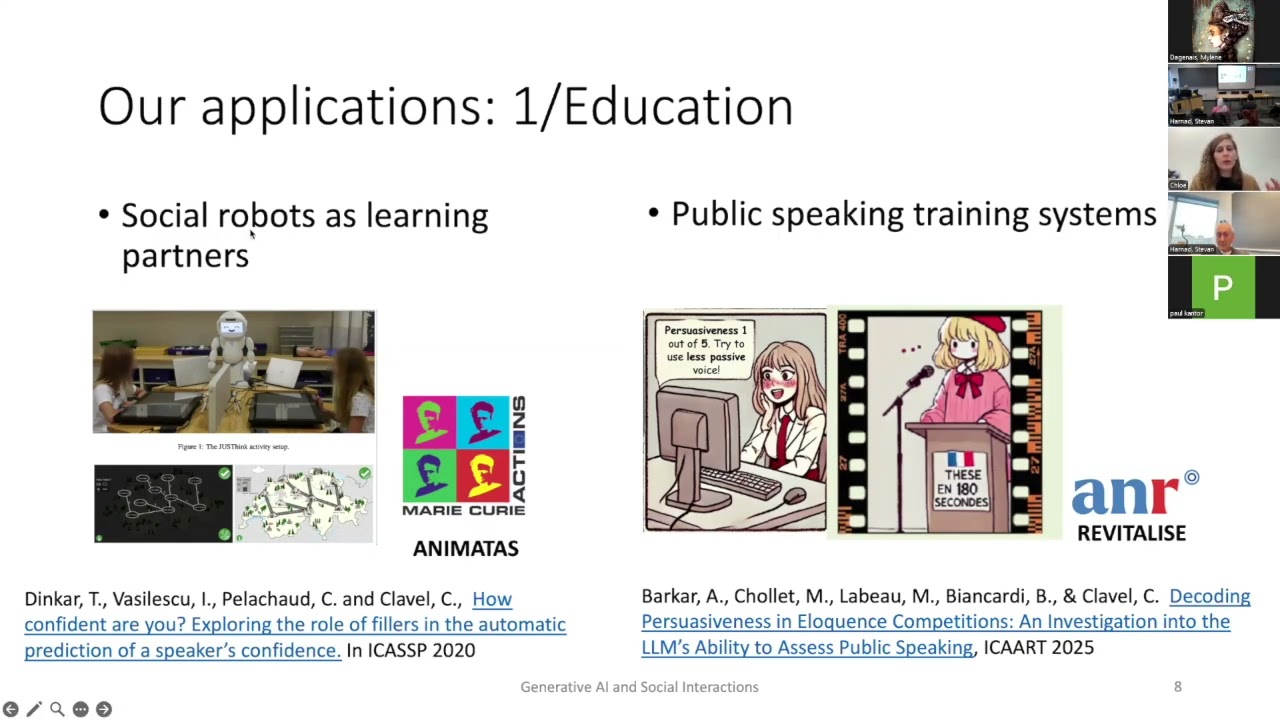
- Presentation of applications in education and health, including social robots and public speaking training.
- Introduction to the transparency challenge in AI systems and the need for interpretable models.
- Explanation of the two research directions: transparency by design and dissecting opaque models.
- Discussion on the importance of annotated datasets and the influence of annotation choices on model behavior.
- Example of annotation scheme for trust in human-robot interaction, grounded in interactional sociology.
- Discussion on handling annotation variability and the limitations of majority voting.
- Presentation of knowledge-driven model design, including multimodal features for repair detection.
Cited Sources
- Chenain, L., Bachoud-Lévi, A.-C., & Clavel, C. (2024). Acoustic Characterization of Huntington's Disease Emotional Expression: An Explainable AI Approach. ACIIW 2024. — Referenced in the description as a relevant publication.
- Clavel, C., Labeau, M., & Cassell, J. (2022). Socio-conversational systems: Three challenges at the crossroads of fields. Frontiers in Robotics and AI, 9, 737173. — Referenced in the description as a relevant publication.
- Guo, Y., Suchanek, F., & Clavel, C. (2024). The Curious Decline of Linguistic Diversity: Training Language Models on Synthetic Text. Findings of NAACL. — Referenced in the description as a relevant publication.
- Guibon, G., Labeau, M., Flamein, H., Lefeuvre, L., & Clavel, C. (2021). Few-Shot Emotion Recognition in Conversation with Sequential Prototypical Networks. EMNLP. — Referenced in the description as a relevant publication.
Concurring Sources
- Picard, R. W. (1997). Affective Computing. MIT Press. — Foundational book that established the field of affective computing.
- Poria, S., Cambria, E., Bajpai, R., & Hussain, A. (2017). A review of affective computing: From unimodal analysis to multimodal fusion. Information Fusion, 37, 98-125. — Comprehensive review of affective computing methods and challenges.
Dissenting Sources
- Floridi, L., & Chiriatti, M. (2020). GPT-3: Its nature, scope, limits, and consequences. Minds and Machines, 30(4), 681-694. — This paper discusses the limitations of large language models, which may contrast with the optimistic view of affective computing presented in the talk.
Contribution & Novelties
The talk provides a comprehensive overview of affective computing and argues for expanding the Turing Test to include emotional understanding. It highlights the importance of transparency in AI systems, both in data annotation and model design, and presents concrete examples from the speaker’s research. The talk bridges social science theories with computational models, offering a multidisciplinary perspective.
Pour aller plus loin :
- Affective computing — Overview of the field and its applications.
- Turing test — Background on the original test and its limitations.
- Social signal processing — Related field focusing on automatic analysis of social signals.
- Explainable artificial intelligence — Key concept for transparency in AI.
106 words
Radar Profile
The radar profile shows high scores in information quantity and quality, indicating a content-rich and well-sourced presentation. The technical level is moderate, suitable for a general scientific audience. The overall reliability is high, reflecting the speaker's expertise and the use of credible references.
💬 No comments were provided for analysis.