Is it really easier to build a child AI than an adult AI?
Keywords
Summary
151 words
Critical Evaluation
Value of the Information & Strength of the Argument
The talk provides valuable insights into the challenges of modeling child language acquisition with AI. Dupoux effectively argues that the problem is more complex than it appears, highlighting the robustness and efficiency of human learning. He presents a clear framework for evaluating computational models, emphasizing the importance of modeling the environment and outcome measures. The argumentation is solid, grounded in empirical data and theoretical considerations. He acknowledges the preliminary nature of his work, which adds to its credibility. The talk is well-structured and thought-provoking, offering a fresh perspective on the Turing test and the potential of AI for understanding human cognition.
110 words
Title / Content Match
The title accurately reflects the central question addressed in the talk, which is whether building a child-like AI is easier than building an adult-like AI, with a focus on language acquisition.
Quality & Reliability
8/10
The talk is given by a leading researcher in cognitive science and machine learning, with a strong publication record. The content is based on established research and includes references to specific studies. However, it is a seminar presentation with preliminary results, and some claims are presented without full peer review.
Key Moments
Markers derived by PSI from the transcript: the creator did not define chapters.
- Introduction to Turing's proposal and the question of building a child AI.
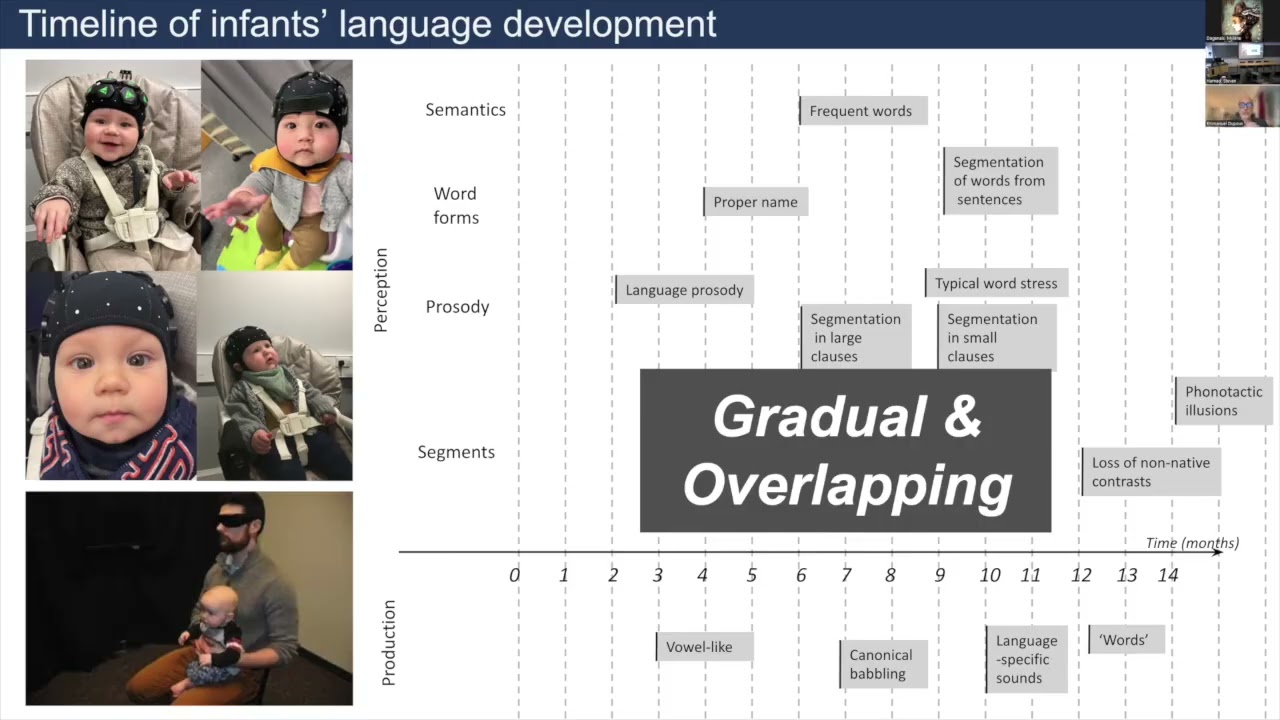
- Discussion of the robustness of language acquisition despite variation in input.
- Overview of theoretical accounts of language acquisition.
- Introduction to the statistical learning hypothesis and its relevance.
- Description of the three models needed for simulating language acquisition.
- Discussion of the challenge of learning discrete units from raw audio.
- Presentation of the study using audiobooks to simulate child input.
- Analysis of the results and implications for the Turing hypothesis.
Cited Sources
- Modeling early phonetic acquisition from child-centered audio data — Referenced as a study on modeling phonetic acquisition from child-centered audio.
- Countering Reward Over-optimization in LLM with Demonstration-Guided Reinforcement Learning — Referenced in the context of reinforcement learning and language models.
- Language Evolution with Deep Learning — Referenced as a chapter in the Oxford Handbook of Approaches to Language Evolution.
- WorldSense: A Synthetic Benchmark for Grounded Reasoning in Large Language Models — Referenced as a benchmark for grounded reasoning in LLMs.
- Modeling the initial state of early phonetic learning in infants — Referenced as a study on modeling the initial state of phonetic learning.
Concurring Sources
- Modeling early phonetic acquisition from child-centered audio data — Supports the claim that child-centered audio data can be used to model phonetic acquisition.
- WorldSense: A Synthetic Benchmark for Grounded Reasoning in Large Language Models — Provides evidence for the challenges of grounded reasoning in LLMs, relevant to the discussion of AI limitations.
Contribution & Novelties
The talk provides a novel perspective on the Turing test by focusing on the challenges of modeling child language acquisition. It highlights the importance of ecologically realistic data and the need for multiple models to simulate the learning process. The discussion of inductive biases in AI models offers a new framework for understanding the controversy between nativist and empiricist views.
Pour aller plus loin :
- Zero Resource Speech Challenge — A benchmark for learning speech representations without supervision, directly related to the talk’s focus on learning from raw audio.
- Statistical learning in language acquisition — Provides background on the statistical learning hypothesis.
- Self-supervised learning — Overview of the learning paradigm used in the models discussed.
115 words
Radar Profile
The radar profile shows high scores in information quantity, quality, and reliability, with a slightly lower score in technical level, indicating that the talk is accessible yet scientifically rigorous. The overall balance suggests a well-rounded presentation suitable for an academic audience.