Q2B25 Silicon Valley | Joe Altepeter, Program Manager, DARPA
Keywords
Summary
169 words
Critical Evaluation
Value of the Information & Strength of the Argument
The talk provides valuable insights into DARPA’s rigorous evaluation methodology for quantum computing, which is not commonly publicly detailed. The argumentation is based on the speaker’s extensive experience and the program’s findings, though it is primarily qualitative and relies on the authority of DARPA. The speaker effectively uses analogies (e.g., early flight) to illustrate the challenges and emphasizes the importance of engineering details over hype. The presentation is persuasive in conveying the complexity and uncertainty of the field, but it lacks quantitative data or specific examples from the evaluations, which would strengthen the argument.
Scientific Rigor, Source Quality, Title Accuracy
The speaker is a credible authority, directly involved in the program. The talk is an expert opinion, not a peer-reviewed study, but it is based on substantial internal program data. The title accurately reflects the content. No external sources are cited, but the program’s website is provided. The talk does not reference specific scientific literature, but it is consistent with the broader quantum computing research landscape. The title is appropriate and does not overpromise.
183 words
Title / Content Match
The title accurately reflects the content: a presentation by DARPA's program manager on quantum benchmarking at the Q2B25 Silicon Valley conference.
Quality & Reliability
8/10
High credibility due to the speaker's position at DARPA and his direct involvement in the Quantum Benchmarking Initiative. The talk is based on extensive internal program data and expert assessment, though it is an opinion/expert presentation rather than a peer-reviewed study.
Key Moments
Markers derived by PSI from the transcript: the creator did not define chapters.
- Introduction: Joe Altepeter's background and DARPA's mission.
- Two key questions: utility and feasibility of quantum computers.
- Simple plot: computation size vs. qubits, illustrating the gap to fault tolerance.
- Quantum Benchmarking Program: pilot studies with DOE labs and Boeing.
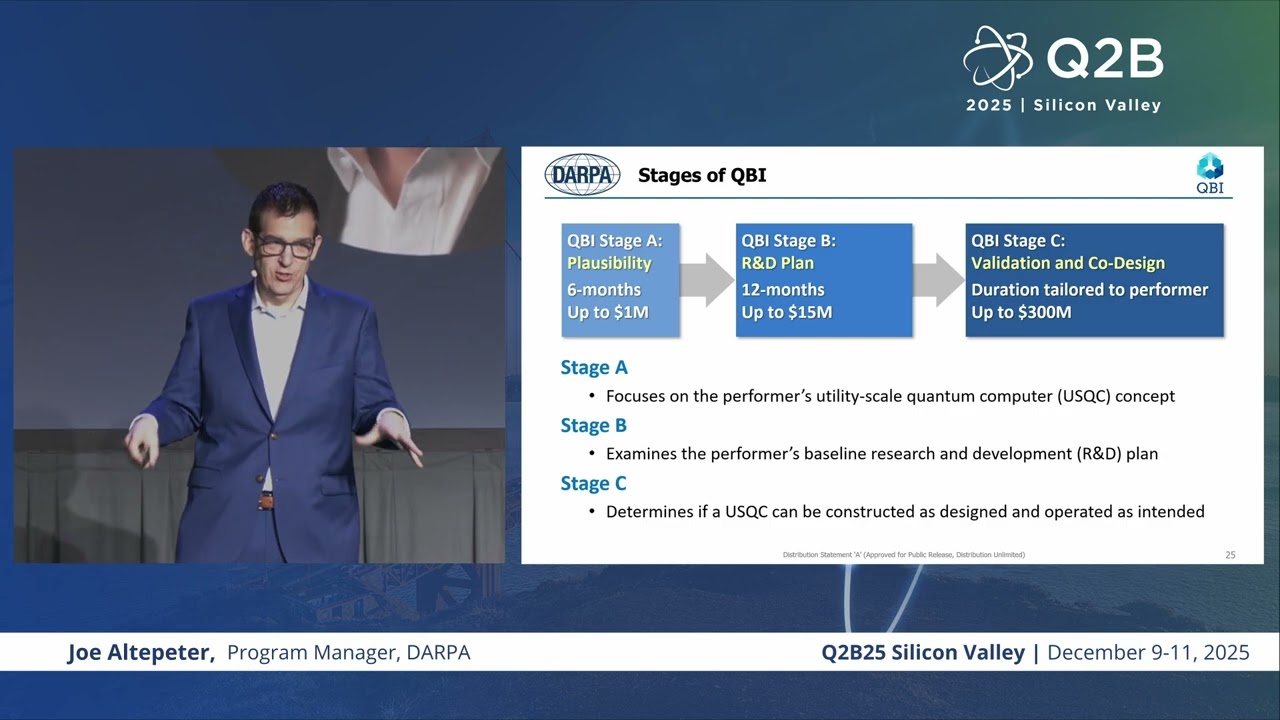
- Quantum Benchmarking Initiative: three stages (whiteboard, roadmap, independent tests).
- Evaluation criteria: three roots (what, how, why) and branches/leaves.
- Stage B: deeper analysis of R&D plans, supply chains, and metrics.
- Scale of effort: 450 people, 13 national labs, unprecedented.
- Preliminary findings: many viable approaches, no dominant technology, likely success by 2033.
Cited Sources
- Q2B Conference Website — The official website for the Q2B conference series, where this talk was given.
Concurring Sources
- Quantum Benchmarking Initiative (DARPA) — Official DARPA program page, consistent with the talk's description.
Contribution & Novelties
This talk provides a rare insider view of DARPA’s Quantum Benchmarking Initiative, detailing its methodology, scale, and preliminary conclusions. It offers a unique perspective on the evaluation of quantum computing companies, emphasizing engineering challenges over quantum algorithms. The talk contributes to the public understanding of how government agencies assess emerging technologies.
Pour aller plus loin :
- Quantum Benchmarking Initiative (DARPA) — Official DARPA program page.
- Quantum error correction — Key concept for fault-tolerant quantum computing.
- Quantum supremacy — Related to benchmarking quantum computers.
- Fault-tolerant quantum computer — The goal of the initiative.
92 words
Radar Profile
The radar profile shows high scores in information quantity, quality, and reliability, with a slightly lower technical level. This indicates a talk that is informative and credible, but not overly technical, suitable for a general technical audience.