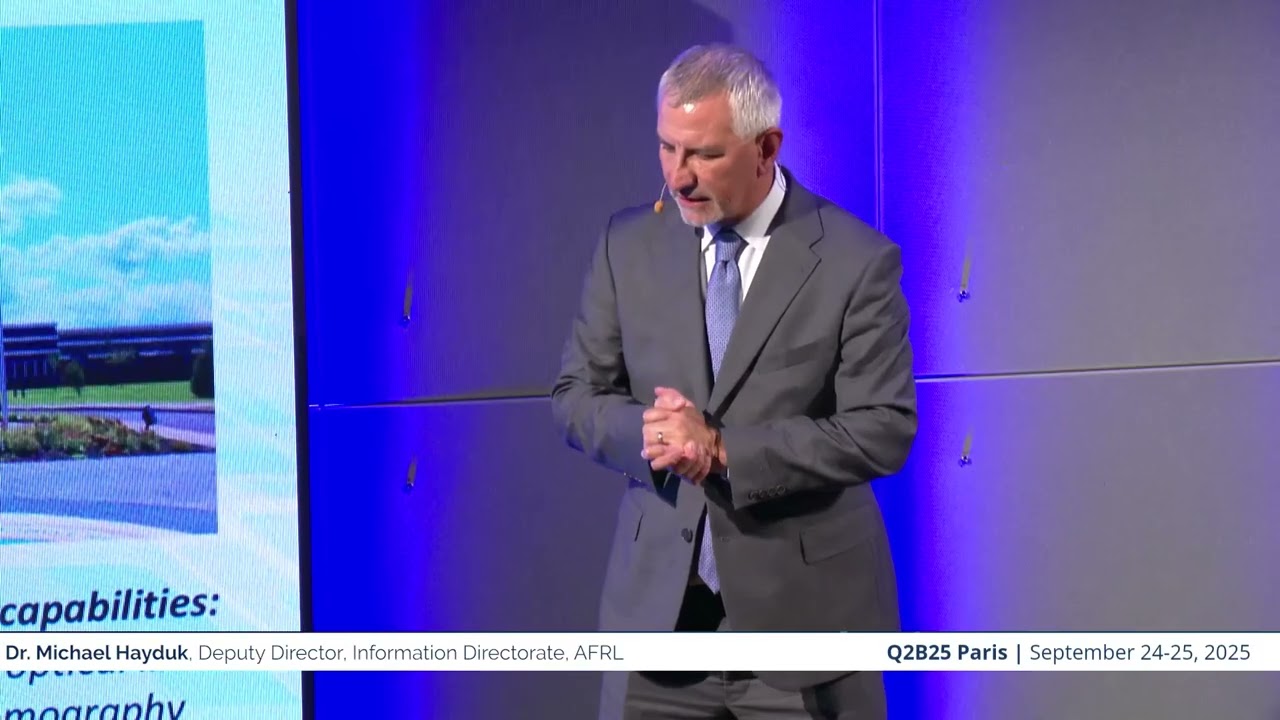
Q2B25 Paris | Dr. Michael Hayduk, Deputy Director, Information Directorate, AFRL
Keywords
Summary
158 words
Critical Evaluation
Value of the Information & Strength of the Argument
The talk provides valuable insights into the practical implementation of quantum networks, highlighting real-world challenges and solutions. The argumentation is solid, based on experimental results and strategic planning. The speaker effectively communicates the progression from lab-based research to field deployment, emphasizing the importance of engineering for real-world conditions. The inclusion of specific performance metrics, such as polarization fidelity improvements, strengthens the credibility. The discussion of heterogeneous qubit technologies and transduction underscores the complexity and forward-thinking approach of AFRL’s program.
Scientific Rigor, Source Quality, Title Accuracy
The presentation is scientifically rigorous, referencing an arXiv paper by Dr. Aaron Sheridan for detailed results. The speaker clearly distinguishes between internal research and external collaborations, such as with QC Ware for polarization control. The title accurately reflects the content, focusing on quantum networking at AFRL. The talk is well-structured, with clear explanations of network topologies and experimental setups. The speaker acknowledges limitations, such as the decision not to fund QKD until certifiable, which adds to the credibility. Overall, the sources are credible and the content aligns with the title.
184 words
Title / Content Match
The title accurately reflects the speaker and topic, focusing on quantum networking at AFRL.
Quality & Reliability
8/10
Presentation by a senior AFRL official detailing ongoing quantum networking research, with references to a peer-reviewed arXiv paper and specific experimental results. The content is credible and technically sound, though it represents an institutional perspective.
Key Moments
Markers derived by PSI from the transcript: the creator did not define chapters.
- Introduction to AFRL and its quantum strategy areas: timing, sensing, networking, computing.
- Overview of AFRL's quantum program structure and technology directorates.
- Discussion of heterogeneous qubit technologies (superconductors, trapped ions, integrated photonics) and transduction.
- Description of quantum local area networks (QLANs) at Griffith, Rome, and Stockbridge.
- Details of the Griffith fiber network and polarization stabilization results.
- Stockbridge testbed as a controllable contested environment with free space and aerial nodes.
- Results from Stockbridge showing polarization control in free space environment.
- Future plans: metropolitan network, drone integration, Rydberg sensors.
- Quantum computing strategy: algorithm development and DARPA QBI evaluation.
- Partnerships and collaboration opportunities.
Cited Sources
- Q2B Conference — Conference website where this talk was presented.
Concurring Sources
- arXiv paper by Dr. Aaron Sheridan — Referenced in the talk for detailed results on quantum network characterization.
Contribution & Novelties
This talk provides a unique insider perspective on the US Air Force’s quantum networking initiatives, detailing specific testbeds and experimental results. It highlights the importance of heterogeneous qubit integration and field deployment, which is often overlooked in academic discussions. The presentation of polarization stabilization in a contested environment is particularly novel.
Pour aller plus loin :
- Quantum key distribution — Background on QKD, which AFRL is not currently funding.
- Entanglement distribution — Overview of quantum networks and entanglement distribution.
- DARPA Quantum Benchmarking Initiative — Program mentioned for evaluating quantum computing hardware.
- Rydberg atom — Basis for Rydberg sensors mentioned in the talk.
102 words
Radar Profile
The radar profile shows high scores in information quantity, quality, and reliability, with a slightly lower technical depth, indicating a presentation that is informative and credible but not overly technical. The overall balance suggests a well-rounded talk suitable for a professional audience.
💬 No comments were provided for analysis.