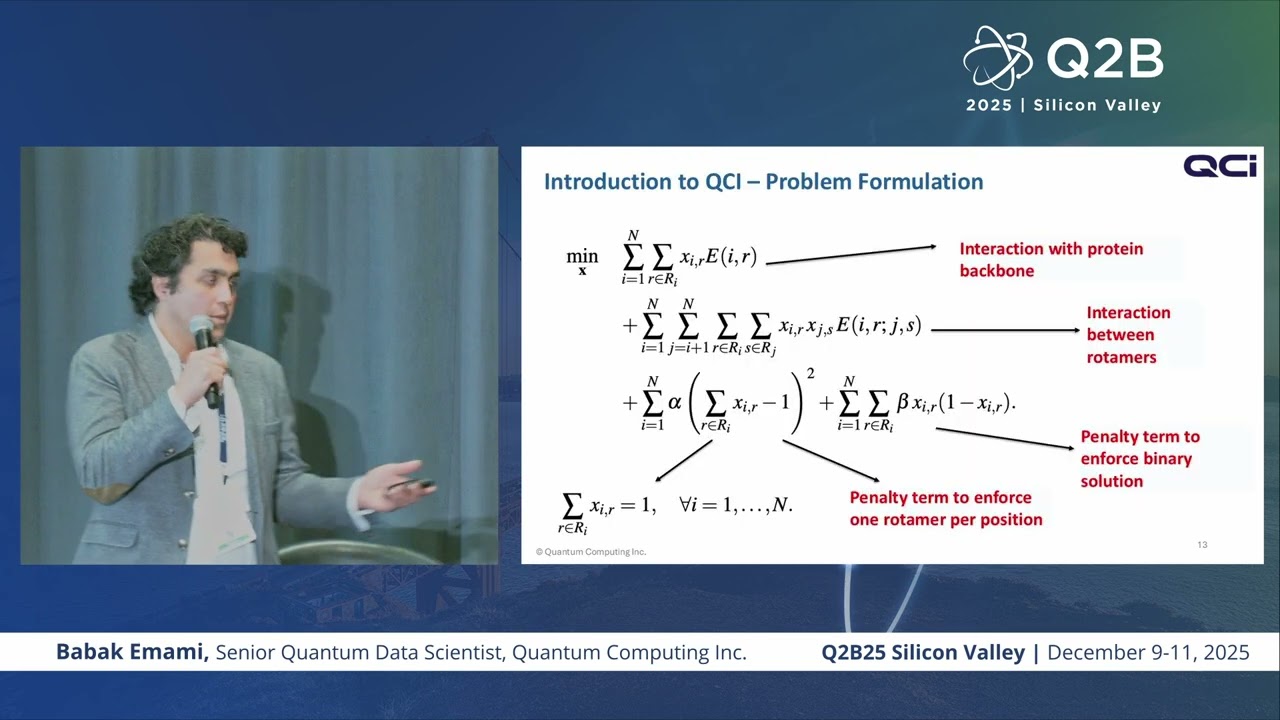
Q2B25 Silicon Valley | Entropy Quantum Computing For Fixed-Backbone Protein Design
Keywords
Summary
153 words
Critical Evaluation
Value of the Information & Strength of the Argument
The presentation provides valuable insights into applying quantum computing to a real-world optimization problem in protein design. The argumentation is solid, with clear problem formulation, methodology, and benchmarking against classical methods. The speakers demonstrate the potential advantage of quantum hardware in terms of runtime scaling, though they acknowledge current limitations in problem size. The results are preliminary but promising, and the partitioning heuristic extends the approach to larger problems. The argumentation is logical and well-supported by the data presented.
88 words
Title / Content Match
The title accurately reflects the content, focusing on entropy quantum computing for protein design.
Quality & Reliability
7/10
Presentation of original research with clear methodology, but limited peer review and small sample size.
Key Moments
Markers derived by PSI from the transcript: the creator did not define chapters.
Cited Sources
- Q2B Conference Website — Conference where the presentation was given
- Presentation Slides — Slides accompanying the presentation
Concurring Sources
- Quantum Computing Inc. Publications — Related publications from QCI on quantum optimization
Contribution & Novelties
This work presents a novel application of entropy quantum computing to protein design, demonstrating the potential of quantum optimization for a real-world problem. The use of QCI’s Dirac 3 hardware and the partitioning heuristic for larger problems are notable contributions. The results show promising runtime scaling compared to classical methods, suggesting a potential advantage for quantum approaches in this domain.
Pour aller plus loin :
- Quantum annealing — Relevant to the optimization approach used.
- Protein design — Background on the problem domain.
- Rotamer library — Key concept in the methodology.
90 words
Radar Profile
The radar profile shows strong scores in information quantity and technical level, with moderate quality and reliability. This indicates a technically detailed presentation with substantial content, but with some limitations in source verification and peer review.