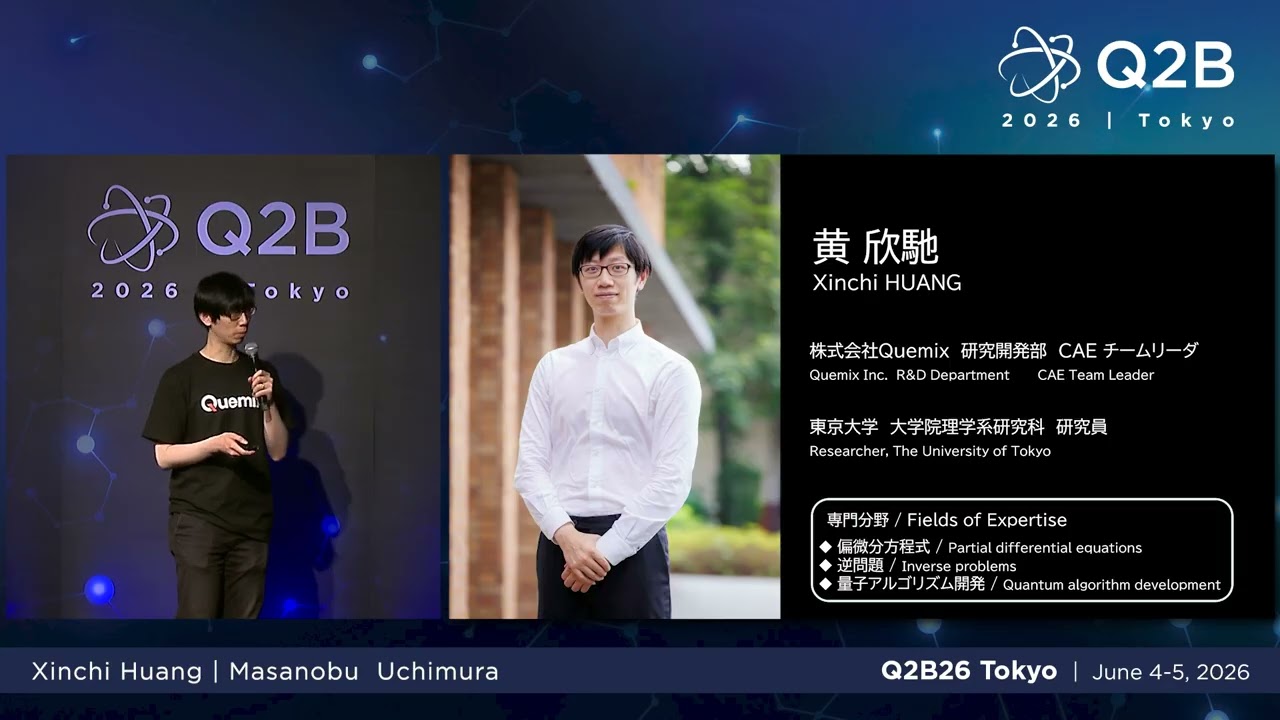
Q2B26 Tokyo | Xinchi Huang (黄欣馳), Quemix, Inc. and Masanobu Uchimura (内村允宣), Nissan Motor Co., Ltd.
Keywords
Summary
182 words
Critical Evaluation
Value of the Information & Strength of the Argument
The presentation provides valuable insights into a practical application of quantum computing to a real industrial problem. The hybrid approach is a pragmatic solution to the limitations of current quantum hardware, and the reported reduction in circuit depth is significant. The argumentation is coherent, with a clear problem statement, proposed method, and results. However, the claims of quantum advantage are based on theoretical estimates and simulations, not on actual quantum hardware demonstrations. The presentation lacks detailed technical specifics, such as the exact quantum circuits used or the error models assumed, which would be necessary for a rigorous evaluation.
Scientific Rigor, Source Quality, Title Accuracy
The presentation is based on original research conducted by the authors, and they mention a joint patent application. However, no external sources are cited, and the only link provided is to the Q2B conference website. The title accurately reflects the content, focusing on the application of quantum fluid simulation to automotive aerodynamics. The scientific rigor is moderate: while the methodology is plausible, the lack of peer-reviewed publication or detailed technical documentation limits the verifiability of the claims. The presentation is aimed at a specialized audience familiar with quantum computing and fluid dynamics.
205 words
Title / Content Match
The title accurately reflects the content, which focuses on applying quantum fluid simulation to automotive aerodynamic design.
Quality & Reliability
7/10
Presentation of a joint research project with concrete results, but limited details on methodology and validation. Claims of quantum advantage are based on estimates and simulations, not yet demonstrated on real hardware.
Key Moments
Markers derived by PSI from the transcript: the creator did not define chapters.
- Introduction by Masanobu Uchimura of Nissan, outlining the company's long-term vision and the role of simulation in development.
- Discussion of digitization in material and vehicle development, including crash and aerodynamic simulations.
- Introduction of the lattice Boltzmann method (LBM) and its suitability for quantum computation.
- Explanation of the challenge of boundary conditions in quantum LBM and the proposed hybrid quantum-classical approach.
- Details of the hybrid method: state preparation, collision, streaming, and classical correction of non-homogeneous terms.
- Results: reduction in circuit depth by factor of 500,000 and demonstration of quadratic quantum advantage in 2D.
- Simulation results showing airflow around a vehicle, with accuracy comparable to classical methods.
- Future work: extending to 3D, improving physical models, and exploring other applications.
Cited Sources
- Q2B Conference Website — Mentioned as the conference where this presentation was given.
Contribution & Novelties
The main novelty is the hybrid quantum-classical approach to handle boundary conditions in LBM, which significantly reduces circuit depth and makes quantum fluid simulation feasible for early fault-tolerant quantum computers. This is a step beyond toy models, applying the method to a realistic automotive geometry.
Pour aller plus loin :
- Lattice Boltzmann methods — Overview of the classical method used as basis.
- Quantum computing — General background on quantum computation.
- Fault-tolerant quantum computer — Context for the target hardware.
79 words
Radar Profile
The radar profile shows high scores in technical level and information quantity, reflecting the specialized content and detailed presentation. The lower score in reliability is due to the lack of external validation and reliance on estimates. Overall, the profile indicates a technically strong but not yet fully verified contribution.