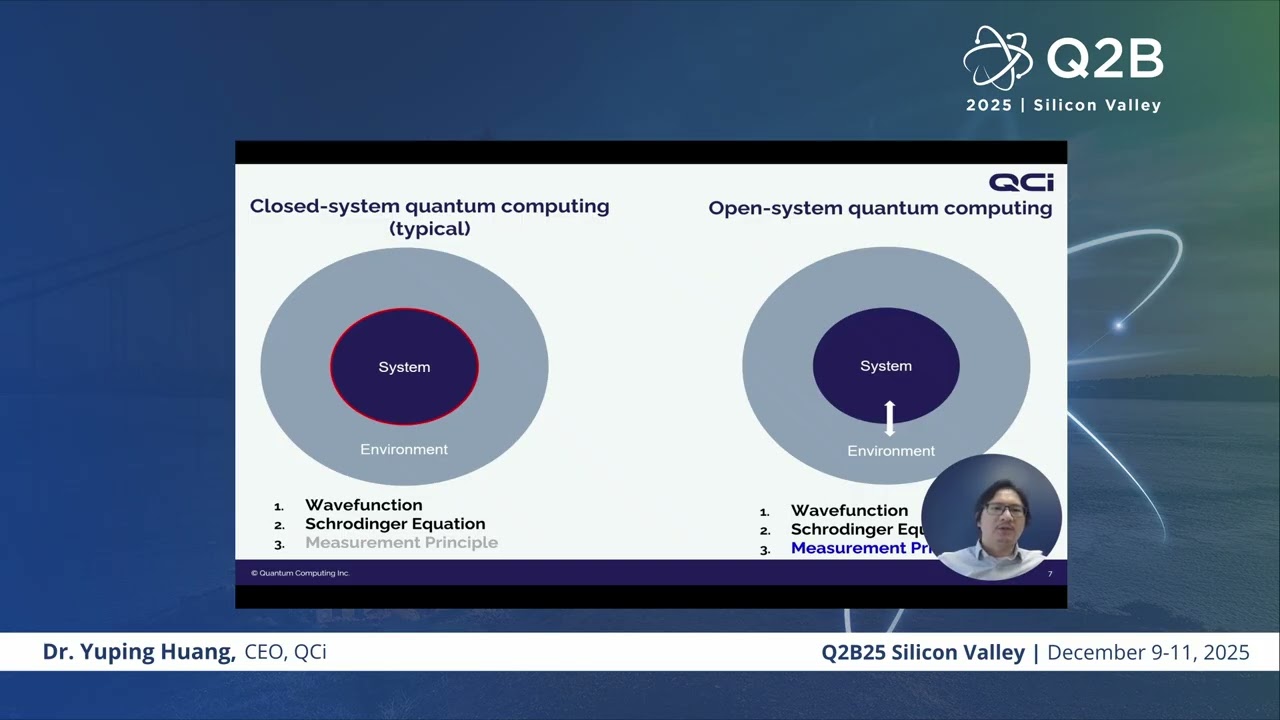
Q2B25 Silicon Valley | Dr. Yuping Huang, CEO, QCi
Keywords
Summary
161 words
Critical Evaluation
Value of the Information & Strength of the Argument
The presentation offers valuable insights into an alternative paradigm in quantum computing, challenging conventional assumptions about the necessity of extreme isolation. The argument is logically structured, starting from fundamental postulates and building to practical applications. The speaker supports his claims with references to his own research and theoretical work, though the presentation is promotional and lacks detailed technical depth. The value lies in presenting a coherent vision for open-system quantum computing and its potential benefits, such as room-temperature operation and reduced costs.
Scientific Rigor, Source Quality, Title Accuracy
The scientific rigor is moderate: the speaker correctly states the postulates of quantum mechanics and references his own published work, but the presentation is a high-level overview without citations to external literature. The title accurately reflects the content, and the speaker’s credentials lend credibility. However, the promotional nature and lack of independent verification of the company’s claims temper the overall reliability. The video description includes links to the Q2B website and a Google Drive file, which may contain additional resources, but they are not directly cited in the talk.
186 words
Title / Content Match
The title accurately reflects the content: a presentation by Dr. Yuping Huang, CEO of QCi, at the Q2B25 Silicon Valley conference.
Quality & Reliability
7/10
The speaker is a domain expert and CEO, presenting a coherent argument based on established quantum mechanics postulates and their own research. However, the talk is a promotional presentation for their company, and specific claims about their technology are not independently verified in the video. The scientific content is accurate but presented at a high level.
Key Moments
Markers derived by PSI from the transcript: the creator did not define chapters.
- Introduction and apologies for pre-recorded talk.
- Challenges common perceptions of quantum as spooky, cold, and closed.
- Reviews the three postulates of quantum mechanics, highlighting the measurement postulate.
- Explains that all quantum systems are inherently open and discusses open system quantum computing.
- Presents practical benefits of open system quantum computing: room temperature, lower cost, etc.
- Describes early research on quantum gates using single atoms and photons, including quantum Zeno blockade.
- Introduces QCi's approach: customer-centric design and hybrid quantum-classical machines.
- Details the Dirac series optimization machine specifications and applications.
- Mentions other quantum products: reservoir computers, quantum networking, and thin-film lithium niobate fabrication.
- Concludes with the vision of a warm, open quantum world and invites questions via email.
Cited Sources
- Q2B Conference Website — Mentioned as the conference website.
- Presentation Slides (Google Drive) — Linked in the video description, likely containing the slides for this presentation.
Concurring Sources
- Open Quantum Systems: An Introduction — Supports the concept of open quantum systems as a standard topic in quantum physics.
Contribution & Novelties
The presentation offers a novel perspective on quantum computing by advocating for open quantum systems as a viable alternative to the dominant closed-system approach. It provides a high-level overview of the theoretical foundations and practical benefits, supported by the speaker’s research and company developments. The talk is valuable for introducing the concept to a broader audience and highlighting potential industry applications.
Pour aller plus loin :
- Open quantum system — Wikipedia article providing a general overview of the concept.
- Quantum Zeno effect — Wikipedia article explaining the quantum Zeno effect, which is central to the speaker’s research.
- Thin-film lithium niobate — Wikipedia article on lithium niobate, the material used in QCi’s chips.
112 words
Radar Profile
The radar profile shows a balanced performance with slightly higher scores in information quantity and quality, and lower in technical depth and reliability, reflecting the presentation's promotional nature and lack of detailed technical exposition.