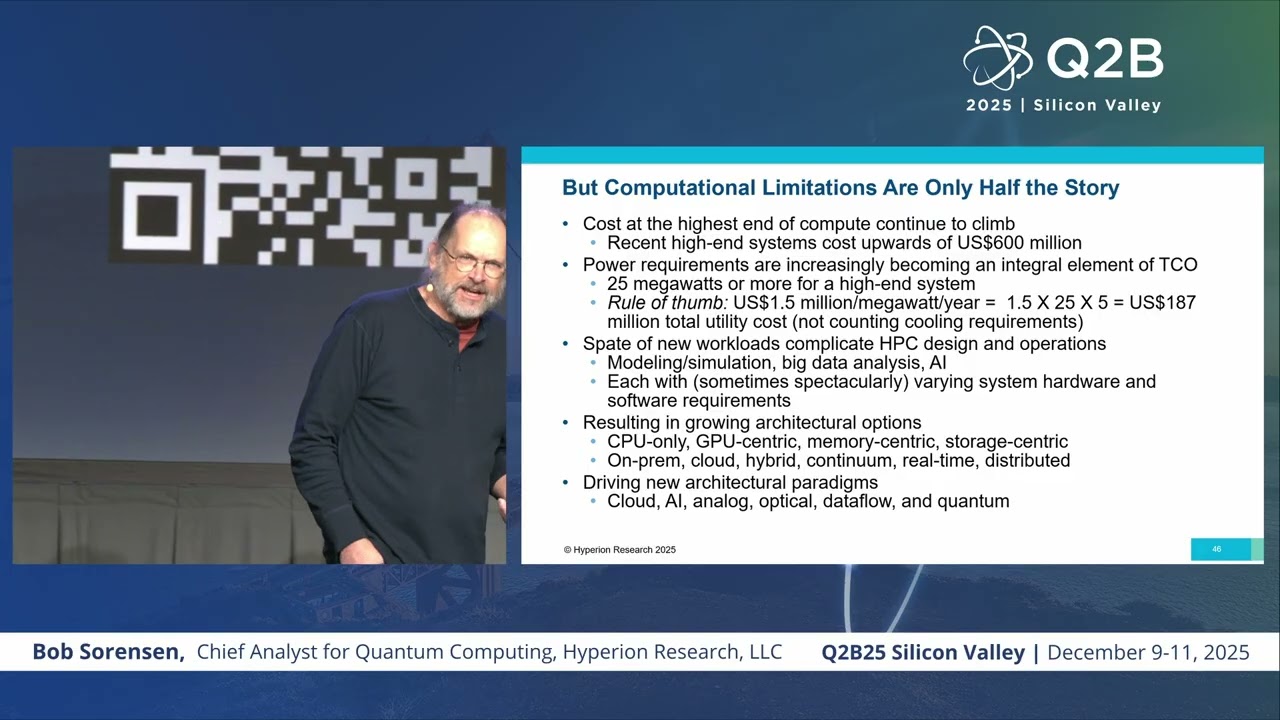
Q2B25 Silicon Valley | Bob Sorensen, Chief Analyst for Quantum Computing, Hyperion Research, LLC
Keywords
Summary
216 words
Critical Evaluation
Value of the Information & Strength of the Argument
The talk provides valuable insights into the practical considerations for adopting quantum computing in HPC environments. Sorensen’s argumentation is structured and logical, based on his experience and industry surveys. He effectively highlights the challenges and opportunities, emphasizing the need for a strategic approach rather than immediate implementation. The value lies in the actionable roadmap he provides, which is grounded in real-world concerns such as cost, integration, and workforce expertise. However, the argumentation is largely qualitative, with limited quantitative data presented, and relies heavily on anecdotal evidence from surveys and personal interactions.
Scientific Rigor, Source Quality, Title Accuracy
The talk demonstrates a good understanding of the HPC and quantum computing landscape, but it lacks formal citations. Sorensen references a DOE study and his own surveys, but does not provide specific sources or data points. The title accurately reflects the content, as the talk focuses on integrating quantum into HPC. The lack of detailed citations reduces the scientific rigor, but the speaker’s expertise and the coherence of the argumentation partially compensate. No comments were provided for analysis.
184 words
Title / Content Match
The title accurately reflects the content: a presentation by Bob Sorensen on integrating quantum computing into the HPC ecosystem.
Quality & Reliability
7/10
The speaker is a recognized analyst in HPC and quantum computing, providing insights based on industry surveys and experience. The talk is opinionated but grounded in data from surveys and market observations. No formal citations are provided, but the content is coherent and aligns with known trends in the field.
Key Moments
Markers derived by PSI from the transcript: the creator did not define chapters.
- Introduction: Bob Sorensen introduces himself and the topic of integrating quantum into HPC.
- Overview of HPC sector: performance trends, aging systems, and rising costs.
- Motivations for quantum adoption: new algorithms, performance concerns, and organizational relevance.
- Hurdles to adoption: integration, expertise, ROI, and lack of requirements.
- Step 1: Characterize existing workloads and identify key pain points.
- Step 2: Develop a classical plan to address pain points, including cost and timeline.
- Step 3: Build in-house support for quantum by engaging HPC end users and planners.
- Step 4: Explore algorithmic opportunities, referencing a DOE study.
- Conclusion: Emphasizing ROI and the importance of early adoption.
Cited Sources
- Q2B Conference Website — Mentioned as the conference website.
- Presentation Slides (Google Drive) — Referenced as the deck for the talk.
Concurring Sources
- DOE Office of Science workload study — Referenced in the talk as a study showing 50% of DOE production workload could benefit from quantum.
Contribution & Novelties
The talk provides a practical, step-by-step roadmap for integrating quantum computing into existing HPC environments, which is a valuable contribution to the field. It emphasizes the importance of starting with workload characterization and classical optimization before engaging with quantum technologies. The speaker’s perspective as an industry analyst adds a market-oriented viewpoint that is often missing in purely academic discussions.
Pour aller plus loin :
- Quantum computing — Overview of quantum computing concepts.
- High-performance computing — Background on HPC.
- Quantum annealing — A specific quantum computing approach mentioned in the talk.
90 words
Radar Profile
The radar profile shows high scores in information quantity and quality, with moderate technical depth and reliability. This indicates a talk that is informative and well-structured, but not highly technical or rigorously sourced.