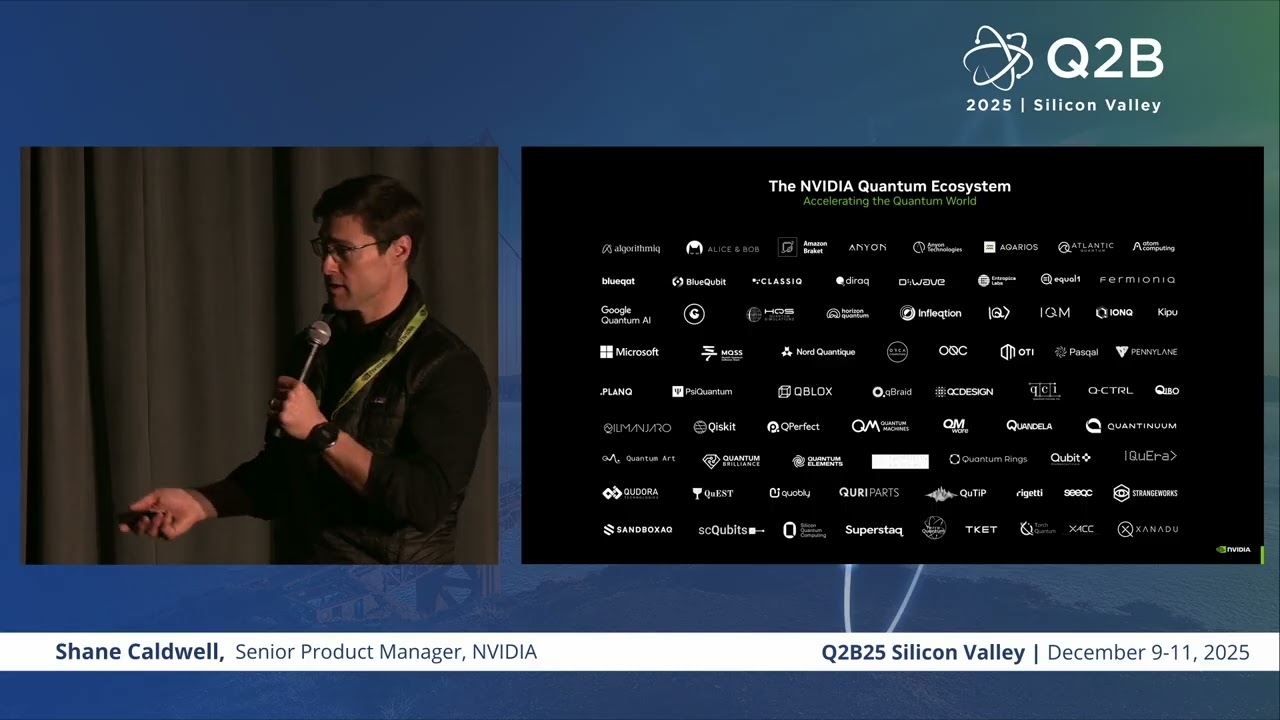
Q2B25 Silicon Valley | Shane Caldwell, Senior Product Manager, NVIDIA
Keywords
Summary
196 words
Critical Evaluation
Value of the Information & Strength of the Argument
The talk provides valuable insights into NVIDIA’s quantum computing roadmap and the technical architecture of NVQLink. The argumentation is coherent, presenting a clear problem (QPU integration into HPC) and a proposed solution (NVQLink). The speaker supports his claims with specific examples and results, such as the collaboration with Quantinuum and the 4-microsecond round-trip latency. However, the talk is largely promotional, and the technical depth is moderate, with some concepts (e.g., QEC decoding) explained at a high level. The argumentation would be stronger with more independent evidence or comparisons to alternative approaches.
Scientific Rigor, Source Quality, Title Accuracy
The talk demonstrates a reasonable level of scientific rigor, as it references specific collaborations and results (e.g., Google’s quantum error mitigation, Quantinuum’s Helios processor). However, no external sources are cited in the video, and the only link provided is to the Q2B conference website. The title accurately reflects the content, and the speaker is a credible authority as a product manager at NVIDIA. The talk would benefit from citing peer-reviewed papers or technical reports to strengthen its claims.
184 words
Title / Content Match
The title accurately reflects the content: a presentation by Shane Caldwell at Q2B25 Silicon Valley about NVIDIA's quantum computing initiatives, focusing on NVQLink.
Quality & Reliability
7/10
The talk is an expert opinion from a senior product manager at NVIDIA, presenting technical details of NVQLink and CUDA-Q. Claims are supported by references to collaborations (Google, Quantinuum) and a white paper, but no external sources are cited in the video itself. The information is plausible and aligns with known NVIDIA efforts, but lacks independent verification.
Key Moments
Markers derived by PSI from the transcript: the creator did not define chapters.
- Introduction and overview of NVIDIA's quantum computing strategy
- Discussion of global trends in accelerated computing and Moore's law
- Introduction to CUDA-Q platform and its features
- Recent work: AI for quantum position paper and Google's quantum error mitigation
- Transition to NVQLink: current QPU integration challenges
- NVQLink architecture: real-time host and Ethernet-based RDMA
- Use cases: quantum error correction decoding and requirements
- CUDA-Q QEC library and workflow
- Results with Quantinuum Helios processor and decoding performance
- Conclusion and call to action
Cited Sources
- Q2B Conference Website — The talk was given at Q2B25 Silicon Valley, and the link provides information about the conference.
Concurring Sources
- NVIDIA Quantum Computing — NVIDIA's official quantum computing page, which aligns with the talk's claims about CUDA-Q and NVQLink.
Contribution & Novelties
The talk presents NVIDIA’s NVQLink as a novel approach to integrating QPUs into supercomputing environments, emphasizing low-latency communication and real-time processing for quantum error correction. The main contribution is the architectural blueprint for a ‘magic blue box’ that accelerates QPU workloads and provides a normalized interface to classical HPC. The talk also highlights CUDA-Q’s QEC library and its end-to-end workflow, which is a practical contribution to the quantum computing community.
Pour aller plus loin :
- Quantum Error Correction — Provides background on QEC, which is central to the talk’s motivation.
- CUDA-Q documentation — Official documentation for CUDA-Q, the platform discussed in the talk.
- NVQLink white paper — NVIDIA’s quantum computing page, which may host the white paper mentioned in the talk.
121 words
Radar Profile
The radar profile shows high scores in technical level and information quantity, reflecting the talk's detailed technical content. Quality of information and global reliability are moderate, as the talk is promotional and lacks external citations. The overall profile suggests a technically informative but somewhat biased presentation.