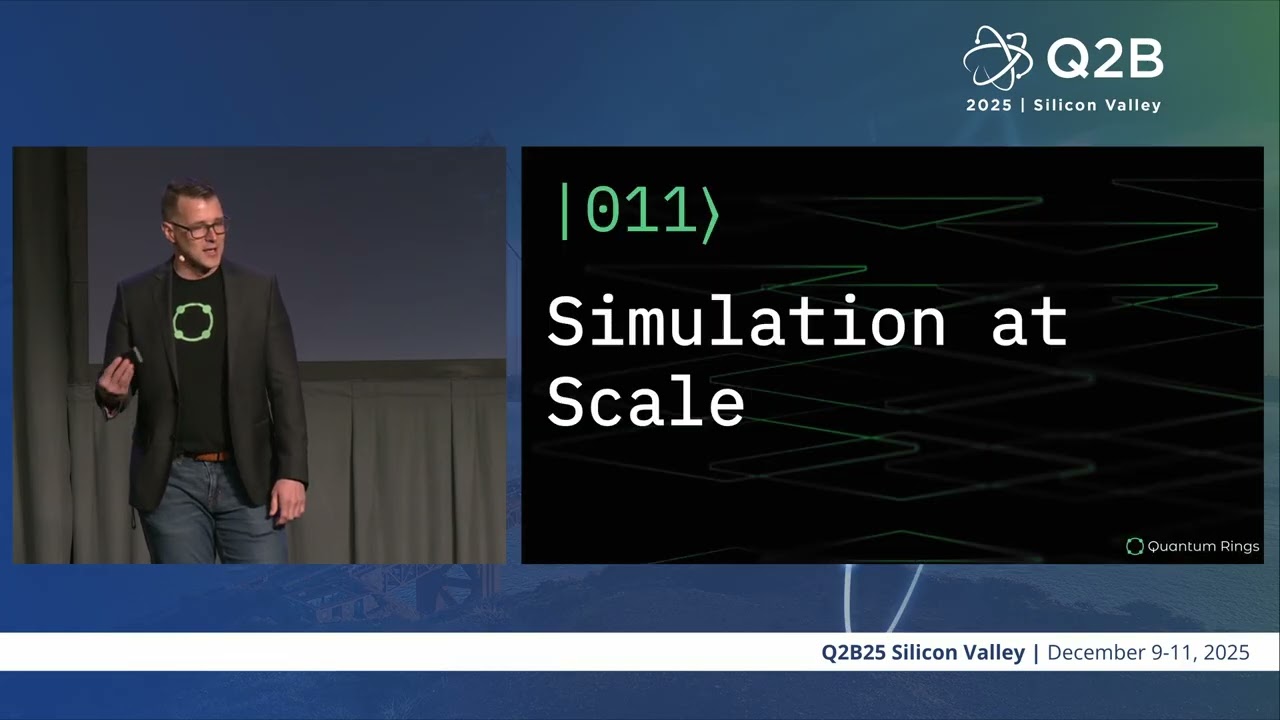
Q2B25 SV | Bob Wold and Venkat Kasirajan, Quantum Rings
Keywords
Summary
206 words
Critical Evaluation
Value of the Information & Strength of the Argument
The presentation provides valuable insights into the practical state of quantum computing and the potential of classical simulation. The argumentation is solid, using concrete examples and comparisons to established benchmarks (e.g., Google’s random circuit sampling, IBM’s utility-scale experiment). The presenters effectively argue that classical simulation can currently outperform quantum hardware on certain tasks, offering a cost-effective alternative for algorithm development. However, the talk is also promotional, and some claims (e.g., solving peaked circuits on a laptop) lack detailed technical explanation. The argumentation is persuasive but would benefit from more independent validation.
Scientific Rigor, Source Quality, Title Accuracy
The presentation references several credible sources, including a McKinsey report, NIST standards, and published papers (e.g., on random circuit sampling and Shor’s algorithm). The title accurately reflects the content. The talk is well-structured and technically coherent, but the lack of detailed citations for some claims (e.g., the 48-bit factorization) slightly reduces its scientific rigor. The description provides links to the Q2B conference and a slide deck, which are useful for further reference.
178 words
Title / Content Match
The title accurately reflects the content, which focuses on large-scale quantum simulation and the presenters' company, Quantum Rings.
Quality & Reliability
7/10
The presentation offers a balanced view of quantum computing's current state and future potential, backed by specific examples and comparisons. However, claims about the simulator's performance are not independently verified, and the talk is partly promotional.
Key Moments
Markers derived by PSI from the transcript: the creator did not define chapters.
- Introduction by Bob Wold, CEO of Quantum Rings, outlining the presentation topics.
- Discussion of the state of quantum computing: optimistic vs. bearish views, including McKinsey's $2 trillion impact forecast.
- Explanation of the challenges: error rates, costs, and the need for logical qubits. Mention of recent progress (50 logical qubits).
- Corporate adoption trends: NIST standards, IBM's claim that 60% of Fortune 500s are exploring quantum.
- Introduction to Quantum Rings' simulator: scalable, high-fidelity, free for academic use.
- Venkat Kasirajan presents random circuit sampling benchmark: Quantum Rings' simulator outperforms Google's quantum machine in fidelity.
- Simulation of IBM's 127-qubit utility-scale problem on a laptop in 30 minutes with better accuracy.
- Factoring integers up to 48 bits, surpassing previous records. Discussion of peaked circuits.
- Performance on complex quantum chemistry circuits with high fidelity. Introduction of Open Quantum platform.
- Open Quantum details: free access to QPUs, drop-in support for Qiskit, and call to action.
Cited Sources
- Q2B Conference — Conference where the presentation was given.
- Presentation slides — Slides accompanying the talk, likely containing detailed data and references.
Concurring Sources
- Quantum computing: A measurement of progress — McKinsey report referenced for economic impact forecast.
- NIST Post-Quantum Cryptography Standards — NIST standards mentioned as a driver for corporate adoption.
Dissenting Sources
- Google's quantum supremacy claim — Google claimed quantum supremacy with random circuit sampling, but Quantum Rings argues their classical simulation is more accurate and faster for that task.
Contribution & Novelties
The presentation showcases Quantum Rings’ simulation engine, which claims to achieve high fidelity on large-scale quantum circuits using classical hardware, potentially enabling practical quantum algorithm development today. The announcement of ‘Open Quantum’ provides free access to real QPUs, lowering barriers for experimentation. The talk contributes to the ongoing discussion on quantum advantage by demonstrating that classical simulation can outperform current quantum hardware on specific benchmarks.
Pour aller plus loin :
- Quantum computing — Overview of quantum computing concepts.
- Random circuit sampling — The benchmark used by Google and Quantum Rings.
- Shor’s algorithm — Quantum algorithm for integer factorization, relevant to their factoring results.
- Qiskit — Open-source quantum computing framework, mentioned for compatibility.
112 words
Radar Profile
The radar profile shows high scores in information quantity and technical level, reflecting the detailed technical content. Quality of information is also high, but reliability is slightly lower due to promotional aspects and unverified claims. The overall profile suggests a technically rich but somewhat biased presentation.
💬 No comments were provided for analysis.