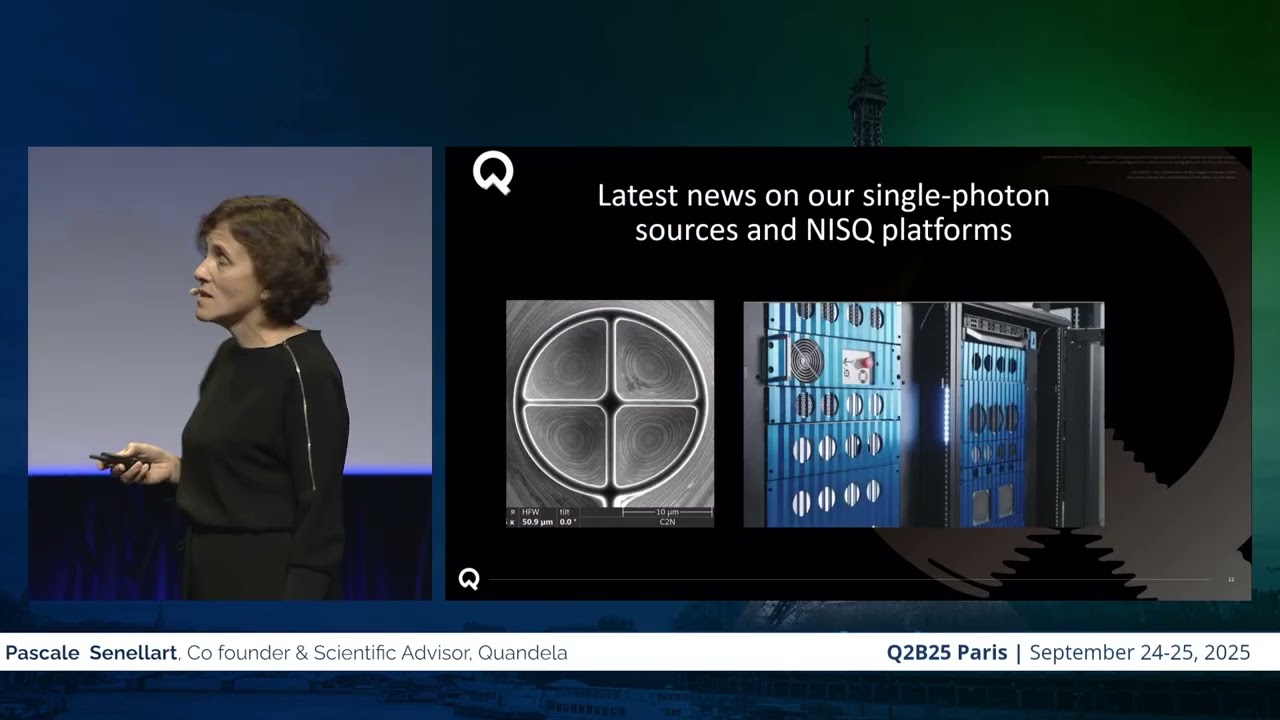
Q2B25 Paris | Pascale Senellart, Co founder & Scientific Advisor, Quandela
Keywords
Summary
157 words
Critical Evaluation
Value of the Information & Strength of the Argument
The talk provides valuable insights into the practical challenges and solutions in photonic quantum computing, particularly the resource efficiency of different approaches. Senellart’s argumentation is solid, backed by specific technical details and comparisons. She clearly explains the advantages of using quantum dots as deterministic photon sources and the potential for significant resource savings in fault-tolerant architectures. The presentation is persuasive, but some claims are forward-looking and not yet fully demonstrated, such as the exact resource reduction factors and the path to quantum utility.
Scientific Rigor, Source Quality, Title Accuracy
The presentation demonstrates scientific rigor, with references to recent publications (e.g., PsiQuantum’s low-loss photonic chip in Nature, Xanadu’s results) and specific technical metrics. The title accurately reflects the content. The talk is an expert opinion, not a peer-reviewed study, but it is grounded in the speaker’s extensive research and company developments.
149 words
Title / Content Match
The title accurately reflects the content: a talk by Pascale Senellart at Q2B25 Paris about Quandela's photonic quantum computing approach.
Quality & Reliability
8/10
Presentation by a recognized expert in photonic quantum computing, with specific technical details and references to recent results. Claims are supported by data and comparisons, but some are forward-looking and not yet peer-reviewed.
Key Moments
Markers derived by PSI from the transcript: the creator did not define chapters.
- Introduction to Quandela and its full-stack approach.
- Advantages of photonic quantum computing.
- Discussion on encoding schemes: single-photon vs. continuous-variable.
- Challenges: minimizing losses and implementing nonlinear gates.
- Quandela's quantum dot sources and their integration.
- Virtual tour of QPUs and upcoming EuroHPC delivery.
- Path to fault tolerance using spin-photon entanglement and cluster states.
- Resource comparison for logical qubit creation.
- Claims of million-fold resource reduction and loss tolerance.
- Future architectures and error correction thresholds.
Cited Sources
- Q2B Conference Website — Mentioned as the conference website for Q2B Paris.
Concurring Sources
- PsiQuantum's low-loss photonic chip (Nature, 2024) — Referenced in the talk as an example of minimizing losses in photonic chips.
Contribution & Novelties
The talk provides an original perspective on resource efficiency in photonic quantum computing, specifically comparing different photon source technologies for fault-tolerant architectures. It highlights Quandela’s hybrid approach using quantum dots and spin-photon entanglement, claiming significant advantages in resource reduction and loss tolerance. The presentation also offers insights into the practical integration of photonic components and the path towards quantum utility.
Pour aller plus loin :
- Photonic quantum computing — Overview of photonic quantum computing approaches.
- Quantum error correction — Fundamentals of quantum error correction.
- Quantum dot — Background on quantum dots as artificial atoms.
- Cluster state — Concept of cluster states for measurement-based quantum computing.
105 words
Radar Profile
The radar profile shows high scores across all dimensions, indicating a technically dense and reliable presentation. The talk is particularly strong in information quantity and technical level, with a slight emphasis on the speaker's expert opinion rather than peer-reviewed data.