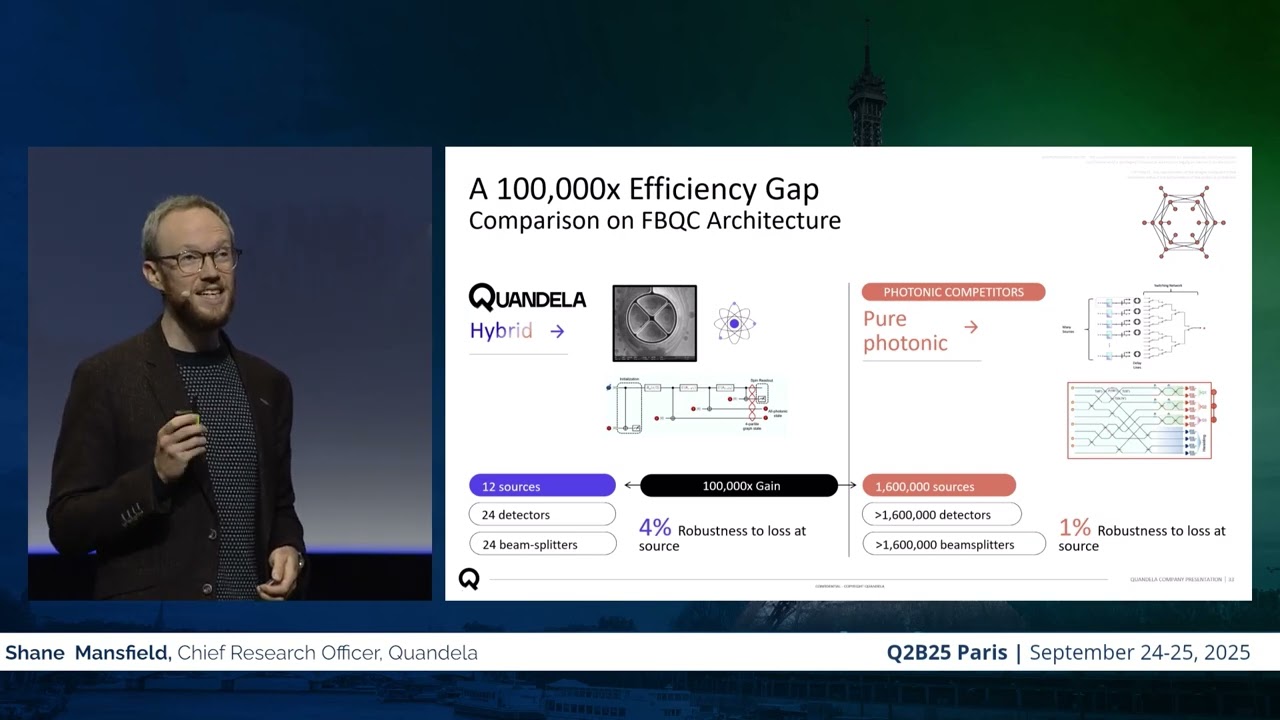
Q2B25 Paris | Shane Mansfield, Chief Research Officer, Quandela
Keywords
Summary
208 words
Critical Evaluation
Value of the Information & Strength of the Argument
The talk provides valuable insights into a specific quantum computing approach, highlighting the advantages of hybrid photonic-matter qubits. The argumentation is structured and backed by quantitative claims, such as the 100,000-fold resource efficiency, which is compelling. However, as a company presentation, there is inherent bias, and the claims are not independently verified. The speaker does not delve into potential drawbacks or challenges of the hybrid approach, such as the difficulty of scaling quantum dot spin coherence or the complexity of optical integration. The comparison with competitors is based on public roadmaps and may be selective. Overall, the information is informative but should be taken with caution due to its promotional nature.
Scientific Rigor, Source Quality, Title Accuracy
The presentation demonstrates scientific rigor in explaining the technology and referencing peer-reviewed work, though specific citations are not provided in the talk. The title accurately reflects the content, focusing on Quandela’s roadmap. The speaker mentions that detailed scientific papers exist but does not list them, relying on the audience to seek them out. The talk is part of a conference (Q2B25) and includes a link to the event, but no direct sources are given. The adequacy between title and content is high, as the talk indeed covers the path to fault tolerance. The lack of explicit citations reduces the verifiability, but the technical depth suggests a solid foundation.
234 words
Title / Content Match
The title accurately reflects the content: a talk by Shane Mansfield at Q2B25 Paris about Quandela's roadmap to fault tolerance.
Quality & Reliability
7/10
Presentation by a senior industry figure (CRO of Quandela) with technical depth and references to peer-reviewed work, but it is a company presentation with potential bias and no independent verification.
Key Moments
Markers derived by PSI from the transcript: the creator did not define chapters.
- Introduction and provocative question about the device in hand.
- Introduction to Quandela: French startup, full-stack quantum computing provider.
- Explanation of current QPU architecture: single-photon emitters, interconnects, control/readout.
- Comparison of matter qubits vs light qubits: decoherence vs inefficient operations.
- Introduction of hybrid technology: quantum dots as deterministic sources and spin-photon entanglement.
- Resource advantage: 100,000x efficiency over fully photonic approaches in fusion-based QC.
- Native architecture: spin-optical quantum computing, leveraging error correction codes.
- Discussion on error correction thresholds and loss tolerance.
- Comparison of qubit counts and logical qubits with competitors; emphasis on logical clock rate.
- Analogy to Moore's law and conclusion: smart factory vs big factory.
Cited Sources
- Q2B Conference Website — Mentioned as the conference hosting the talk.
Concurring Sources
- Quandela official website — Company website providing details on their technology and roadmap.
Contribution & Novelties
The talk presents Quandela’s specific hybrid approach to photonic quantum computing, which combines deterministic single-photon sources with spin qubits, offering a potential resource advantage. It introduces the spin-optical quantum computing architecture and claims significant improvements in error correction thresholds. The presentation provides a concrete comparison with fully photonic approaches, quantifying a 100,000-fold efficiency gain. This is a novel perspective in the quantum computing landscape, emphasizing efficiency over raw qubit count.
Pour aller plus loin :
- Quantum dot — Relevant to the core technology discussed.
- Photonic quantum computing — Context for the field.
- Fusion-based quantum computing — The competitor approach mentioned.
- Surface code — Error correction code discussed.
107 words
Radar Profile
The radar profile shows high scores in information quantity, quality, and technical level, but lower in reliability due to the promotional nature. This suggests a technically rich but potentially biased presentation.