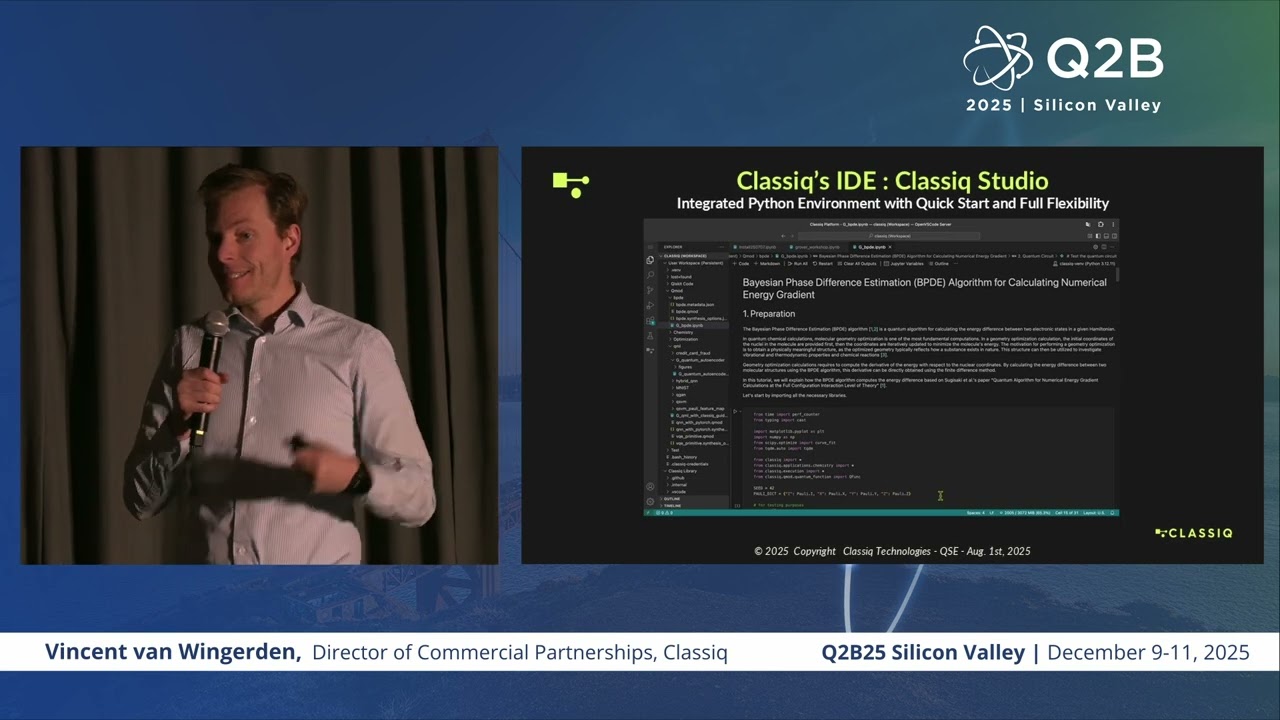
Q2B25 Silicon Valley | Vincent van Wingerden, Director of Commercial Partnerships, Classiq
Keywords
Summary
184 words
Critical Evaluation
Value of the Information & Strength of the Argument
The talk provides valuable insights into the challenges of quantum programming and presents a compelling argument for high-level abstraction and automated compilation. The speaker effectively explains the limitations of low-level gate-based programming and the need for scalable software solutions. The argumentation is coherent, using analogies to classical computing and highlighting the benefits of the synthesis engine. However, the claims are largely qualitative and based on company materials, lacking detailed technical evidence or independent benchmarks. The presentation is persuasive but primarily serves as a promotional pitch for Classiq’s products.
Scientific Rigor, Source Quality, Title Accuracy
The talk is an expert opinion from a company representative, not a peer-reviewed scientific presentation. The speaker references the University of Illinois for a study on programming efficiency, but no specific citation is provided. The title accurately reflects the content, and the presentation is well-structured. The lack of detailed sources and the promotional nature of the talk reduce its scientific rigor, but the technical concepts discussed are consistent with known practices in quantum computing. No comments were provided for analysis.
183 words
Title / Content Match
The title accurately reflects the content: a presentation by Vincent van Wingerden at Q2B25 Silicon Valley about Classiq's quantum software.
Quality & Reliability
7/10
The talk is an expert opinion from a company representative, presenting the company's approach and claims without peer-reviewed evidence. The technical content is plausible and aligns with known concepts in quantum computing, but specific performance claims are not independently verified.
Key Moments
Markers derived by PSI from the transcript: the creator did not define chapters.
- Introduction and the challenge of programming quantum computers
- Classiq's mission and position in quantum software
- High-level abstraction and QMOD language
- Quantum numbers, arrays, and structs
- The synthesis engine and compilation process
- Comparison with transpilation and performance improvements
- Debugging and visualization tools
- Execution on various backends
- Examples and results in different industries
- Conclusion and invitation to explore technology
Cited Sources
- Q2B Conference Website — Referenced as the conference website for Q2B Silicon Valley.
Concurring Sources
- Classiq Official Website — The company's official website, which likely contains more information about their technology and claims.
Dissenting Sources
- No discordant sources found — No sources contradicting the claims were mentioned in the video.
Contribution & Novelties
The talk presents Classiq’s approach to quantum programming, emphasizing high-level abstraction and automated compilation. The main novelty is the synthesis engine that explores the entire implementation space, potentially leading to more efficient circuits than manual or transpiler-based methods. This is a significant contribution to the field of quantum software engineering.
Pour aller plus loin :
- Quantum programming — Provides background on quantum programming languages and paradigms.
- Quantum circuit — Explains the basics of quantum circuits and gates.
- Quantum compiler — Discusses the role of compilers in quantum computing.
88 words
Radar Profile
The radar profile shows balanced scores across information quantity, quality, technical level, and reliability, with a slight emphasis on information quantity and quality. This suggests a well-structured presentation with substantial content, though the reliability is moderate due to the promotional nature.