Q2B25 Silicon Valley | Konstantinos Karagiannis, Director, Quantum Computing Services, Protiviti
Keywords
Summary
163 words
Critical Evaluation
Value of the Information & Strength of the Argument
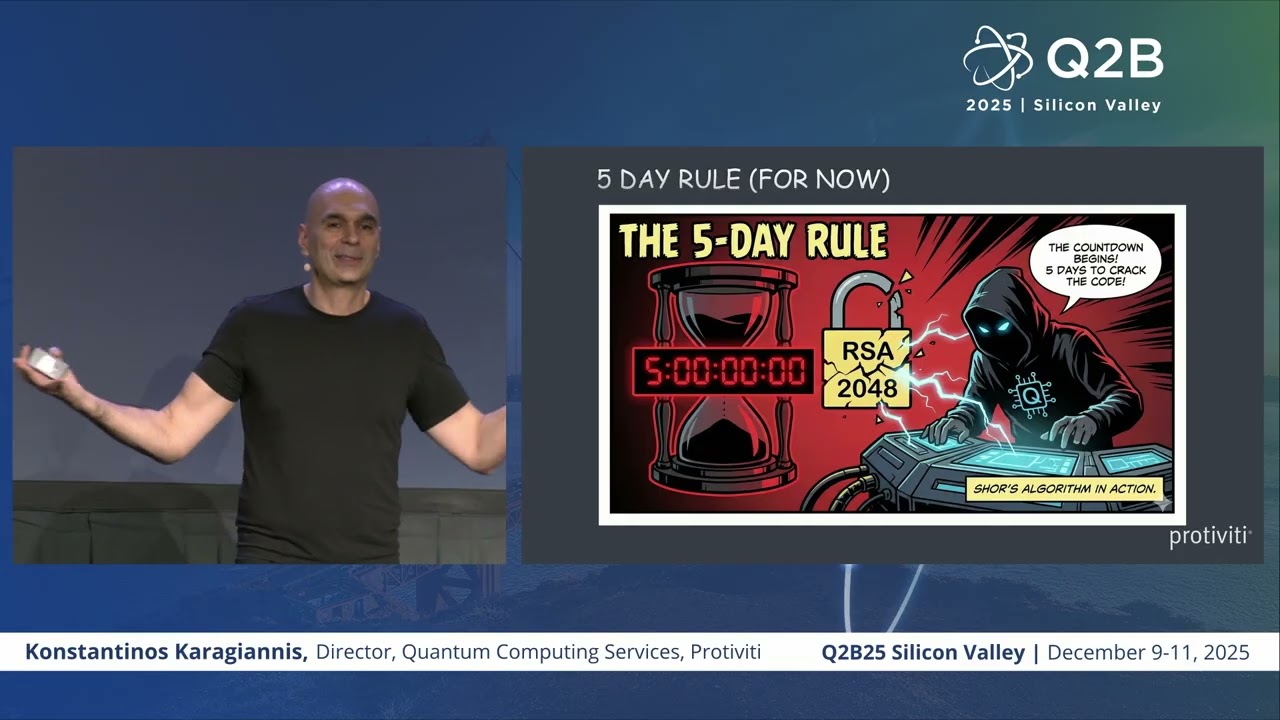
The talk provides valuable insights into the practical implications of quantum computing for end users, moving beyond theoretical discussions. The speaker’s argumentation is solid, grounded in recent research (e.g., Gidney’s paper, Photonic’s resource estimation) and industry surveys (Forescout). He effectively prioritizes threats, arguing that code signing attacks are more likely than data decryption, and supports this with historical examples. The ‘five-day rule’ is a novel and useful framing. However, some claims lack detailed citations, and the talk is opinion-driven, which may not appeal to those seeking rigorous academic analysis.
Scientific Rigor, Source Quality, Title Accuracy
The speaker demonstrates strong domain expertise, citing specific papers and industry reports, but the talk is not heavily referenced. He mentions Gidney’s paper, Photonic’s resource estimation, Forescout’s survey, and CNSA 2.0 timeline, but does not provide direct URLs. The title accurately reflects the content, focusing on end-user considerations. The talk is well-structured and the speaker’s credibility is high, but the lack of formal citations reduces the overall rigor.
172 words
Title / Content Match
The title accurately reflects the content, which focuses on what end users need to know about post-quantum cryptography.
Quality & Reliability
7/10
The speaker is a recognized expert in quantum computing and post-quantum cryptography, with years of industry experience. He cites specific papers and industry reports, but the talk is largely opinion-based and lacks detailed citations for some claims. The information is credible but not rigorously sourced.
Key Moments
Markers derived by PSI from the transcript: the creator did not define chapters.
- Introduction and overview of the talk's focus on end users.
- Discussion of Shor's and Grover's algorithms, and the evolution of qubit estimates.
- Introduction of the 'five-day rule' based on Gidney's paper and Photonic's estimates.
- Analysis of threat landscape: harvest now decrypt later, signature forgery, and code signing attacks.
- Discussion of industry readiness, including TLS and SSH adoption rates.
- Overview of PQC adoption in major software: Chrome, Microsoft, Signal, iMessage, OpenSSL, Zoom.
- Warning about PQC-related scams and the need to replace outdated hardware, especially IoT.
- Discussion of blockchain vulnerabilities, including Bitcoin address reuse and Ethereum's proof-of-stake.
- Call to action for end users to push for PQC adoption by 2029.
Cited Sources
- Q2B Conference Website — The talk was presented at Q2B25 Silicon Valley, and the website provides information about the conference.
Concurring Sources
- NIST Post-Quantum Cryptography Standardization — NIST's ongoing effort to standardize PQC algorithms, aligning with the talk's discussion of finalists and timelines.
- CNSA 2.0 — NSA's timeline for migrating to quantum-resistant algorithms, referenced in the talk.
Dissenting Sources
- IonQ's claim of cracking encryption in 10 quarters — The speaker mentions IonQ's aggressive timeline, which contrasts with NIST's 10-year estimate, but no specific source is provided.
Contribution & Novelties
The talk provides a practical, end-user-focused perspective on post-quantum cryptography, emphasizing the ‘five-day rule’ as a key determinant of threat models. It highlights the importance of code signing attacks over data decryption, a nuanced view often overlooked. The speaker also reviews current PQC adoption in common software, offering actionable insights for individuals.
Pour aller plus loin :
- Shor’s algorithm — Foundational algorithm for breaking RSA.
- Grover’s algorithm — Quantum search algorithm affecting symmetric encryption.
- Post-quantum cryptography — Overview of cryptographic methods resistant to quantum attacks.
- NIST Post-Quantum Cryptography Standardization — Official NIST page for PQC standards.
- CNSA 2.0 — NSA’s guidance on quantum-resistant algorithms.
104 words
Radar Profile
The radar profile shows high scores in information quantity and quality, reflecting the speaker's expertise and the talk's comprehensive coverage. The technical level is moderate, making it accessible to a broad audience. Overall reliability is good, though the lack of formal citations slightly reduces the score.