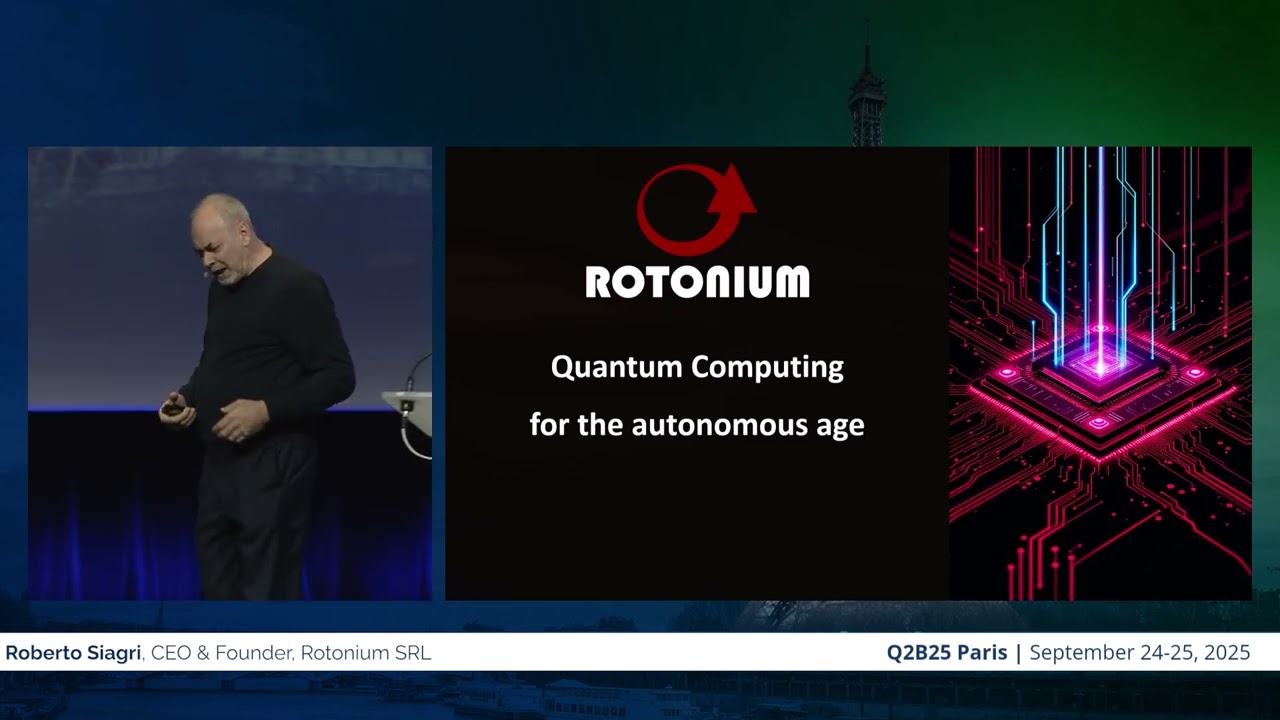
Q2B25 Paris | Roberto Siagri, CEO & Founder, Rotonium SRL
Keywords
Summary
148 words
Critical Evaluation
Value of the Information & Strength of the Argument
The talk provides a high-level overview of Rotonium’s technology and vision, but lacks detailed technical specifications or experimental data. The argumentation is largely based on analogies (e.g., personal computers) and visionary statements rather than concrete evidence. The value lies in the novel concept of using OAM for qudit encoding and the emphasis on practical, miniaturized quantum computing for edge applications. However, the lack of peer-reviewed publications or independent verification weakens the scientific credibility.
Scientific Rigor, Source Quality, Title Accuracy
The talk is an expert opinion with no cited sources. The only link provided is to the Q2B conference website, which is not a scientific reference. The title accurately reflects the content. The presentation is more of a pitch than a rigorous scientific exposition, with limited technical depth and no discussion of challenges or limitations.
143 words
Title / Content Match
The title accurately reflects the content: a presentation by Roberto Siagri at Q2B25 Paris.
Quality & Reliability
6/10
The talk presents a plausible but unverified technical approach with limited technical detail and no peer-reviewed references. The claims are ambitious and lack experimental evidence in the presentation.
Key Moments
Markers derived by PSI from the transcript: the creator did not define chapters.
- Introduction: vision of quantum computers in smartphones, need for photonics.
- Introduces 'quantum utility' metric including size, weight, power.
- Explains encoding multiple qubits in a single photon using OAM.
- Discusses advantages: room temperature, no need for synchronous sources.
- Presents product roadmap: 16 qubit desktop by 2027, PCIe format.
- Emphasizes edge computing applications: satellites, robots, drones.
- Shows current 4-qubit processor and integration plans.
- Argues edge will conquer center, analogy with personal computers.
- Discusses autonomous age and need for small data solutions.
- Q&A: confirms room-temperature sources and detectors, explains topological error detection.
Cited Sources
- Q2B Conference Website — Mentioned as the conference where the talk was given.
Concurring Sources
- Quantum computing with photons — General context on photonic quantum computing, which aligns with the talk's approach.
Dissenting Sources
- Challenges in photonic quantum computing — Photonic quantum computing faces challenges such as photon loss and scalability, which are not addressed in the talk.
Contribution & Novelties
The talk presents a novel approach to quantum computing using OAM-based qudits in a single photon, aiming for room-temperature operation and miniaturization. This could enable edge quantum computing, a relatively unexplored area. The concept of ‘quantum utility’ considering size, weight, and power is also innovative.
Pour aller plus loin :
- Orbital angular momentum of light — Background on OAM, the basis of the encoding.
- Quantum computing — General overview of quantum computing paradigms.
- Silicon photonics — Technology platform mentioned for integration.
81 words
Radar Profile
The radar profile shows moderate scores across all dimensions, indicating a balanced but not exceptional presentation. The talk provides some technical insight but lacks depth and rigorous sourcing.
💬 No comments were provided for analysis.