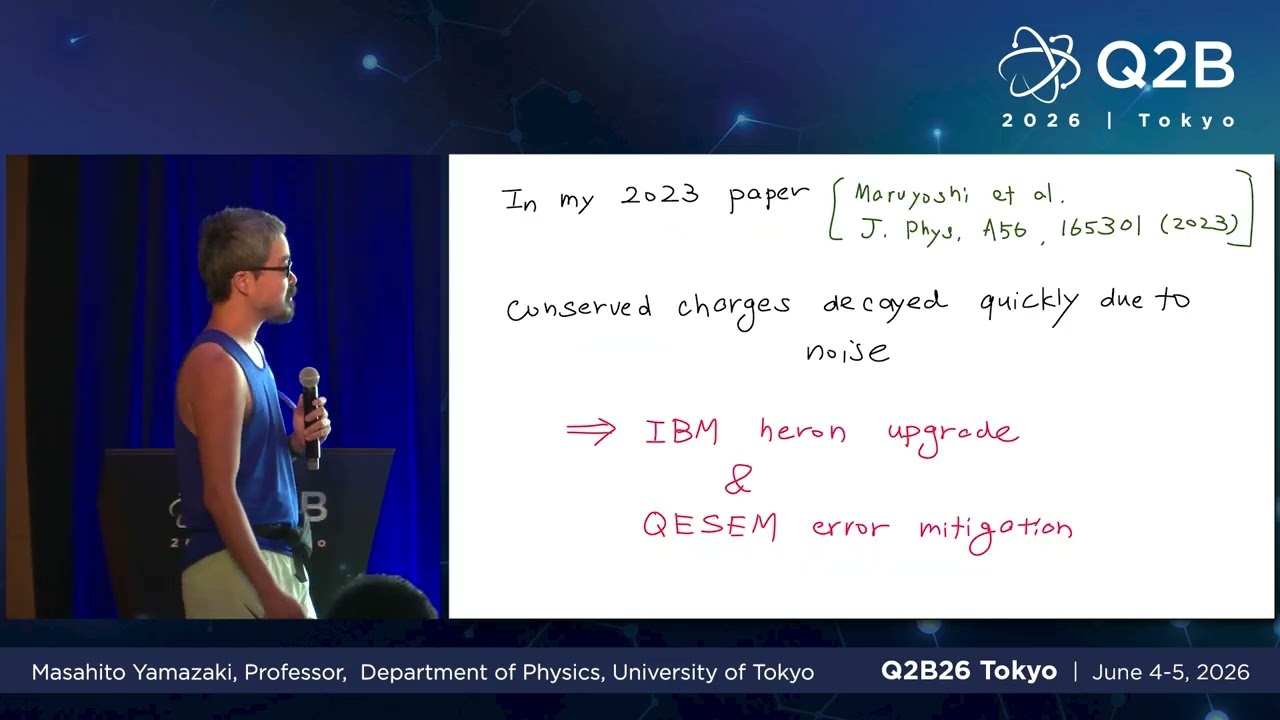
Q2B26 Tokyo | Masahito Yamazaki, Professor, Department of Physics, University of Tokyo
Keywords
Summary
166 words
Critical Evaluation
Value of the Information & Strength of the Argument
The talk provides valuable insights into the practical application of error mitigation in quantum simulation, particularly for integrable models and quantum many-body scars. The speaker presents concrete experimental results on IBM devices, showing that error mitigation can recover expected behaviors. The argumentation is solid, grounded in well-established physics concepts, and the speaker clearly explains the motivation and methodology. However, the results are preliminary and not yet peer-reviewed, which limits the strength of the conclusions. The talk is more of a progress report than a definitive study, but it offers a useful perspective on the current state of quantum simulation and error mitigation.
Scientific Rigor, Source Quality, Title Accuracy
The speaker demonstrates scientific rigor by referencing specific models (SYK, integrable spin chains) and providing data from real quantum devices. He mentions his own paper on the SYK model and acknowledges the work of Google Quantum. The sources are appropriate for a conference talk, though he does not provide detailed citations or references. The title accurately reflects the content, as the talk is indeed about quantum simulation and error mitigation, with a focus on quantum many-body scars. The speaker’s affiliation and expertise add credibility to the presentation.
204 words
Title / Content Match
The title accurately reflects the content: a presentation by Professor Masahito Yamazaki at the Q2B26 Tokyo conference, focusing on quantum simulation and error mitigation.
Quality & Reliability
7/10
The speaker is a professor of physics at the University of Tokyo, with a strong background in theoretical physics and quantum computing. He presents preliminary results from his research, including specific experiments on IBM quantum devices. The talk is a personal account of his experience, not a peer-reviewed publication, but it is grounded in established physics concepts and includes concrete data. The reliability is high for the context of a conference presentation, though the results are preliminary and not yet published.
Key Moments
Markers derived by PSI from the transcript: the creator did not define chapters.
- Introduction and acknowledgments
- Background on quantum simulation and the exponential growth of Hilbert space
- Discussion of chaotic systems and the SYK model for quantum advantage
- Introduction to integrable models and their use for benchmarking
- Results on integrable models with error mitigation
- Introduction to quantum many-body scars and their significance
- Results on quantum many-body scars with error mitigation on 60 qubits
- Conclusion and future directions
Cited Sources
- Q2B Conference Website — Conference information and agenda
Concurring Sources
- Q2B Conference Website — Conference information and agenda
Contribution & Novelties
The talk provides a unique perspective from a theoretical physicist applying fundamental physics concepts to practical quantum computing. It demonstrates the effectiveness of error mitigation techniques on real quantum hardware for specific physics problems, such as integrable models and quantum many-body scars. The results, while preliminary, show significant improvement in fidelity, which is valuable for the quantum computing community. The talk also highlights the potential of quantum many-body scars for quantum memory and sensing, opening new avenues for research.
Pour aller plus loin :
- Quantum many-body scars — Overview of the phenomenon and its significance.
- SYK model — A model of maximally chaotic quantum matter, relevant to the talk’s discussion.
- Error mitigation — Techniques to reduce errors in quantum computations without full error correction.
124 words
Radar Profile
The radar profile shows high scores in quality of information and technical level, reflecting the speaker's expertise and the depth of the content. The quantity of information is moderate, as the talk is a concise overview of ongoing research. The reliability score is slightly lower due to the preliminary nature of the results. Overall, the profile indicates a technically strong and informative presentation.