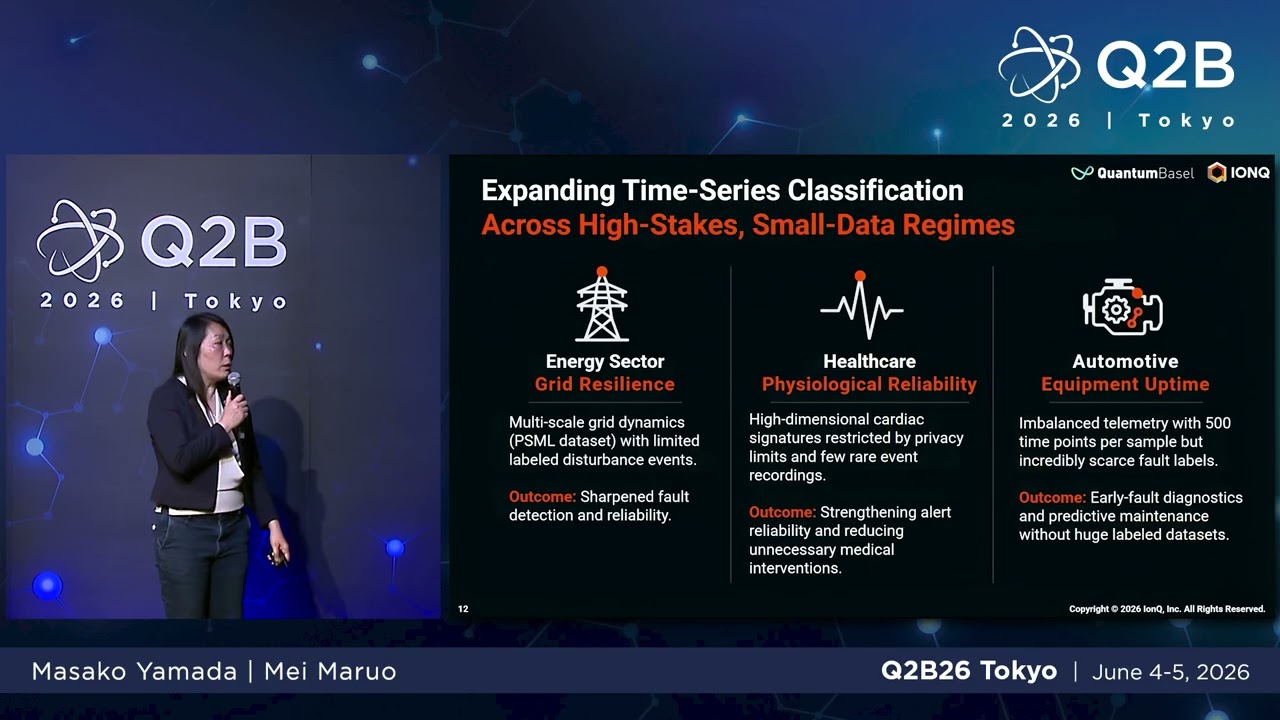
Q2B26 Tokyo | Masako Yamada, Senior Director Applications and Mei Maruo, Senior Physicist, IonQ
Keywords
Summary
155 words
Critical Evaluation
Value of the Information & Strength of the Argument
The presentation provides valuable insights into IonQ’s current applications and roadmap. The CAE example with Synopsys is concrete, showing a real integration and measured speedup, which strengthens the argument for near-term quantum advantage. The QML results, now on real QPUs, are more compelling than simulator-based claims. However, the argumentation is largely promotional, with claims like ’leading quantum computing company’ and ‘1000x faster’ lacking detailed evidence. The speakers do not delve into limitations or challenges, and the technical depth is moderate, suitable for a conference audience but not for experts seeking rigorous analysis.
Scientific Rigor, Source Quality, Title Accuracy
The presentation cites partnerships with Synopsys, Ansys, and cloud providers (AWS, Azure, GCP) but does not provide specific references or publications. The claims about fidelity and speed are presented as facts without external validation. The title accurately reflects the content, and the talk is well-structured. However, the lack of citations and the promotional tone reduce the scientific rigor. The description includes a link to the Q2B conference website, which serves as a general reference but not to specific sources.
186 words
Title / Content Match
The title accurately reflects the content: a presentation by IonQ executives at Q2B26 Tokyo.
Quality & Reliability
7/10
Presentation by IonQ executives with specific technical claims (e.g., 99.99% fidelity, 7-15% speedup in CAE, quantum ML results on real QPUs). However, claims are largely unverified in the talk, and the presentation has a promotional tone. The speakers are credible as company representatives, but independent verification is lacking.
Key Moments
Markers derived by PSI from the transcript: the creator did not define chapters.
- Introduction of IonQ as a quantum platform company.
- Discussion of CAE partnership with Synopsys and quantum graph partitioning.
- Results of CAE integration: 7-15% reduction in time-to-solution.
- Quantum machine learning on real QPUs, fine-tuning BERT and time-series models.
- Energy consumption comparison between quantum and GPU methods.
- Mei Maruo introduces resilience and reliability engineering.
- World record 99.99% two-qubit gate fidelity and 1000x speed advantage.
- Interconnect roadmap: speed-up, scale-up, scale-out phases.
Cited Sources
- Q2B Conference — Conference website where the talk was presented.
Concurring Sources
- IonQ website — Company website with product information and claims.
Contribution & Novelties
The presentation offers a concrete example of quantum advantage in CAE with a real integration into LS-DYNA, and QML results on real QPUs, which is a step beyond simulator-based studies. The emphasis on hybrid intelligence and accessibility is notable. However, the talk is more of a company update than a novel scientific contribution.
Pour aller plus loin :
- Quantum machine learning — Overview of QML concepts.
- LS-DYNA — The CAE software mentioned.
- BERT (language model) — The foundational AI model used in QML fine-tuning.
84 words
Radar Profile
The radar profile shows moderate scores across all dimensions, with a slight emphasis on information quantity and technical level, reflecting a presentation that provides substantial content but lacks deep scientific rigor and independent verification.