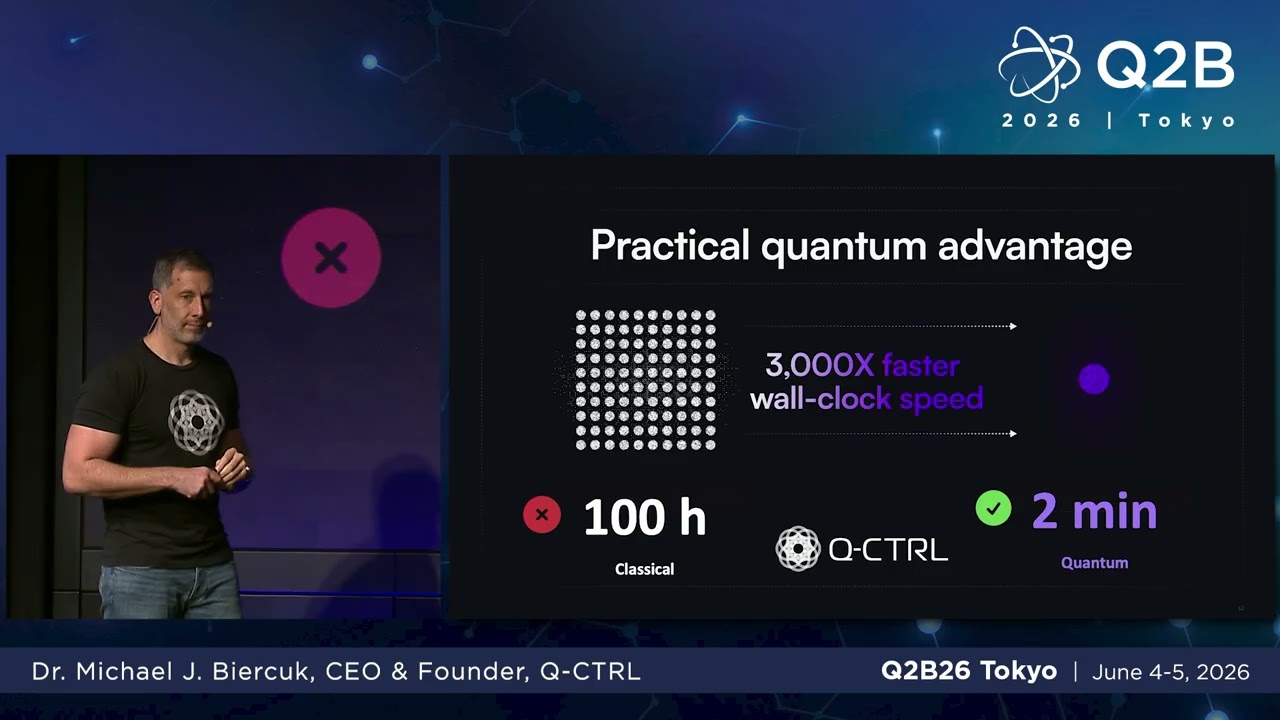
Q2B26 Tokyo | Dr. Michael J. Biercuk, CEO & Founder, Q-CTRL
Keywords
Summary
147 words
Critical Evaluation
Value of the Information & Strength of the Argument
The talk provides valuable insights into the current state of quantum computing and the potential for practical quantum advantage. The argumentation is strong, supported by specific technical details and quantitative results. The speaker effectively demonstrates the value of error suppression by comparing quantum and classical performance on a relevant problem. The narrative is coherent, moving from fundamental physics demonstrations to practical applications and deployment strategies. The presentation of new, unpublished results adds novelty and excitement. However, as a company CEO, the speaker has a vested interest in promoting Q-CTRL’s products, which could introduce bias. Nevertheless, the technical claims are plausible and align with known advancements in the field.
Scientific Rigor, Source Quality, Title Accuracy
The talk demonstrates scientific rigor by referencing specific technical concepts (e.g., Fermi-Hubbard model, Trotterized evolution) and comparing against established classical simulation tools like iTensor from the Flatiron Institute. The speaker mentions collaborations with reputable organizations (IBM, Rigetti, IonQ, AWS, RIKEN, DARPA) and external validations (e.g., Multiverse Computing’s independent confirmation). The title accurately reflects the content, as it is a presentation by Q-CTRL’s CEO at a quantum technology conference. The talk is not a peer-reviewed publication, but it presents results that are likely to be published or have been published elsewhere. The speaker also mentions a new manuscript from Multiverse Computing that validates their results, adding credibility. Overall, the sources are credible, though the presentation is promotional in nature.
241 words
Title / Content Match
The title accurately reflects the content: a presentation by Dr. Biercuk at Q2B26 Tokyo, focusing on Q-CTRL's work in quantum error suppression and practical quantum advantage.
Quality & Reliability
8/10
The speaker is a recognized expert in quantum control, and the talk presents specific technical results with quantitative claims (e.g., 100x speedup, 1% agreement) that are plausible and align with known advances in quantum error suppression. However, the talk is a company presentation, so there is a potential bias in favor of Q-CTRL's products. The results are not peer-reviewed in this format, but they reference external validations and collaborations with reputable institutions.
Key Moments
Markers derived by PSI from the transcript: the creator did not define chapters.
- Introduction and overview of Q-CTRL's mission and recognition.
- Discussion of error suppression technologies and their benefits.
- Introduction of the Fermi-Hubbard model and its relevance to energy sector.
- Demonstration of Tomonaga-Luttinger liquid with world-record gate count.
- Presentation of 120-qubit simulation and comparison with classical simulation.
- Announcement of practical quantum advantage: 2 minutes vs 100 hours.
- Discussion of steps for large-scale deployment: automation, stabilization, virtualization, deployment.
- Introduction of autonomous calibration agents and quantum containerization with NVIDIA.
- Reveal of quantum gravitational navigation results and future DARPA miniaturization.
Cited Sources
- Q2B Conference Website — The talk is part of the Q2B26 Tokyo conference, and the website provides information about the event.
Concurring Sources
- Multiverse Computing validation (mentioned in talk) — The speaker mentions a new manuscript from Multiverse Computing that independently confirmed the quantum advantage result.
Contribution & Novelties
The talk presents new results in quantum error suppression and practical quantum advantage, including a world-record simulation of a Tomonaga-Luttinger liquid and a demonstration of quantum advantage for a Fermi-Hubbard model. It also introduces autonomous calibration agents and quantum containerization, and reveals first results in quantum gravitational navigation. These contributions advance the field by showing concrete steps toward making quantum computers useful for real-world problems.
Pour aller plus loin :
- Fermi-Hubbard model — Provides background on the model used in the simulations.
- Trotterized evolution — Explains the Trotter-Suzuki decomposition used for time evolution.
- Quantum error suppression — Overview of error mitigation techniques.
- Quantum sensing — General concept of quantum sensors, relevant to the navigation application.
115 words
Radar Profile
The radar profile shows high scores in quantity and quality of information, with slightly lower technical depth and reliability, reflecting the promotional nature of the talk. The speaker provides substantial technical details, but the reliability is tempered by the company perspective.
💬 No comments were provided for analysis.