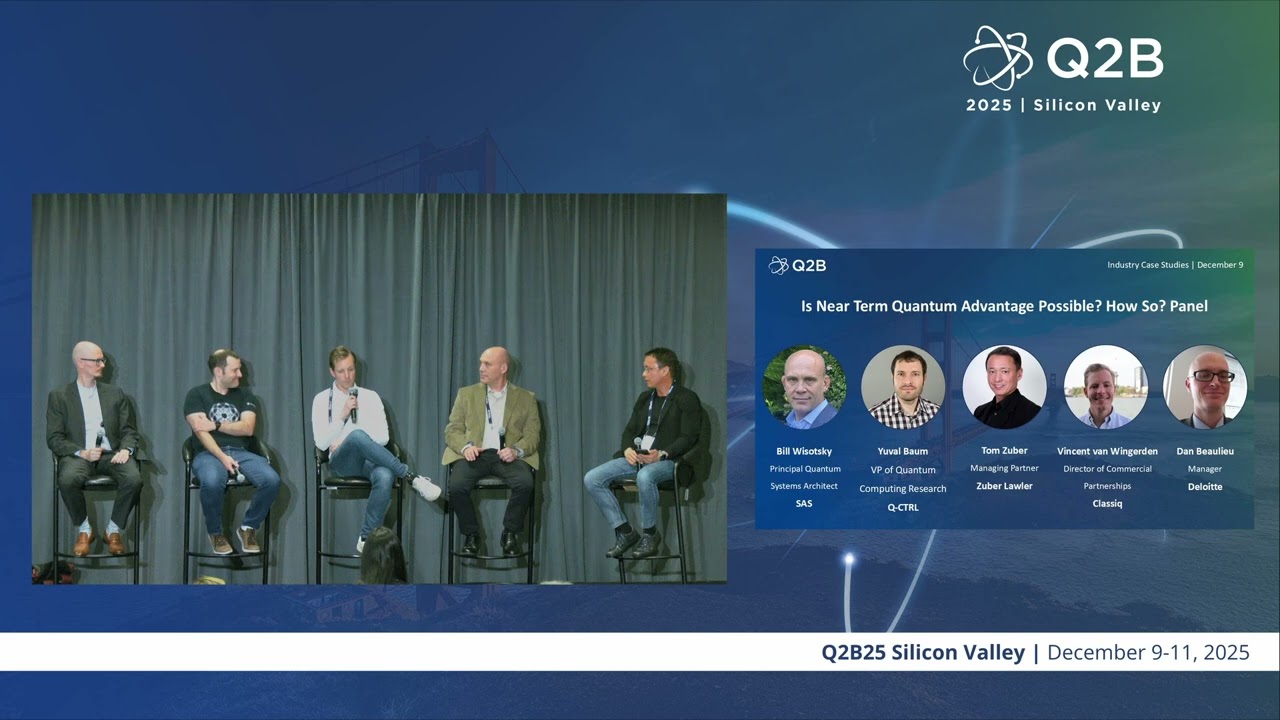
Q2B25 Silicon Valley | Is Near Term Quantum Advantage Possible? How So? - SAS Panel
Keywords
Summary
181 words
Critical Evaluation
Value of the Information & Strength of the Argument
The panel provides valuable insights into the practical challenges and opportunities of near-term quantum computing. The discussion is grounded in real-world examples, such as Deloitte’s experience with a problem that took three days to run on actual hardware, and SAS’s work on quantum reservoir computing. The panelists argue convincingly that quantum advantage may be achieved in specific, narrow use cases before fault-tolerant quantum computers are available. They emphasize the importance of hybrid approaches and the need for new algorithms. However, the arguments are largely based on anecdotal evidence and expert opinion rather than rigorous scientific data, and the panelists sometimes speculate without strong evidence. The discussion is balanced, acknowledging both the potential and the significant hurdles.
Scientific Rigor, Source Quality, Title Accuracy
The panelists are credible experts from reputable organizations, and their statements reflect professional experience. However, the discussion is not heavily cited, and only one peer-reviewed article is mentioned (Deloitte’s work on quantum reservoir computing). The title accurately reflects the content, which is a focused panel discussion on near-term quantum advantage. The lack of formal citations and the speculative nature of some claims slightly reduce the scientific rigor. The panel does not provide a systematic review of the literature, but it offers valuable practitioner perspectives.
215 words
Title / Content Match
The title accurately reflects the content: a panel discussion on the possibility and pathways to near-term quantum advantage.
Quality & Reliability
7/10
Panel of industry experts from SAS, Deloitte, Q-CTRL, and Classiq discussing near-term quantum advantage. The discussion is grounded in practical experience and specific examples, but it is largely opinion-based and lacks rigorous scientific citations. The panelists are credible, but the content is not peer-reviewed.
Key Moments
Markers derived by PSI from the transcript: the creator did not define chapters.
- Panelists introduce themselves and their roles.
- Definition of quantum advantage: any hybrid quantum-classical improvement, not just exponential speedup.
- Discussion of technical constraints: scaling, noise, and the challenge of encoding classical data.
- Vincent discusses the importance of circuit depth reduction and new algorithms.
- Yuval emphasizes the need for abstraction and new algorithms, and predicts advantage without error correction.
- Vincent introduces Classiq's AI agent for generating quantum algorithms.
- Bill identifies optimization and quantum reservoir computing as promising near-term applications.
- Daniel discusses quantum reservoir computing with small datasets and its peer-reviewed results.
- Yuval shares a project with Mazda where quantum outperformed classical on small datasets.
- Discussion on evaluating application fit for quantum hardware and the need for new algorithms.
Cited Sources
- Q2B Conference Website — The panel is part of the Q2B Silicon Valley conference, and the website provides context for the event.
Concurring Sources
- Quantum computing — General background on quantum computing, consistent with the panel's discussion.
Contribution & Novelties
The panel provides a practical, industry-focused perspective on near-term quantum advantage, emphasizing hybrid approaches and the importance of software and algorithms. It highlights specific examples like quantum reservoir computing and the use of AI for algorithm generation, which are less commonly discussed in academic settings. The discussion also underscores the potential for narrow, situational advantages before fault-tolerant quantum computing.
Pour aller plus loin :
- Quantum computing — Provides background on quantum computing concepts.
- Quantum error mitigation — Discusses techniques for reducing errors in NISQ devices.
- Quantum machine learning — Overview of quantum machine learning, relevant to the discussion on quantum reservoir computing.
102 words
Radar Profile
The radar profile shows a balanced performance across all dimensions, with slightly higher scores in information quantity and technical level, reflecting the panel's depth of discussion. The lower score in information quality and global reliability is due to the lack of formal citations and the speculative nature of some claims.
💬 No comments were provided for analysis.