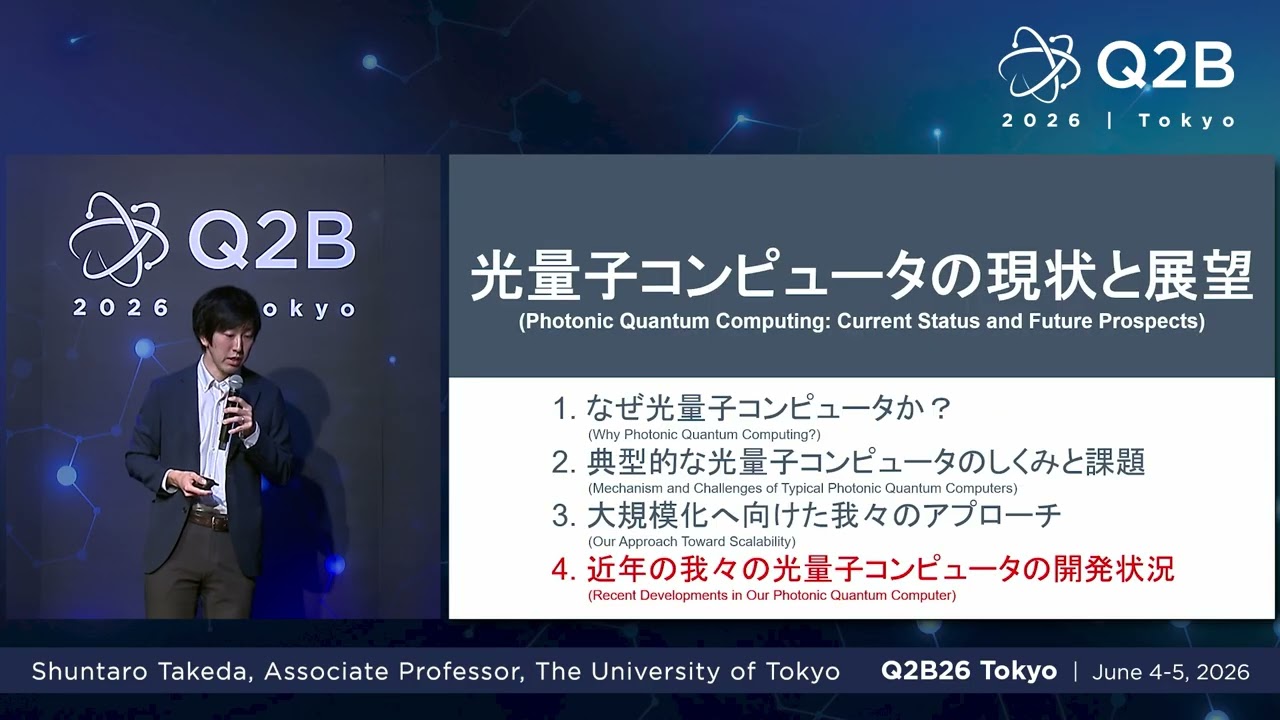
Q2B26 Tokyo | Shuntaro Takeda, Associate Professor, The University of Tokyo
Keywords
Summary
227 words
Critical Evaluation
Value of the Information & Strength of the Argument
The talk provides valuable insights into a less mainstream approach to quantum computing, highlighting the potential advantages of photonics and continuous variables. The speaker presents a clear argument for why this approach is worth pursuing, addressing challenges and outlining their research progress. The argumentation is logical and grounded in his own experience, though it lacks detailed technical depth for a specialist audience. The value lies in the overview of the field and the specific innovations from his group.
Scientific Rigor, Source Quality, Title Accuracy
The speaker references several research efforts, including those from China, Xanadu, RIKEN, and his own group, but does not provide specific citations or URLs. The talk is based on his expertise and ongoing research, which adds credibility, but the lack of detailed references limits the ability to verify claims. The title accurately reflects the content, and the talk is well-structured. No comments were provided for analysis.
159 words
Title / Content Match
The title accurately reflects the content, which is a presentation by Shuntaro Takeda on photonic quantum computing.
Quality & Reliability
7/10
The speaker is an associate professor at a top university, presenting his own research and that of others in the field. The content is technical and specific, but it is a conference talk without peer review or detailed citations. Some claims are made without full context, but the overall information is credible.
Key Moments
Markers derived by PSI from the transcript: the creator did not define chapters.
- Introduction and overview of quantum computing platforms
- Advantages of photonic quantum computing: room temperature, networking, high speed
- Recent achievements in photonic quantum computing (e.g., quantum supremacy demonstrations)
- Challenges of traditional photonic approach: low efficiency and scalability issues
- Introduction of continuous variable approach and its benefits
- Loop-based architecture for scalability and memory
- Research progress: prototypes and achievements from 2017 to 2023
- Current limitations: linear gates only and need for non-linearity
- Applications: continuous variable optimization and quantum machine learning
- Conclusion and future prospects
Cited Sources
- Q2B Conference Website — The talk was given at Q2B Tokyo, and the website provides information about the conference.
Concurring Sources
- Xanadu Quantum Technologies — Xanadu is a company working on photonic quantum computing, mentioned in the talk.
Contribution & Novelties
The talk presents a unique perspective on photonic quantum computing, emphasizing the continuous variable approach and loop-based architecture as a path to scalability. It provides an update on the speaker’s research progress and highlights potential applications. The novelty lies in the specific technical approach and the argument for its advantages over other platforms.
Pour aller plus loin :
- Continuous-variable quantum information — Provides background on the theoretical framework.
- Photonic quantum computing — Overview of the field and different approaches.
- Quantum machine learning — Relevant to the applications discussed.
88 words
Radar Profile
The radar profile shows high scores in technical level and information quality, indicating a technically dense and informative talk. The lower score in information quantity reflects the relatively short duration and limited scope. Overall, the talk is well-balanced for a specialized audience.