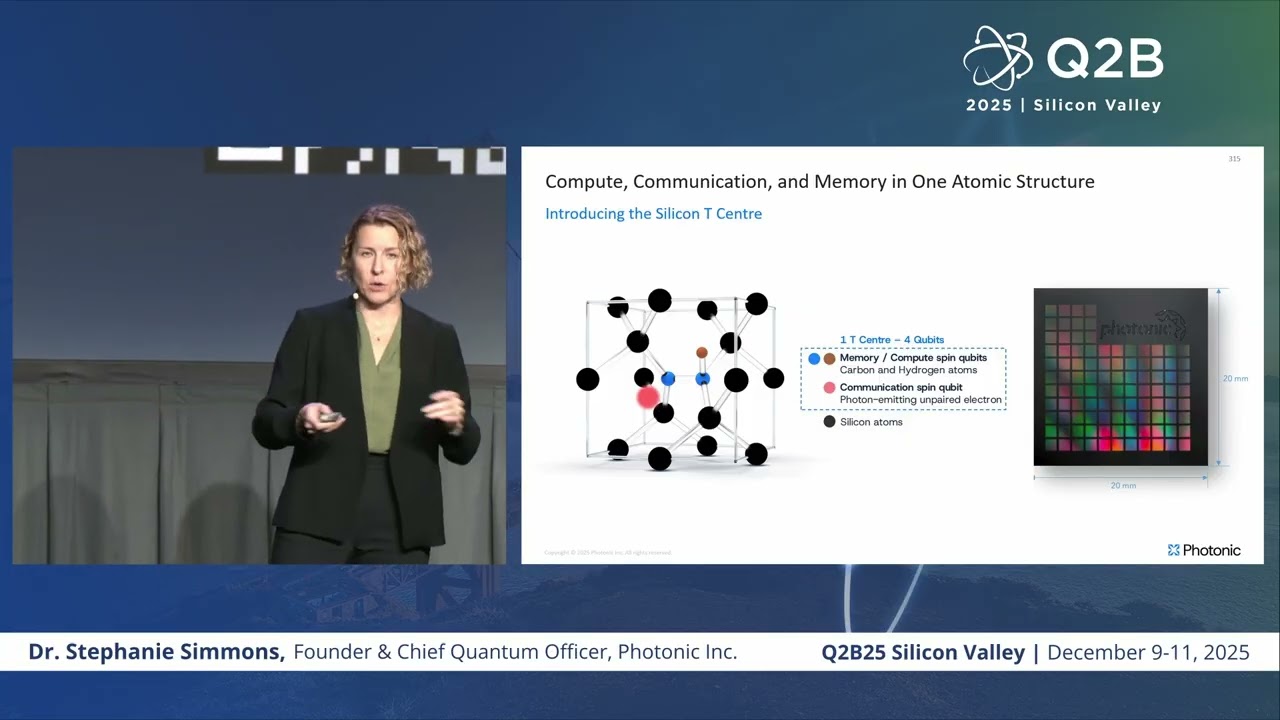
Q2B25 Silicon Valley | Stephanie Simmons, Founder & Chief Quantum Officer, Photonic Inc.
Keywords
Summary
193 words
Critical Evaluation
Value of the Information & Strength of the Argument
The talk provides valuable insights into the importance of quantum resource estimation and the often-overlooked costs of distributed entanglement. Simmons argues convincingly that the industry should move beyond vanity metrics and consider the full system cost when evaluating quantum architectures. She supports her argument with specific examples, such as the need for hundreds of trillions of Bell pairs for distributed algorithms like Shor’s. However, the talk is also a promotional piece for Photonic Inc., and the argumentation is somewhat one-sided, emphasizing the advantages of their approach without deeply addressing potential drawbacks or alternative solutions.
Scientific Rigor, Source Quality, Title Accuracy
The talk references a white paper published by Photonic Inc. and a RAND Corporation review, but does not provide specific citations within the talk. The title accurately reflects the content, as it is a presentation by Stephanie Simmons at Q2B25. The talk is not heavily sourced, and the claims are primarily based on the speaker’s expertise and company results. The description includes links to the Q2B website and a Google Drive file, which likely contains the white paper, but these are not directly cited in the talk.
196 words
Title / Content Match
The title accurately reflects the content: a talk by Stephanie Simmons at Q2B25 Silicon Valley.
Quality & Reliability
7/10
The speaker is a recognized expert in quantum computing, and the talk references specific technical results and a DARPA program. However, it is a promotional talk for Photonic Inc., and some claims are not independently verified.
Key Moments
Markers derived by PSI from the transcript: the creator did not define chapters.
- Introduction and reflection on 25 years in quantum computing
- Shift from vanity metrics to system-level costing
- Discussion of DARPA program and Photonic's selection
- Scale-up vs. distributed architectures
- Introduction of T centers and Photonic's platform
- Quantum resource estimation and QLDPC results
- Cost of distributed entanglement and interconnect
- Comparison with other QRE approaches
- Conclusion and call to action
Cited Sources
- Q2B Conference Website — Conference website for Q2B Silicon Valley, where the talk was presented.
- Photonic Inc. White Paper on QRE — White paper shared during the talk, containing detailed QRE results.
Concurring Sources
- RAND Corporation Review on Quantum Computing — Mentioned in the talk as a review of published results on quantum resource estimation.
Contribution & Novelties
The talk contributes to the ongoing discussion on quantum resource estimation by highlighting the importance of including distributed entanglement costs in QRE, which is often overlooked. It also presents Photonic’s unique approach using T centers in silicon for distributed quantum computing. The talk encourages the industry to adopt a more holistic view of system costs.
Pour aller plus loin :
- Quantum Resource Estimation — Overview of QRE concepts.
- Distributed Quantum Computing — Background on distributed quantum computing.
- Quantum Error Correction — Foundational concepts for QLDPC codes.
86 words
Radar Profile
The radar profile shows high scores in technical level and information quality, reflecting the expert presentation and detailed technical content. However, the lower score in reliability indicates that the talk is promotional and lacks independent verification.