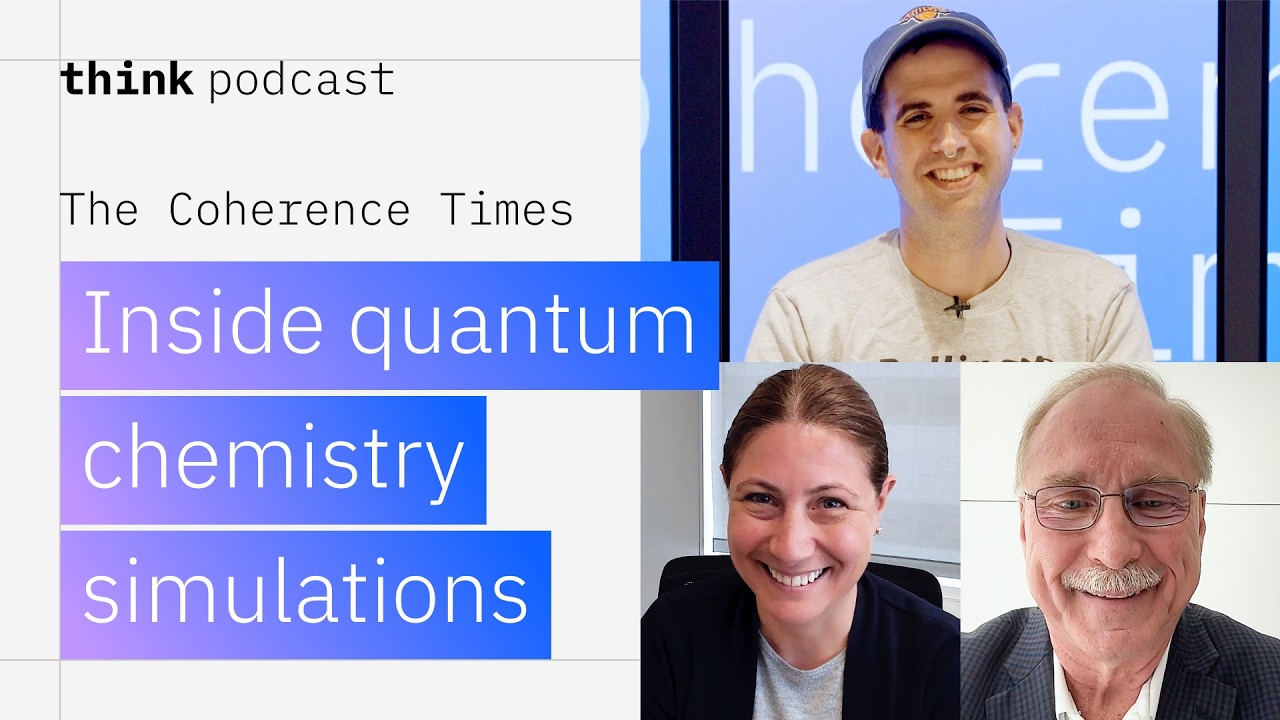
How quantum computers model molecules
Keywords
Summary
196 words
Critical Evaluation
Value of the Information & Strength of the Argument
The podcast provides valuable insights into the current state of quantum chemistry simulations, with concrete examples and technical details. The argumentation is solid, grounded in the speakers’ direct experience and recent published work. They clearly explain the limitations of previous methods (VQE) and the advantages of SQD, and they support their claims with specific results (e.g., scaling from 300 to 12,000 atoms). The discussion is balanced, acknowledging challenges such as noise and the need for better basis sets, and it avoids overhyping the technology.
93 words
Title / Content Match
The title accurately reflects the content, which focuses on how quantum computers model molecules, with detailed discussion of methods and recent large-scale simulations.
Quality & Reliability
8/10
The discussion features two experts from IBM and Cleveland Clinic, directly involved in the research, and references a peer-reviewed publication (Gordon Bell submission) and IBM's official blog. The technical explanations are consistent with known quantum chemistry methods, though the podcast format limits depth and independent verification.
Key Moments
Markers derived by PSI from the transcript: the creator did not define chapters.
- Introduction to the episode and guests.
- Explanation of why quantum computers are suited for chemistry.
- Discussion on classical computational chemistry methods.
- Overview of the collaboration between IBM and Cleveland Clinic.
- Comparison of VQE and SQD algorithms.
- Detailed explanation of the fragment-based workflow.
- Discussion of the 12,000-atom protein simulation.
- Integration with HPC and the role of RIKEN's Fugaku.
- Future directions and challenges in quantum chemistry.
Cited Sources
- Sample-based quantum diagonalization tutorial — Referenced as a tutorial for the SQD method used in the simulations.
- Cleveland Clinic and RIKEN chemistry blog — Mentioned as a source for more information on the large-scale protein simulation.
- The Coherence Times podcast page — The podcast's official page for more quantum content.
Concurring Sources
- IBM Quantum blog on Cleveland Clinic collaboration — Official IBM blog post detailing the same simulation work, consistent with the podcast's claims.
Contribution & Novelties
The episode provides an accessible yet detailed explanation of recent advances in quantum chemistry, particularly the combination of SQD and EWF methods to simulate large molecules. It highlights the shift from VQE to SQD and the importance of integrating quantum processors with classical HPC resources. The discussion offers a realistic view of the current capabilities and challenges, making it a valuable resource for those interested in the practical applications of quantum computing.
Pour aller plus loin :
- Quantum chemistry on quantum computers — Provides background on the field and its computational challenges.
- Variational quantum eigensolver — Context on the earlier method discussed and its limitations.
- Quantum computing — General overview of quantum computing principles.
114 words
Radar Profile
The radar profile shows high scores in information quantity, quality, and reliability, with a slightly lower technical level, reflecting the podcast's balance between depth and accessibility. The overall shape indicates a well-rounded, credible source suitable for both newcomers and those with some background.
💬 No comments were provided for analysis.