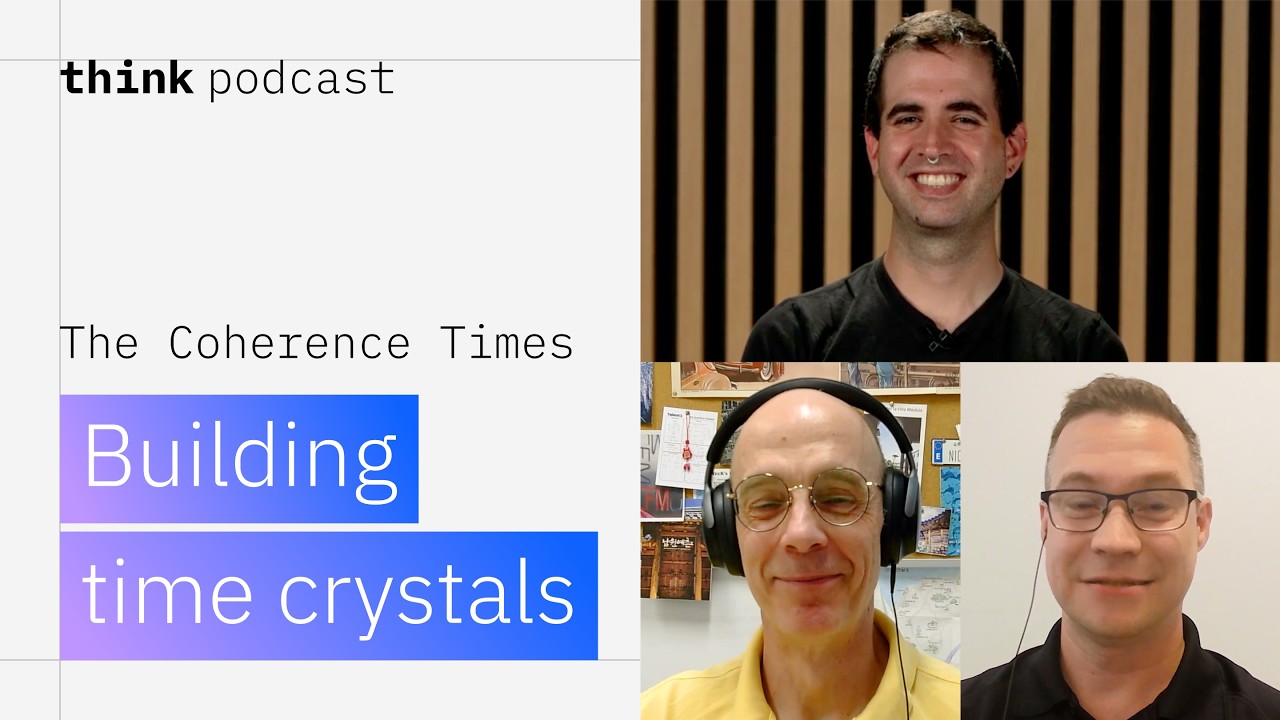
Building time crystals with quantum computers
Keywords
Summary
219 words
Critical Evaluation
Value of the Information & Strength of the Argument
The podcast provides valuable insights into the concept of time crystals and their realization on quantum computers. The hosts and guests effectively explain complex physics concepts in an accessible manner, using analogies like a lattice fence and a metronome. The argumentation is solid, grounded in the researchers’ direct experience and published results. They clearly articulate the scientific significance of studying out-of-equilibrium systems and the advantages of using quantum computers for such experiments. The discussion also addresses potential misconceptions, such as the idea that a simple on-off switch could create a time crystal, and clarifies the importance of many-body interactions and rigidity. Overall, the content is informative and well-reasoned, though it lacks detailed technical depth for experts.
Scientific Rigor, Source Quality, Title Accuracy
The podcast maintains a high level of scientific rigor, with the guests being active researchers in the field. They reference specific prior work, such as the first experimental demonstrations by Chris Monroe’s and Mikhail Lukin’s groups, and mention the theoretical origins with Frank Wilczek. The description provides links to IBM Quantum Platform and the podcast page, which are relevant for further exploration. The title accurately reflects the content, focusing on building time crystals with quantum computers. The discussion is consistent with established scientific knowledge, and the researchers are careful to distinguish between theoretical possibilities and experimental achievements. No significant discrepancies or unsupported claims were noted.
236 words
Title / Content Match
The title accurately reflects the content, which focuses on the construction and study of time crystals using quantum computers.
Quality & Reliability
8/10
The podcast features two researchers directly involved in the study, providing credible expert insights. The discussion is grounded in published research and real experimental results, though it is presented in a conversational format without detailed methodological exposition.
Key Moments
Markers derived by PSI from the transcript: the creator did not define chapters.
- Introduction to time crystals and the podcast's focus.
- Dr. Lorente explains the concept of a time crystal.
- Discussion on the subharmonic response and many-body interactions.
- Exploration of out-of-equilibrium systems and their relevance.
- History of time crystals from Wilczek to first experiments.
- Transition to two-dimensional time crystals and the role of quantum computers.
- Details of the experiment on IBM's quantum computer.
- Researchers share their experience and initial challenges.
- Potential applications and future directions.
Cited Sources
- IBM Quantum Platform — Mentioned as a resource for running quantum circuits.
- The Coherence Times podcast page — Referenced for more quantum content.
Concurring Sources
- Time crystal - Wikipedia — General reference on time crystals, consistent with the podcast's explanation.
Contribution & Novelties
This podcast provides an accessible yet insightful overview of a recent research achievement: the creation of a two-dimensional time crystal on a quantum computer. It highlights the unique capabilities of quantum computers in simulating complex many-body systems and studying out-of-equilibrium dynamics. The discussion offers a behind-the-scenes look at the research process, including initial challenges and the importance of hardware improvements. It also contextualizes the work within the broader field of quantum simulation and condensed matter physics.
Pour aller plus loin :
- Time crystal - Wikipedia — Provides a comprehensive overview of time crystals, including theory and experiments.
- Floquet theory - Wikipedia — Relevant for understanding the periodic driving in time crystals.
- Quantum simulation - Wikipedia — Discusses the use of quantum computers to simulate physical systems.
126 words
Radar Profile
The radar profile shows high scores in information quantity, quality, and reliability, with a slightly lower technical level, reflecting the podcast's accessible yet expert-driven approach. The balanced profile indicates a well-rounded presentation suitable for a broad audience interested in quantum physics.
💬 Sur les 0 commentaires analysés, aucune tendance n'a pu être dégagée.