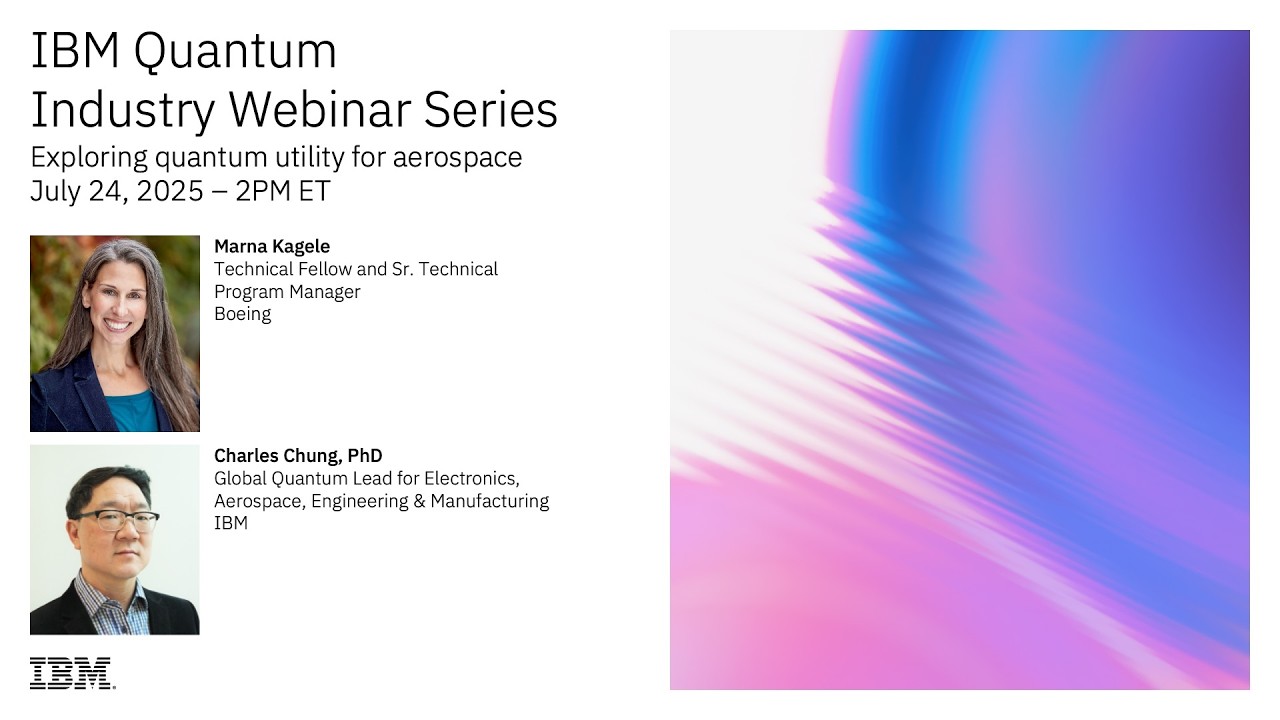
Exploring quantum utility for aerospace
Keywords
Summary
133 words
Critical Evaluation
Value of the Information & Strength of the Argument
The webinar provides valuable insights into the current state and future potential of quantum computing for aerospace. It presents a clear argument for quantum advantage in specific applications, supported by examples like the SQD algorithm’s success in simulating transition metal systems. The discussion of resource estimates and algorithmic improvements adds depth. However, the argumentation is somewhat promotional, with claims about future milestones (e.g., quantum advantage by 2026) presented without detailed evidence. The speakers effectively explain complex concepts, but the lack of independent validation weakens the overall argumentation.
Scientific Rigor, Source Quality, Title Accuracy
The webinar references credible sources, including a Pacific Northwest National Labs paper on turbulence simulation and IBM’s own research on SQD. The DARPA-funded resource analysis by L3 Harris is mentioned, but no specific citation is given. The title accurately reflects the content. The presentation is scientifically rigorous in its explanations, but the promotional nature and lack of detailed citations reduce its overall scientific rigor. No comments were provided for analysis.
172 words
Title / Content Match
The title accurately reflects the content, which focuses on quantum computing applications for aerospace, including simulation and materials development.
Quality & Reliability
7/10
The webinar is presented by IBM Research and a Boeing technical fellow, providing credible expert perspectives. It references specific studies (e.g., PNNL paper on turbulence simulation, IBM's SQD algorithm) and includes resource estimates from a DARPA-funded analysis. However, it is promotional in nature, lacks detailed citations, and does not provide peer-reviewed evidence for all claims.
Key Moments
Markers derived by PSI from the transcript: the creator did not define chapters.
- Introduction by host, introducing speakers Charles Chung and Marnie Kriegel.
- Charles Chung discusses aerospace industry trends: demand, drones, hypersonics, space economy, and challenges like escalating costs and decarbonization.
- Discussion on computational trends: AI surpassing human baselines, slowdown in supercomputer performance growth, and the emergence of quantum-centric supercomputing.
- Introduction to quantum algorithms for CFD, focusing on the HHL algorithm's logarithmic scaling and its potential for turbulence simulation.
- Presentation of PNNL paper on turbulence simulation using quantum algorithms, with constraints (low speed, weakly compressible regimes).
- Resource estimates for turbulence simulation: need for ~100,000 qubits and 10^23 T-gates, far beyond current capabilities.
- Discussion on algorithmic advances reducing resource requirements, exemplified by the SQD algorithm for chemistry.
- Introduction to materials simulation: high-entropy alloys, their vast composition space, and the need for computational methods.
- Explanation of classical limitations in simulating transition metals and excited states, and how SQD addresses these.
- IBM's roadmap: quantum-centric supercomputing, quantum advantage by 2026, and path to error-corrected quantum computers.
Cited Sources
- IBM Quantum System Two — Mentioned as part of quantum-centric supercomputing demonstration at RIKEN.
- Fugaku supercomputer — Combined with IBM Quantum System Two at RIKEN.
- PNNL paper on turbulence simulation — Referenced as a remarkable paper applying quantum algorithms to Navier-Stokes equations.
- L3 Harris resource analysis — DARPA-funded analysis on quantum resources needed for turbulence simulation.
- IBM SQD algorithm paper — Published last year on quantum-centric supercomputing for chemistry.
Concurring Sources
- IBM Quantum System Two — Mentioned as part of quantum-centric supercomputing demonstration.
- Fugaku supercomputer — Combined with IBM Quantum System Two at RIKEN.
Contribution & Novelties
The webinar provides a comprehensive overview of quantum computing applications for aerospace, highlighting specific algorithms (HHL, SQD) and their potential to accelerate simulation and materials development. It offers a realistic assessment of current limitations and future milestones, based on IBM’s roadmap. The discussion of high-entropy alloys and the need for computational methods is particularly insightful.
Pour aller plus loin :
- Quantum computing — Overview of quantum computing principles.
- HHL algorithm — Detailed explanation of the HHL algorithm.
- Density functional theory — Classical method for electronic structure, limitations discussed.
- High-entropy alloys — Definition and properties of high-entropy alloys.
- IBM Quantum roadmap — Official IBM Quantum roadmap.
105 words
Radar Profile
The radar profile shows high scores in quantity of information and technical level, indicating a content-rich and technically detailed presentation. Quality and reliability are slightly lower, reflecting the promotional nature and lack of independent verification. Overall, the webinar is informative but should be complemented with peer-reviewed sources for critical assessment.