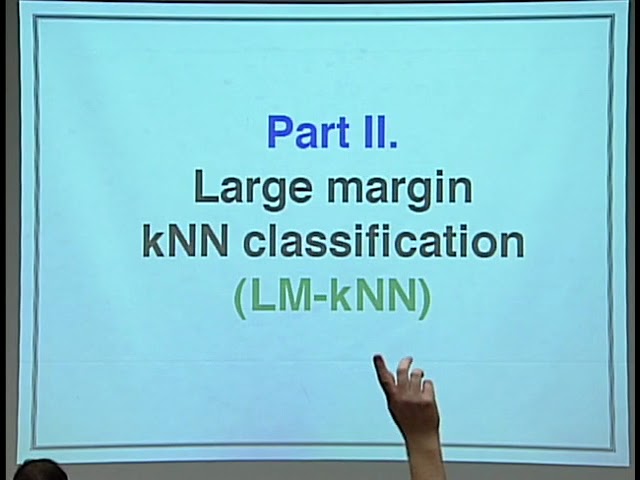
Lawrence K. Saul: Distance Metric Learning for Large Margin Classification
Keywords
Summary
178 words
Critical Evaluation
Value of the Information & Strength of the Argument
The talk provides valuable insights into the application of convex optimization to classical machine learning problems. The argumentation is solid, building from the basics of SVMs to the novel LMNN approach, with clear motivations and intuitive explanations. The speaker effectively demonstrates the advantages of the proposed method through examples and results, though the presentation is somewhat dated (2006). The discussion of the relationship between k-NN and Gaussian mixture models adds depth, and the emphasis on margin maximization as a unifying principle is compelling.
Scientific Rigor, Source Quality, Title Accuracy
The scientific rigor is high, as the talk is based on published research (Weinberger et al., 2005) and the methods are well-founded in convex optimization. The speaker cites relevant prior work, such as tangent distance and shape contexts, and discusses limitations of SVMs. The title accurately reflects the content, and the talk is well-structured. However, as a lecture, it lacks formal citations and peer review, and some technical details are glossed over. The audience questions indicate engagement, but no specific comments are provided for analysis.
183 words
Title / Content Match
The title accurately reflects the content, focusing on distance metric learning for large margin classification, with a clear exposition of the main ideas and results.
Quality & Reliability
8/10
The talk presents a well-structured research lecture with clear technical content, based on published work (Weinberger et al., 2005). The speaker is a recognized expert, and the methods are grounded in convex optimization. However, the video is a recording of a 2006 talk, so some information may be dated, and the presentation is not peer-reviewed in this format.
Key Moments
Markers derived by PSI from the transcript: the creator did not define chapters.
- Introduction and overview of the two main ideas: distance metric learning and large margin classification.
- Discussion on the importance of distance metrics and the convexity of positive semi-definite matrices.
- Review of support vector machines, their advantages and disadvantages.
- Introduction to large margin k-nearest neighbors (LMNN) and the idea of learning a linear transformation.
- Formulation of the LMNN optimization problem as a semidefinite program.
- Results on handwritten digit recognition and face identification.
- Discussion on large margin Gaussian mixture models as a parametric alternative.
- Comparison with related work and potential applications in speech recognition.
- Conclusion and summary of contributions.
Cited Sources
- Distance Metric Learning for Large Margin Nearest Neighbor Classification — The paper describing the LMNN method, presented in the talk.
Concurring Sources
- Distance Metric Learning for Large Margin Nearest Neighbor Classification — The paper presenting the LMNN method, which aligns with the talk's content.
Contribution & Novelties
The talk presents a novel approach to learning distance metrics for k-nearest neighbor classification, formulated as a convex optimization problem. The key innovation is the integration of large margin principles into a non-parametric classifier, leading to improved performance on benchmark tasks. The method is shown to be scalable and applicable to multi-way classification, addressing limitations of SVMs.
Pour aller plus loin :
- Semidefinite programming — The optimization framework used in LMNN.
- Large margin nearest neighbor — Overview of the method.
- K-nearest neighbors algorithm — The base classifier.
- Support vector machine — The comparison baseline.
94 words
Radar Profile
The radar profile shows high scores across all dimensions, indicating a well-balanced and rigorous presentation. The talk excels in technical depth and information quality, with a strong focus on convex optimization and its application to machine learning.