Language Models as Epistemic Interfaces
Keywords
Summary
188 words
Critical Evaluation
Value of the Information & Strength of the Argument
The talk provides valuable insights into the epistemic limitations of current language model interfaces and proposes concrete research directions to address them. The argumentation is well-structured, starting with a clear motivation (the shift from search to chatbots) and then systematically presenting three research projects that tackle different aspects of the problem. The speaker effectively uses examples and analogies to illustrate his points, and he acknowledges the complexity of the issues. The discussion of attribution methods is particularly strong, as it highlights the challenges of training models to cite their parametric knowledge and offers a novel solution. The talk also raises important questions about trust and transparency in AI systems, which are highly relevant to the broader AI community.
Scientific Rigor, Source Quality, Title Accuracy
The talk demonstrates scientific rigor through its clear methodology and references to ongoing research. The speaker cites specific papers and datasets (e.g., Wikipedia, Common Crawl) and discusses the limitations of existing approaches. However, since the work is largely unpublished or in progress, the details are not fully verifiable. The title accurately reflects the content, focusing on the epistemic role of language models. The talk does not include a formal literature review, but it situates the work within the broader context of interpretability and training data attribution. The Q&A session adds depth, as the speaker engages with audience questions and clarifies his approach. Overall, the sources are credible, and the title-content alignment is strong.
246 words
Title / Content Match
The title accurately reflects the talk's focus on language models as interfaces for knowledge consumption, with an emphasis on epistemic signals.
Quality & Reliability
8/10
The talk presents recent research from a reputable academic lab, with clear methodology and references to ongoing work. The speaker is a recognized expert in the field. However, the content is largely based on unpublished or in-progress work, and the presentation is a high-level overview rather than a detailed technical exposition.
Key Moments
Markers derived by PSI from the transcript: the creator did not define chapters.
- Introduction: Chatbots as primary source of knowledge, example of coffee query.
- Discussion of missing signals: provenance, certainty, trust.
- Contrast with search interface and cognitive effort.
- Overview of three research areas: provenance, process, uncertainty.
- Part 1: Knowledge attribution - parametric vs nonparametric knowledge.
- Discussion of passive indexing and its limitations.
- Synthetic data generation for forward and backward indexing.
- Part 2: Tool use for externalizing reasoning.
- Part 3: Calibration of long-form generation.
Cited Sources
- Paper on knowledge attribution (ICLR 2026) — Mentioned as upcoming ICLR paper on retrieval-free attribution.
- Wikipedia — Used as a source for pretraining data in experiments.
- Common Crawl — Used as a source for pretraining data in experiments.
Concurring Sources
- Influence Functions — Related work on training data attribution.
- Retrieval-Augmented Generation — Contrast with nonparametric knowledge approaches.
Dissenting Sources
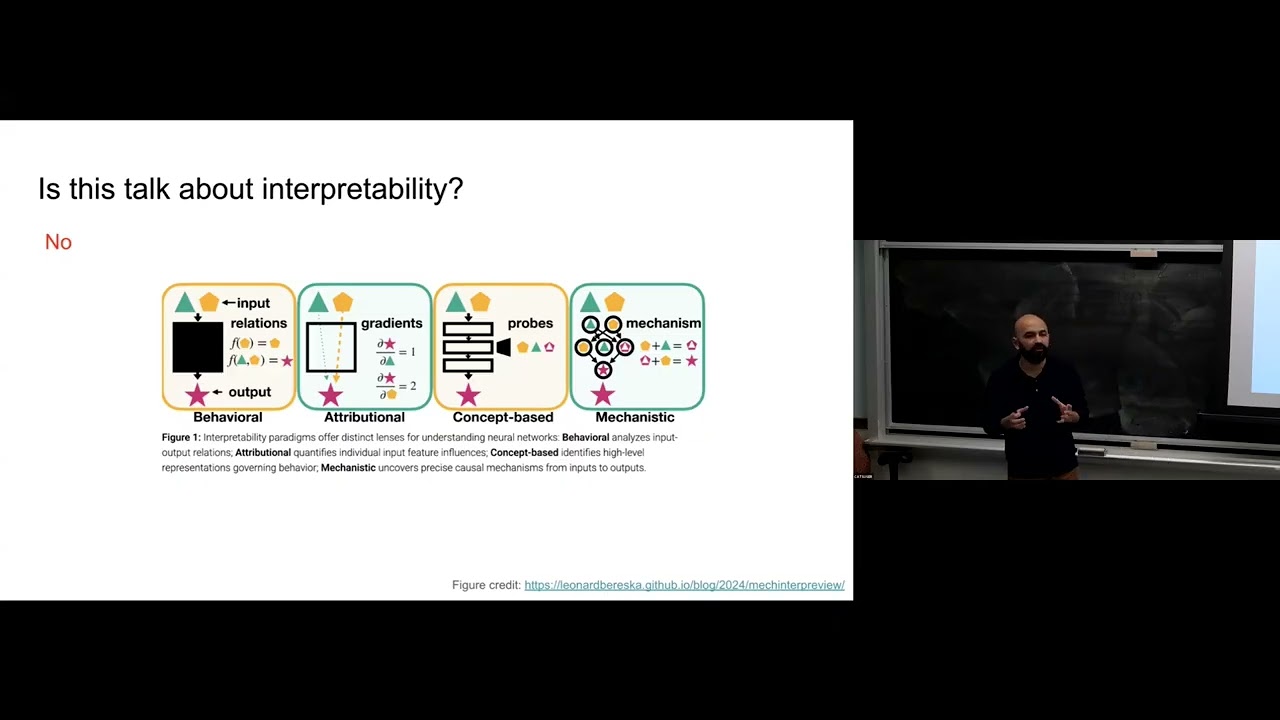
- Mechanistic Interpretability — The speaker explicitly distinguishes his approach from mechanistic interpretability, which focuses on model internals rather than user-facing signals.
Contribution & Novelties
The talk presents novel approaches to improving the epistemic reliability of language models. The key contributions include: (1) a retrieval-free method for training models to attribute knowledge to pretraining documents, using synthetic data to strengthen source-fact associations; (2) the idea of using tool calls to externalize reasoning, making the process more transparent; and (3) a framework for calibrating long-form generation by treating correctness and confidence as distributions. These ideas are original and address critical gaps in current AI systems.
Pour aller plus loin :
- Training Data Attribution — Overview of methods to trace model predictions to training data.
- Mechanistic Interpretability — Related field focusing on understanding model internals.
- Calibration (statistics) — Statistical concept relevant to uncertainty estimation.
117 words
Radar Profile
The radar profile shows high scores in quality of information and reliability, reflecting the speaker's expertise and rigorous methodology. The quantity of information is moderate, as the talk covers three research areas but at a high level. The technical level is high, suitable for an academic audience. Overall, the talk is well-balanced, with a strong emphasis on scientific rigor.
💬 No comments were provided for analysis.