SALT Closing Presentations Day 2
Keywords
Summary
131 words
Critical Evaluation
Value of the Information & Strength of the Argument
The presentation provides valuable insights into the practical challenges of building multimodal LLMs, based on hands-on experience from a collaborative workshop. The argumentation is solid, with clear problem statements and proposed solutions, but the results are preliminary and often inconclusive. The speakers are transparent about limitations, such as the failure of lightweight evaluations to predict heavyweight performance, and they caution against p-hacking. The discussion of brain-based benchmarks is innovative, though the feasibility and validity of such an approach are not fully established. Overall, the content is informative for researchers in the field, but it is more of a progress report than a definitive study.
Scientific Rigor, Source Quality, Title Accuracy
The scientific rigor is moderate: the presentation is based on original work by the team, but it is not peer-reviewed and lacks formal citations. The speakers reference benchmarks like MSAB, MMAU Pro, and a Stanford paper on X-ray vision, but no URLs are provided. The title accurately reflects the content, which is a series of workshop presentations. The discussion of p-hacking and the cautionary tale about ablations demonstrate a thoughtful approach to research methodology. However, the lack of detailed experimental protocols and the preliminary nature of the results limit the overall rigor.
211 words
Title / Content Match
The title accurately reflects the content: it is a recording of the second day of closing presentations from the SALT workshop, featuring multiple speakers from the team.
Quality & Reliability
7/10
Presentation by academic researchers at a workshop, describing ongoing work and preliminary results. The content is expert-level and technically detailed, but not peer-reviewed and lacks formal citations. The speakers acknowledge limitations and open problems, which adds credibility.
Key Moments
Markers derived by PSI from the transcript: the creator did not define chapters.
- Introduction by David Harwath: team overview and three open problems.
- Pavle presents lightweight vs heavyweight evaluation pipeline.
- Discussion of MMAU Pro benchmark and initial results.
- RJ presents brain data as a benchmark for encoder evaluation.
- Chinro and team present multimodal encoder training approaches.
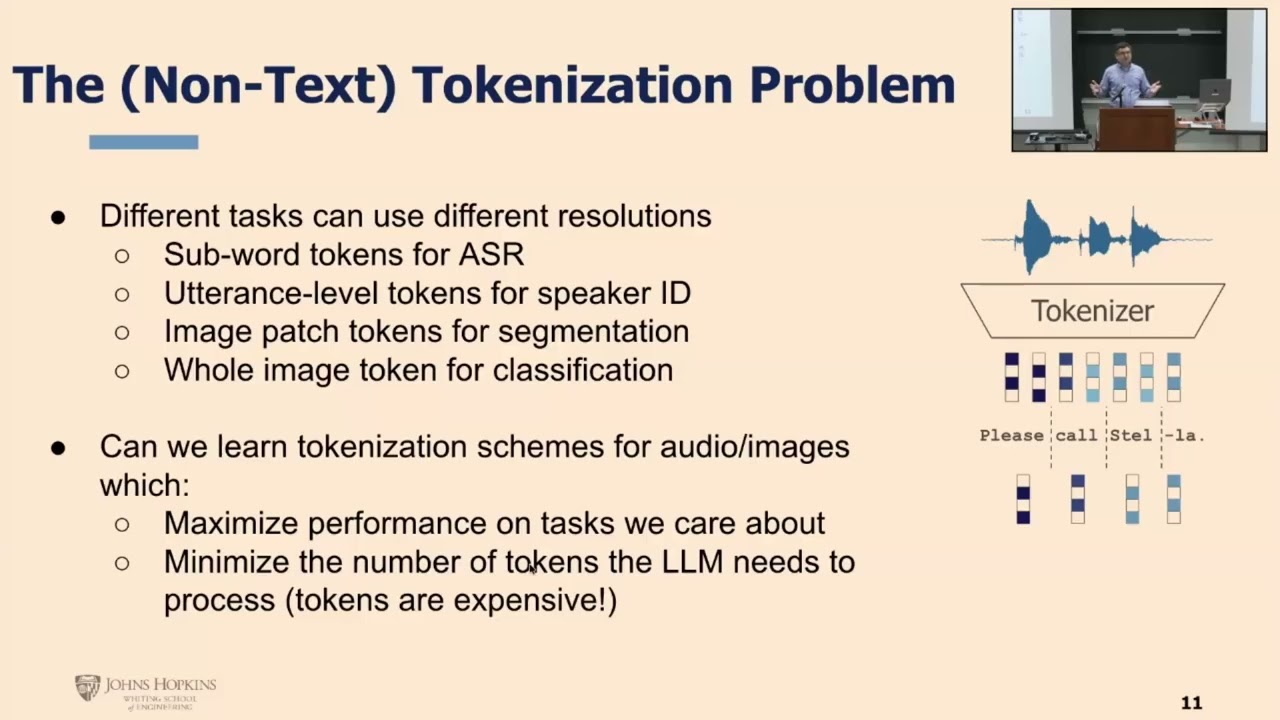
- Roger and team discuss tokenization for continuous inputs.
- David presents analysis of encoder-free LLMs.
- Open discussion and Q&A session.
Cited Sources
- MSAB benchmark — Mentioned as a source of lightweight tasks for audio evaluation.
- MMAU Pro benchmark — Used for heavyweight evaluation of multimodal LLMs.
- Stanford paper on X-ray vision — Referenced in discussion about models performing well without visual input.
Concurring Sources
- MMAU Pro benchmark — Used as a standard for evaluating multimodal LLMs.
- MSAB benchmark — Provides lightweight tasks for audio encoder evaluation.
Dissenting Sources
- Stanford X-ray vision paper — Suggests that models can perform well without visual input, challenging the validity of certain benchmarks.
Contribution & Novelties
The presentation offers a candid look at the challenges of evaluating and building multimodal LLMs, with practical lessons from a collaborative workshop. The proposal to use brain data as a benchmark is novel, though speculative. The discussion of tokenization for continuous inputs highlights an underexplored area. The team’s emphasis on lightweight evaluation as a predictive tool, despite mixed results, is a valuable contribution to the field.
Pour aller plus loin :
- Multimodal learning — Overview of multimodal learning concepts.
- Large language model — Background on LLMs.
- Speech recognition — Related to audio encoders.
- Brain–computer interface — Context for brain-based benchmarks.
100 words
Radar Profile
The radar profile shows high scores in quantity of information and technical level, reflecting the dense, expert-level content. Quality and reliability are moderate, consistent with preliminary research findings. The overall profile indicates a technically rich but not fully validated presentation.
💬 No comments were provided for analysis.