Najim Dehak: Can Human Languge Technologies Improve the Lives of Older Adults
Keywords
Summary
145 words
Critical Evaluation
Value of the Information & Strength of the Argument
The talk provides valuable insights into the application of speech and language technologies for elder care, highlighting concrete research directions and ongoing projects. The argumentation is based on the speaker’s expertise and the identified needs of the aging population, such as the shortage of geriatricians and the desire for aging in place. However, the talk is more of an overview and lacks detailed evidence or data to support the claims. The speaker presents the initiative as a promising solution but does not delve into potential limitations or challenges in depth.
Scientific Rigor, Source Quality, Title Accuracy
The talk is an expert opinion and does not cite specific sources. The speaker references collaborations with colleagues and mentions grants (e.g., NIH P30) but does not provide detailed citations. The title is somewhat misleading as it focuses on language technologies, but the talk covers a broader scope. The content is scientifically grounded in the speaker’s research and the field, but the lack of explicit sources reduces the rigor. The title-content alignment is moderate, as the talk does discuss language technologies but also covers other aspects.
191 words
Title / Content Match
The title is somewhat misleading as the talk focuses more on the broader initiative and research directions rather than specifically on how language technologies improve lives, though it does touch on that.
Quality & Reliability
7/10
The talk is an expert opinion from a faculty member at Johns Hopkins, presenting ongoing research and initiatives. It is not a peer-reviewed study, but the speaker is credible and the content is grounded in established research areas. The presentation is clear and provides specific examples, but lacks detailed citations and rigorous data.
Key Moments
Markers derived by PSI from the transcript: the creator did not define chapters.
- Introduction and overview of the talk
- Background on the Human Aging Project and the need for engineering solutions
- Mission and vision of the new unit for aging research
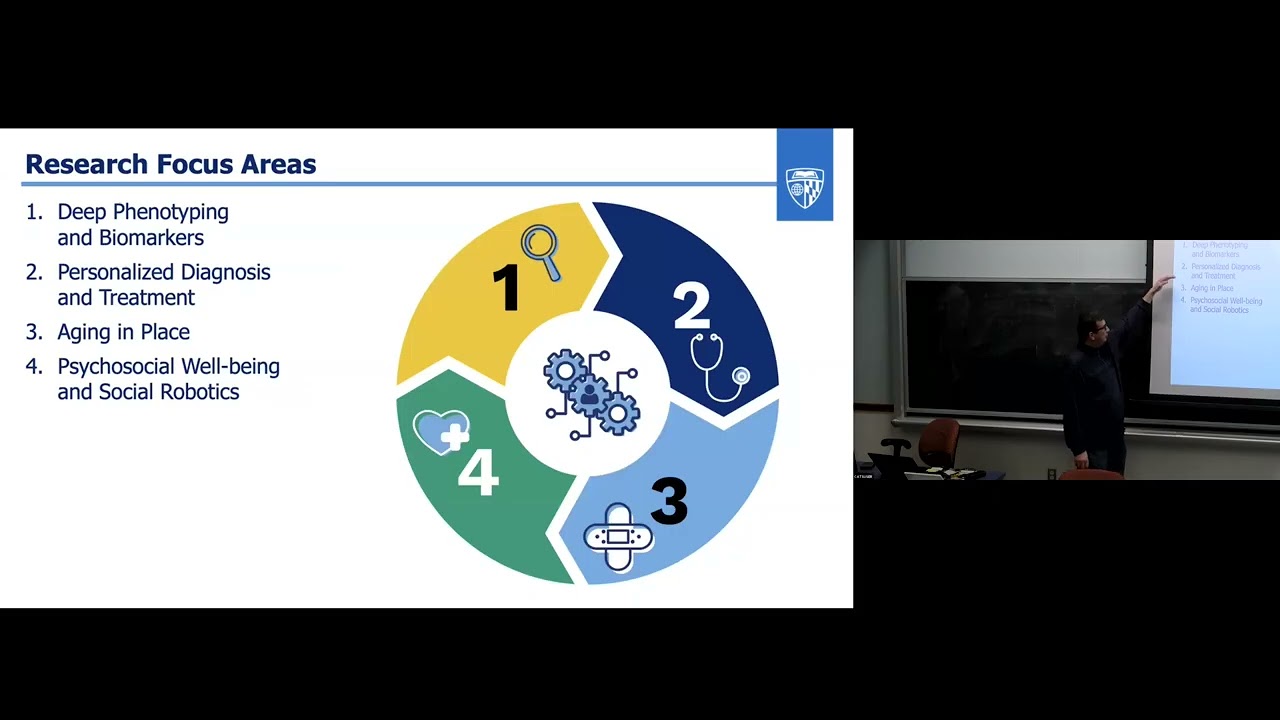
- Research focus areas: studying aging, personalized diagnosis, continuous monitoring, aging in place
- Examples of current research: digitalizing neurological tests, speech and eye movement analysis
- Collaboration with CLSP and other engineering groups
- Discussion on social robots and assistive technology
- Call for collaboration and how to get involved
Contribution & Novelties
The talk presents a novel initiative that integrates engineering and clinical care for aging, emphasizing a collaborative ecosystem. It highlights the potential of speech and language technologies for health monitoring and cognitive assessment, which is an emerging area. The talk also introduces specific research projects and the use of a simulation apartment for testing technologies.
Pour aller plus loin :
- Human Aging Project — Official website of the Human Aging Project at Johns Hopkins.
- Geriatric assessment — Overview of comprehensive geriatric assessment.
- Speech processing for health — Article on speech biomarkers for neurological disorders.
94 words
Radar Profile
The radar profile shows high scores in information quantity and quality, with moderate technical level and reliability. This indicates a well-informed talk with practical insights, but not highly technical or rigorously sourced.