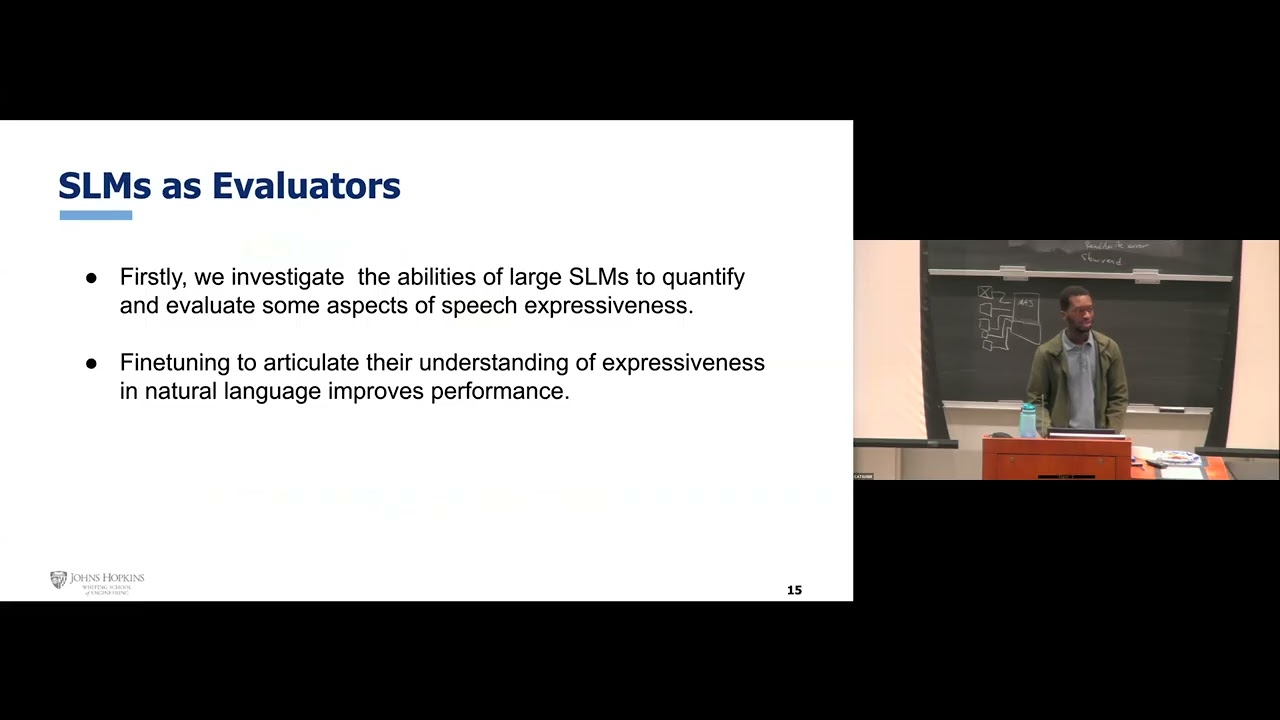
Leveraging Large Speech Language Models as Evaluators for Expressive Speech
Keywords
Summary
131 words
Critical Evaluation
Value of the Information & Strength of the Argument
The presentation provides valuable insights into using SLMs for expressive speech evaluation, a novel application. The argumentation is solid, supported by experimental results comparing multiple models and baselines. The speaker clearly explains the methodology and acknowledges limitations, such as potential data contamination and the need for cross-dataset studies. The discussion with the audience adds depth, addressing questions about label sets and model training. Overall, the value lies in demonstrating the potential of SLMs as scalable alternatives to human evaluation, with promising results even with limited fine-tuning data.
Scientific Rigor, Source Quality, Title Accuracy
The scientific rigor is adequate: the speaker presents original research with clear experimental setup and comparisons. However, the lack of detailed statistical analysis (e.g., confidence intervals) and the absence of cross-dataset validation weaken the conclusions. The sources cited are primarily the datasets used (MSP-Podcast, RAVDESS) and the SLM models (Qwen, Qwen2), but no external references are provided in the description. The title accurately reflects the content, and the presentation is well-structured. The discussion highlights potential issues, such as data contamination, which the speaker acknowledges.
186 words
Title / Content Match
The title accurately reflects the content, focusing on using SLMs for evaluating expressive speech.
Quality & Reliability
7/10
The presentation is based on original research with clear methodology, but lacks detailed statistical analysis and external validation. The speaker acknowledges limitations and open questions, indicating scientific honesty.
Key Moments
Markers derived by PSI from the transcript: the creator did not define chapters.
- Introduction to expressive speech generation and the need for evaluation.
- Overview of speech language models and their architecture.
- Explanation of the compressor and projector components.
- Discussion on fine-tuning strategies and parameter efficiency.
- Introduction of expressive attributes and datasets used.
- Presentation of zero-shot and fine-tuned results for emotion recognition.
- Comparison of SLMs with SSL baselines and discussion on continuous attributes.
- Discussion on data contamination and cross-dataset validation.
- Future work on unified speech-text evaluation and quality assessment.
Cited Sources
- MSP-Podcast dataset — Used for emotion and continuous attribute labels.
- RAVDESS dataset — Used for emotion recognition tasks.
- Qwen audio model — One of the SLMs evaluated.
- Qwen2 audio model — Another SLM evaluated.
Concurring Sources
- MSP-Podcast dataset — Used for emotion and continuous attribute labels.
- RAVDESS dataset — Used for emotion recognition tasks.
Contribution & Novelties
The work proposes a novel application of SLMs as automatic evaluators for expressive speech, demonstrating that fine-tuning on a small amount of data can yield competitive performance. This could reduce reliance on expensive human evaluations. The comparison with SSL baselines and the analysis of continuous attributes provide new insights.
Pour aller plus loin :
- Speech Language Models — Overview of speech processing and language models.
- Emotion Recognition — Background on emotion detection in speech.
- Fine-tuning (machine learning) — Explanation of fine-tuning techniques.
82 words
Radar Profile
The radar profile shows balanced scores across all dimensions, with slightly higher quality of information and technical level, indicating a solid but not exceptional presentation. The relatively lower quantity of information suggests the talk could have provided more details or examples.
💬 No comments were provided for analysis.