Philipp Koehn: Multilingual Language Processing in 21 century: Lessons Learned and Challenges Ahead
Keywords
Summary
173 words
Critical Evaluation
Value of the Information & Strength of the Argument
The talk provides a valuable historical perspective on machine translation, synthesizing key developments from rule-based to neural approaches. Koehn’s arguments are well-supported by his extensive experience and references to specific systems and datasets. He presents compelling evidence of progress, such as the chart showing translator productivity improvements. The discussion on the role of language models and the shift to LLMs is insightful, and he offers practical lessons learned. However, some claims are anecdotal, and the talk is more of a personal overview than a rigorous scientific analysis.
Scientific Rigor, Source Quality, Title Accuracy
Koehn demonstrates scientific rigor by referencing well-known systems (Moses, Europarl), datasets (OPUS, Common Crawl), and evaluation campaigns (WMT). He cites specific papers and researchers, such as the transformer paper and the work of Jacob Devlin. The title accurately reflects the content, which is a comprehensive overview of multilingual language processing. The talk is based on his own research and contributions to the field, lending credibility to his insights. However, as a talk, it lacks formal citations and peer review, but the sources mentioned are reputable and verifiable.
189 words
Title / Content Match
The title accurately reflects the content: a retrospective on multilingual language processing with lessons learned and future challenges.
Quality & Reliability
8/10
Talk by a leading researcher in machine translation, providing a historical overview and personal insights. The content is based on decades of experience and references well-known systems and datasets, but it is not a peer-reviewed publication and relies on anecdotal evidence and personal opinions.
Key Moments
Markers derived by PSI from the transcript: the creator did not define chapters.
- Introduction and overview of the talk's structure.
- Discussion of rule-based systems and the shift to statistical methods.
- Chart showing progress in machine translation quality over time.
- Productivity gains for translators using MT post-editing.
- Evolution of statistical methods and the use of large language models.
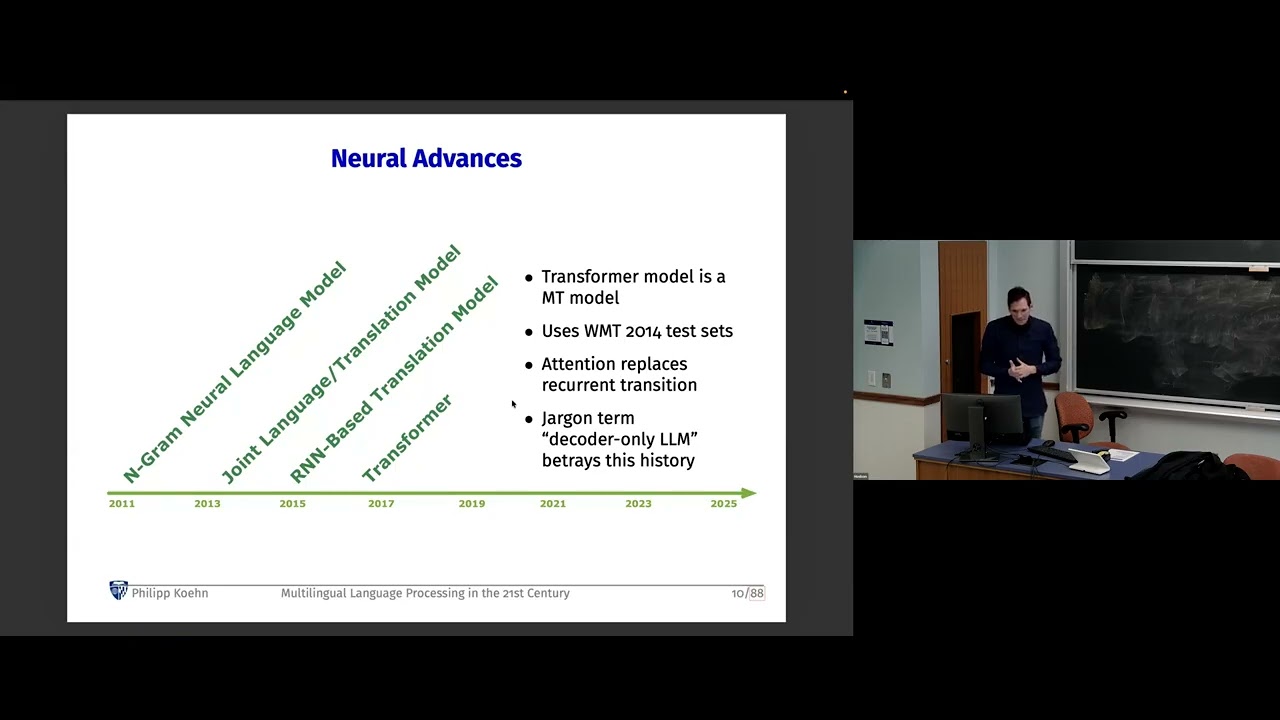
- Introduction of neural machine translation and the attention mechanism.
- The transformer model and its impact.
- Data scaling experiments and the importance of monolingual data.
- Adoption of large language models for translation and standard recipe.
- WMT evaluation campaigns and the open-source culture.
- Challenges in low-resource languages and evaluation.
- Future directions: multimodal models and robust systems.
Cited Sources
- Moses — Open-source statistical machine translation system developed by Koehn and others.
- Europarl — Parallel corpus extracted from European Parliament proceedings.
- OPUS — Collection of parallel corpora.
- WMT — Conference on Machine Translation, evaluation campaigns.
- Attention Is All You Need — The transformer paper.
Concurring Sources
- Moses — Open-source SMT system mentioned in the talk.
- Europarl — Parallel corpus used in MT research.
- Attention Is All You Need — Transformer paper referenced.
Contribution & Novelties
The talk offers a unique retrospective from a pioneer in the field, synthesizing 25 years of machine translation research. It provides insights into the evolution of techniques, the importance of open data and tools, and the challenges that remain. The discussion on the role of language models and the shift to LLMs is particularly timely.
Pour aller plus loin :
- Statistical Machine Translation — Overview of statistical MT.
- Neural Machine Translation — Overview of neural MT.
- Transformer (machine learning model) — Details on the transformer architecture.
- BLEU — Metric for evaluating machine translation.
- Low-resource languages — Definition and challenges.
99 words
Radar Profile
The radar profile shows high scores in quantity and quality of information, reflecting the speaker's expertise and the comprehensive coverage. The technical level is also high, indicating a detailed discussion. The overall reliability is strong, but the talk is not a formal publication, so the scores are slightly lower than a peer-reviewed source.