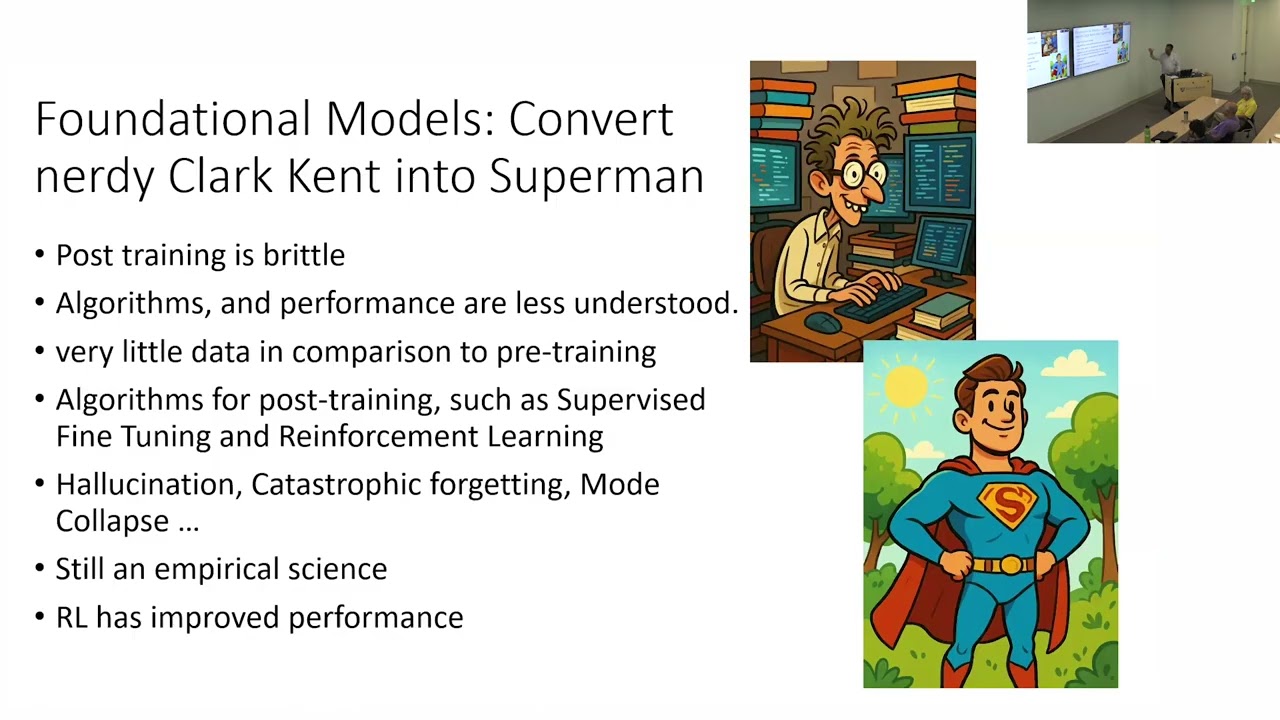
Ramani Duraiswami, Towards AGI: Building, Benchmarking and Improving Large Audio-Language Models
Keywords
Summary
157 words
Critical Evaluation
Value of the Information & Strength of the Argument
The talk provides a high-value overview of the state of the art in LALMs, grounded in the speaker’s extensive research. The argumentation is solid, tracing the evolution of the Audio Flamingo family and linking design choices to empirical results. The speaker is candid about limitations, such as the challenge of diarization and the risk of catastrophic forgetting, which strengthens the credibility of the presentation. The emphasis on open-source models and benchmarks is a significant contribution to the field.
Scientific Rigor, Source Quality, Title Accuracy
The talk is scientifically rigorous, referencing a series of peer-reviewed publications (ICLR, EMNLP, ICML, NeurIPS) and benchmarks (MMAU, MMAU-Pro). The sources are credible and directly relevant. The title accurately reflects the content, which is a detailed account of building, benchmarking, and improving LALMs. The speaker’s expertise and the depth of technical detail support the high quality of the information presented.
153 words
Title / Content Match
The title accurately reflects the content: the talk covers the building, benchmarking, and improvement of large audio-language models, with a clear focus on the path towards auditory general intelligence.
Quality & Reliability
8/10
The talk is given by a leading researcher in the field, presenting a coherent overview of a series of peer-reviewed publications (ICLR, EMNLP, ICML, NeurIPS). The claims are supported by references to specific models and benchmarks, and the speaker acknowledges limitations and open questions. However, as a conference talk, it is an expert opinion and not a peer-reviewed meta-analysis, and some claims are presented without full experimental detail.
Key Moments
Markers derived by PSI from the transcript: the creator did not define chapters.
- Introduction and speaker background
- Motivation for LALMs and the promise of LLMs
- Core recipe for building LALMs: architecture and design choices
- Evolution of the Audio Flamingo family of models
- Benchmarking: creation of MMAU and MMAU-Pro
- Improvements in Audio Flamingo Next: temporal reasoning and diarization
- Applications to genomics and scientific computing
- Q&A session and discussion
Cited Sources
- MMAU: A Holistic Benchmark of Agent Capabilities for Diverse Audio Understanding — Introduced as the first comprehensive benchmark for audio general intelligence, published at ICLR 2025.
- Audio Flamingo 2: An Audio-Language Model with Long Audio Understanding — One of the models in the Audio Flamingo family, presented as a step towards long audio understanding.
- Audio Flamingo 3: An Audio-Language Model with Long Audio Understanding — The most capable model in the family, trained on 50 million data pieces and capable of understanding music, speech, and events.
- Audio Flamingo Next: Towards Auditory General Intelligence — The latest model, extending to 30 minutes of audio and incorporating temporal reasoning.
- MMAU-Pro: A Benchmark for Audio Understanding — Successor to MMAU, developed during JSALT 2025, presented at AAAI 2026.
Concurring Sources
- Audio Flamingo 2 — The paper describing the model, which supports the claims about its capabilities.
- MMAU — The benchmark paper, which validates the evaluation methodology.
Dissenting Sources
- Gemini 1.5 Pro — While the speaker claims their models outperform Gemini on some benchmarks, Gemini is a proprietary model with different training data and objectives, making direct comparison complex.
Contribution & Novelties
The talk provides a comprehensive overview of the state of the art in LALMs, highlighting the speaker’s group’s contributions in building open-source models and benchmarks. The main novelty is the systematic approach to curriculum training and the introduction of temporal reasoning capabilities, which are crucial for advancing auditory general intelligence.
Pour aller plus loin :
- Large Audio-Language Models — Overview of the Audio Flamingo family.
- MMAU Benchmark — The first comprehensive benchmark for audio understanding.
- Whisper — The audio encoder used as a base, originally for speech recognition.
- Chain-of-Thought Reasoning — Technique used for temporal reasoning in LALMs.
98 words
Radar Profile
The radar profile shows a well-rounded performance across all dimensions, with slightly higher scores in information quantity and quality, reflecting the depth and breadth of the talk. The technical level is high, indicating a specialized audience, and the reliability is strong due to the speaker's expertise and references to peer-reviewed work.
💬 Sur les 0 commentaires analysés, aucune tendance n'a pu être dégagée.