Nima Mesgarani: Robust Representation of Attended Speech in Human Brain with Implications for ASR
Keywords
Summary
152 words
Critical Evaluation
Value of the Information & Strength of the Argument
The talk provides valuable insights into the neural basis of speech perception, particularly the robustness of attended speech in noisy environments. The argumentation is solid, based on well-designed experiments and rigorous analysis. The speaker clearly explains the methods and results, and he addresses questions from the audience, clarifying technical details. The value lies in bridging neuroscience and ASR, offering potential bio-inspired solutions for robust speech recognition.
Scientific Rigor, Source Quality, Title Accuracy
The talk is scientifically rigorous, referencing established work (e.g., TIMIT, STRF models) and presenting new data from human recordings. The speaker does not cite specific papers in the talk, but the description provides no links. The title accurately reflects the content. The talk is a seminar, so it is not a formal publication, but the methods and results are consistent with published research in the field.
147 words
Title / Content Match
The title accurately reflects the content: the talk focuses on the neural representation of attended speech in the human brain and its implications for automatic speech recognition.
Quality & Reliability
8/10
The talk is given by a leading researcher in auditory neuroscience, presenting peer-reviewed research (e.g., Mesgarani et al., 2014, Science) and preliminary data from human intracranial recordings. The methods are well-established, and the claims are supported by experimental evidence. However, some results are preliminary and not yet peer-reviewed, and the talk is a seminar rather than a formal review.
Key Moments
Markers derived by PSI from the transcript: the creator did not define chapters.
- Introduction: motivation for studying brain and ASR together.
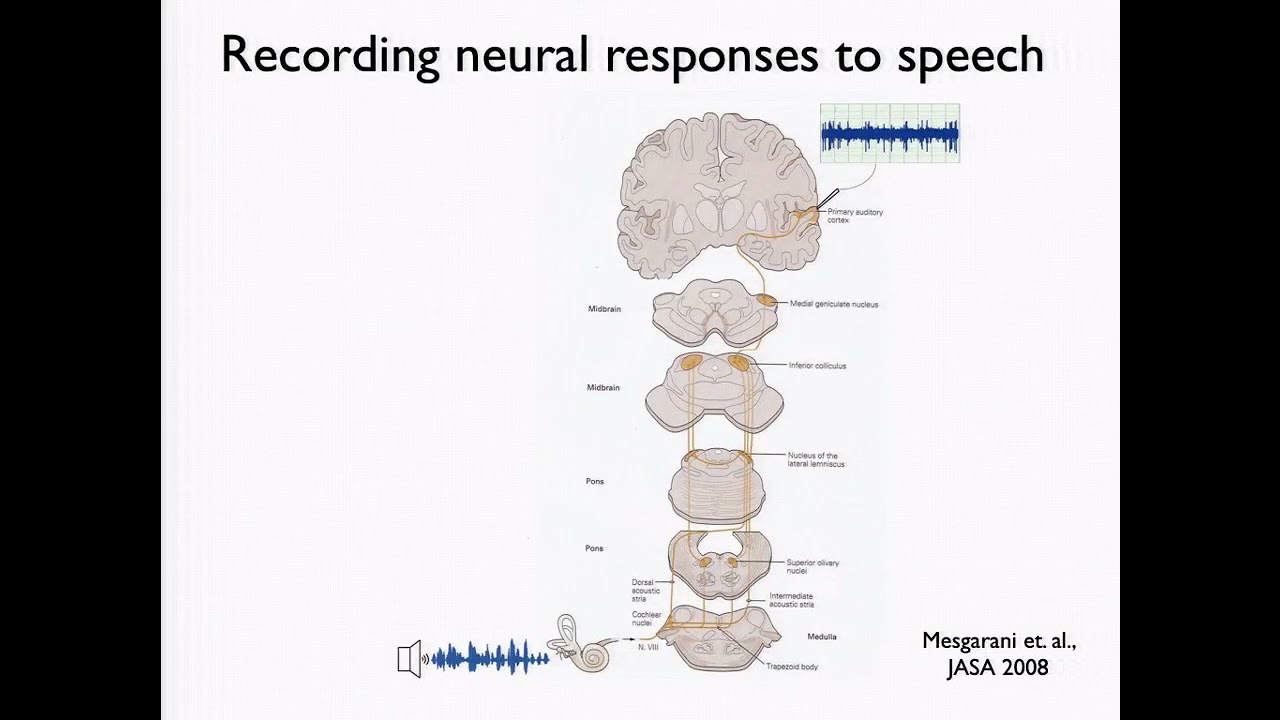
- Background on auditory pathway and STG.
- Ferrets: STRF models and phoneme selectivity.
- Human intracranial recordings: preliminary data.
- Cocktail party experiment: task design.
- Stimulus reconstruction method and results.
- Attention effects on neural responses.
- Implications for ASR and speech prosthetics.
Contribution & Novelties
The talk presents original research on the neural representation of attended speech in the human brain, using intracranial recordings. It demonstrates that STG activity tracks the attended speaker, not the mixture, and that this can be decoded using linear models. This has implications for developing robust ASR systems inspired by the brain’s attention mechanisms.
Pour aller plus loin :
- Mesgarani et al., 2014, Science: Phonetic feature encoding in human superior temporal gyrus — Key paper on phoneme selectivity in human STG.
- Cocktail party effect - Wikipedia — Overview of the phenomenon.
- Spectrotemporal receptive field - Wikipedia — Explanation of STRF models.
101 words
Radar Profile
The radar profile shows high scores in information quantity, quality, and reliability, with a slightly lower technical level, indicating a well-balanced presentation accessible to a broad scientific audience.