Emmanuel Dupoux: A computational approach to early language bootstrapping
Keywords
Summary
168 words
Critical Evaluation
Value of the Information & Strength of the Argument
The talk provides valuable insights into the challenges of computational modeling of language acquisition, particularly the failure of simple clustering on real speech. Dupoux presents empirical evidence and logical arguments to support his claims, such as the degradation of word segmentation with increased allophones. He also offers a novel perspective on feature representation using templates. The argumentation is solid, though some points are presented as work in progress without full experimental validation.
Scientific Rigor, Source Quality, Title Accuracy
Dupoux references several studies and collaborations, including work with Sanjeev Khudanpur and his student, and mentions specific algorithms (e.g., successive state splitting, Brent’s algorithm). The talk is rigorous in its scientific approach, though it is a seminar presentation and not a peer-reviewed publication. The title accurately reflects the content, focusing on computational methods for early language bootstrapping.
144 words
Title / Content Match
The title accurately reflects the content: a computational approach to early language acquisition, focusing on bootstrapping phonemes and words.
Quality & Reliability
8/10
The speaker is a recognized researcher in cognitive science, presenting work in progress with references to published studies and collaborations. The talk is technical and grounded in empirical data, though it is a seminar presentation rather than a peer-reviewed publication.
Key Moments
Markers derived by PSI from the transcript: the creator did not define chapters.
- Introduction to the problem of language acquisition in infants.
- Discussion of phoneme discrimination and perceptual narrowing in infants.
- Proposal of unsupervised clustering as a mechanism for phoneme acquisition.
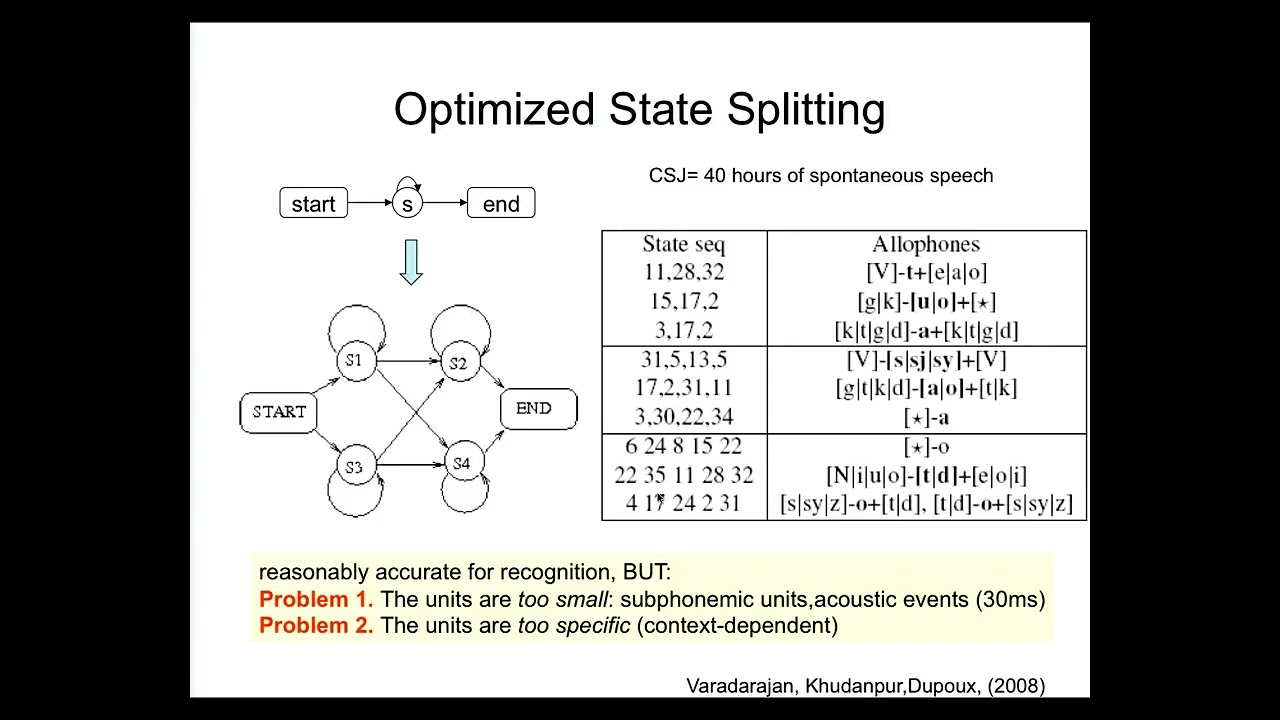
- Application of successive state splitting to Japanese speech, yielding sub-phonemic units.
- Discussion of the problem of over-segmentation and the need for alternative feature representations.
- Introduction of template-based coding using dynamic time warping.
- Results showing improved linear separability with template features.
- Discussion of context-dependency and allophones.
- Experiments showing degradation of word segmentation with increased allophones.
- Conclusion and future directions, including sparse coding and larger databases.
Cited Sources
- Successive state splitting algorithm — Mentioned as the algorithm used for unsupervised clustering on Japanese speech.
- Brent's algorithm for word segmentation — Referenced in the experiment on word segmentation performance.
Concurring Sources
- Statistical learning in language acquisition — Supports the idea that infants track statistical distributions in speech.
Contribution & Novelties
The talk contributes to the field by critically evaluating the standard unsupervised clustering approach for phoneme acquisition and demonstrating its limitations on real speech. It proposes alternative feature representations and highlights the importance of addressing context-dependency. The work is part of ongoing research, offering a fresh perspective on computational modeling of language acquisition.
Pour aller plus loin :
- Statistical learning in language acquisition — Provides background on statistical learning mechanisms.
- Dynamic time warping — The technique used for template matching.
- Sparse coding — Mentioned as a future direction for deriving templates.
91 words
Radar Profile
The radar profile shows high scores in information quantity, quality, technical level, and reliability, indicating a dense and well-supported presentation. The talk is highly technical and aimed at a specialized audience, with a strong emphasis on empirical evidence and computational methods.