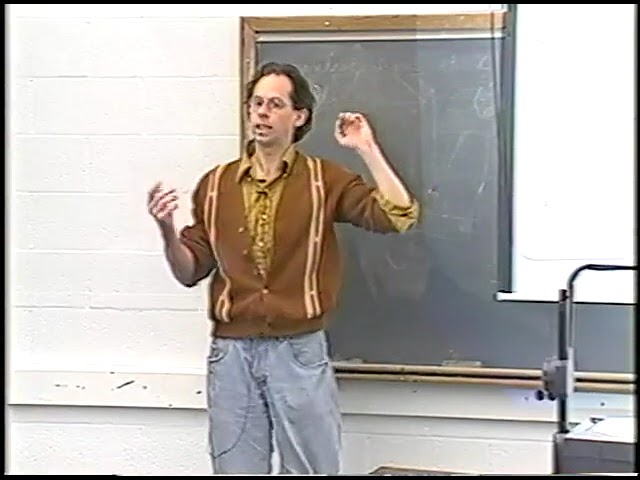
Dan Jurafsky: What's up with the pronunciation variation? Why it's so hard to model and what to d...
Keywords
Summary
205 words
Critical Evaluation
Value of the Information & Strength of the Argument
The talk provides valuable insights into the challenges of modeling pronunciation variation in ASR, backed by empirical experiments. Jurafsky systematically evaluates existing methods and presents a novel methodology to isolate the effects of training data on variation modeling. The argumentation is solid, with clear explanations of experimental design and results. He acknowledges limitations and alternative explanations, strengthening the credibility of his conclusions.
Scientific Rigor, Source Quality, Title Accuracy
The talk is scientifically rigorous, with a clear methodology and reliance on established research. Jurafsky cites specific studies and mentions collaborators, but does not provide explicit references or URLs. The title accurately reflects the content. The talk appears to be a technical seminar, and the audience questions indicate engagement and scrutiny. No comments were provided for analysis.
134 words
Title / Content Match
The title accurately reflects the content, which focuses on pronunciation variation and its modeling challenges in speech recognition.
Quality & Reliability
8/10
The talk is a technical lecture by a recognized expert in computational linguistics, presenting empirical research with clear methodology and data. The content is well-structured and grounded in established research, though it is a single presentation and not peer-reviewed.
Key Moments
Markers derived by PSI from the transcript: the creator did not define chapters.
- Introduction to the problem: word error rates for conversational speech are an order of magnitude worse than for read speech.
- Discussion of experiments showing pronunciation variation is a major factor in recognition errors.
- Critique of traditional pronunciation networks and decision trees based on phonetic context.
- Proposal to model variation based on non-phonetic contextual factors like neighboring words.
- Description of the methodology: comparing forced alignment scores from canonical and surface lexicons.
- Results showing that triphone models can capture some variation with more training data, but not all.
- Analysis of specific types of variation: syllable deletion, vowel reduction, and phone substitution.
- Discussion of ongoing work to dynamically adjust lexicons based on contextual factors.
Cited Sources
- Speech and Language Processing — Mentioned as a textbook authored by Dan Jurafsky and James Martin.
Contribution & Novelties
The talk contributes a novel methodology for analyzing pronunciation variation in ASR by comparing canonical and surface lexicons across training stages. It challenges the focus on phonetic context and suggests that non-phonetic factors are crucial. The findings have implications for improving ASR systems.
Pour aller plus loin :
- Pronunciation variation in speech recognition — Overview of the topic.
- Triphone — Explanation of triphone models.
- Forced alignment — Technique used in the methodology.
72 words
Radar Profile
The radar profile shows high scores in technical level and information quality, with slightly lower scores in quantity and reliability. This indicates a technically dense and reliable presentation, though the amount of information is moderate and the reliability is based on a single expert source.