Universal Speech Content Factorization - Henry Li Xinyuan
Keywords
Summary
145 words
Critical Evaluation
Value of the Information & Strength of the Argument
The talk provides a clear and logical argumentation for the USCF method, building from the observation of phoneme clustering in SSL embeddings to the derivation of a linear factorization. The speaker explains the mathematical foundations (SVD, least-squares) and addresses potential pitfalls, such as the failure of naive optimization due to imbalanced scaling. The value of the information is high: it introduces a novel, training-efficient approach to voice conversion that requires minimal target data. The argumentation is solid, supported by empirical results (human evaluation) and audio demonstrations. However, the talk is informal and lacks detailed quantitative comparisons, which are presumably in the paper. The speaker also acknowledges limitations and open questions, which adds credibility.
Scientific Rigor, Source Quality, Title Accuracy
The talk is scientifically rigorous in its methodology: it builds on established concepts (WaveLM, SVD) and provides a clear mathematical formulation. The speaker references prior work (Speech Content Factorization) and discusses the reasoning behind design choices. However, the talk does not cite specific sources or provide references, and the description contains no links. The title accurately reflects the content, focusing on universal speech content factorization. The presentation is an original study, but the lack of explicit citations and detailed results limits the verifiability. The speaker’s informal style and audience interaction do not detract from the scientific content.
225 words
Title / Content Match
The title accurately reflects the content, which focuses on a universal method for speech content factorization.
Quality & Reliability
8/10
The talk presents a novel method (USCF) with clear mathematical formulation, experimental validation, and honest discussion of limitations. The approach is based on established techniques (SVD, linear regression) and evaluated with human listeners. However, the presentation is informal and lacks detailed quantitative results, and the method's claims are not fully verified in the talk.
Key Moments
Markers derived by PSI from the transcript: the creator did not define chapters.
- Introduction: talk overview and definition of voice conversion.
- High-level approach: WaveLM embeddings and linear transformation.
- Background: phoneme clustering in WaveLM feature space.
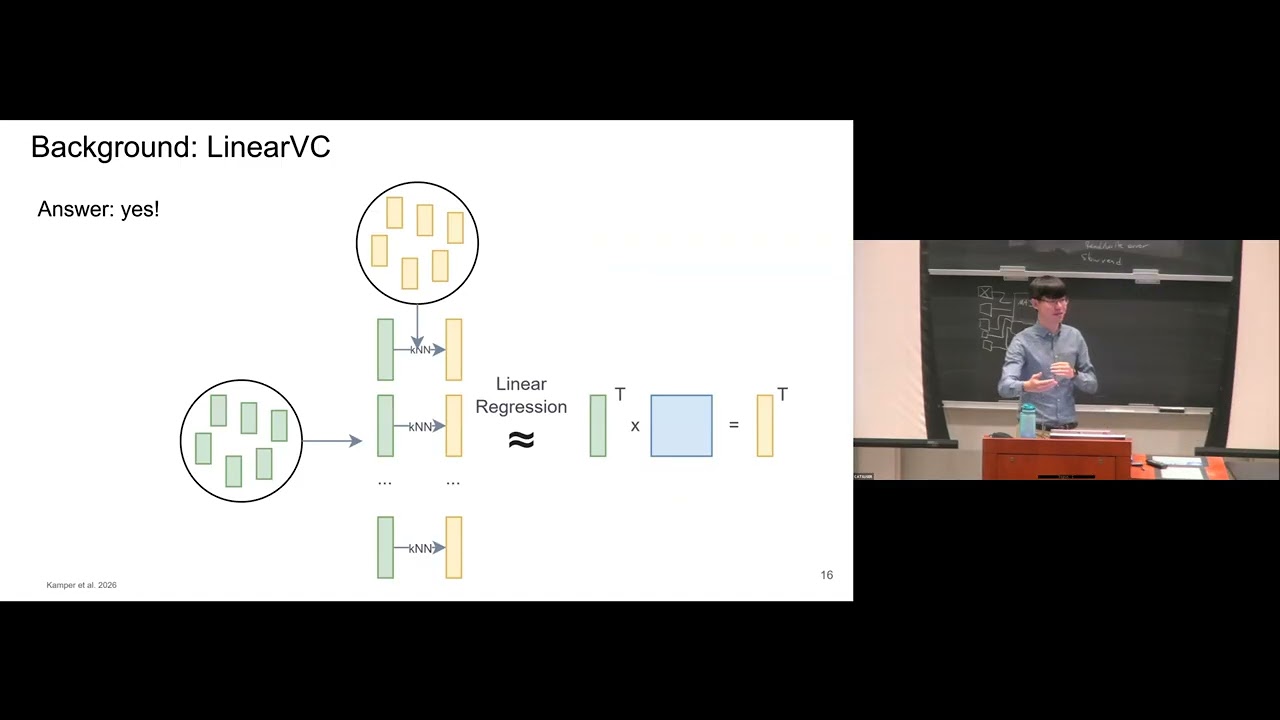
- KNN-based voice conversion and linear regression between speakers.
- Introduction of SVD for content factorization.
- Low-rank approximation and content basis vectors.
- Optimization problem for universal speech-to-content mapping.
- Content-to-speech mapping for unseen speakers.
- Audio demonstrations and human evaluation results.
- Discussion of limitations and future work (TTS application).
Contribution & Novelties
The talk introduces USCF, a novel linear method for universal speech content factorization that enables zero-shot voice conversion with minimal target data. It extends prior closed-set methods to open-set scenarios and demonstrates competitive performance compared to neural baselines. The approach is training-efficient and offers a potential alternative acoustic representation for TTS.
Pour aller plus loin :
- WaveLM: A self-supervised speech model — Relevant to the underlying SSL model used.
- Speech Content Factorization — Note: URL uncertain, but concept is directly related.
- Singular Value Decomposition — Mathematical foundation of the method.
- Zero-shot voice conversion — Note: URL uncertain, but concept is directly related.
102 words
Radar Profile
The radar profile shows high scores in technical level and information quality, indicating a technically dense and informative presentation. The lower score in information quantity suggests the talk is focused and concise, while the high reliability score reflects the method's solid mathematical foundation and empirical validation.