CLSP Summer Program: Plenary Speaker
Keywords
Summary
249 words
Critical Evaluation
Value of the Information & Strength of the Argument
The talk provides valuable insights into the practical challenges of biosecurity, particularly the intersection with AI. The speaker’s argumentation is solid, grounded in real-world examples and his direct experience. He effectively illustrates the difficulty of screening DNA orders, the evolving threat landscape, and the cultural clash between cybersecurity and biodefense. He also raises important questions about the role of AI in both exacerbating and mitigating risks. The talk is persuasive and well-structured, though it is more of an expert opinion than a rigorous scientific presentation.
Scientific Rigor, Source Quality, Title Accuracy
The speaker demonstrates rigor by referencing specific incidents (e.g., the 2023 ricin test) and organizations (e.g., Secure Bio). However, he does not provide formal citations or references, and some claims are anecdotal. The title is generic, but the content is focused and relevant. The talk is not peer-reviewed, but it is given by a recognized expert in the field.
159 words
Title / Content Match
The title is generic ('Plenary Speaker'), but the content is a focused expert talk on biosecurity and AI, which is appropriate for a summer program plenary.
Quality & Reliability
8/10
The speaker is a leading expert in biosecurity and nucleic acid screening, with direct involvement in the field. The talk is grounded in practical experience and references real incidents (e.g., the 2023 ricin test). However, it is an opinion/expert talk rather than a peer-reviewed presentation, and some claims are anecdotal.
Key Moments
Markers derived by PSI from the transcript: the creator did not define chapters.
- Introduction and housekeeping announcements about schedule and crab feast.
- Introduction of speaker by Eva, highlighting his background and achievements.
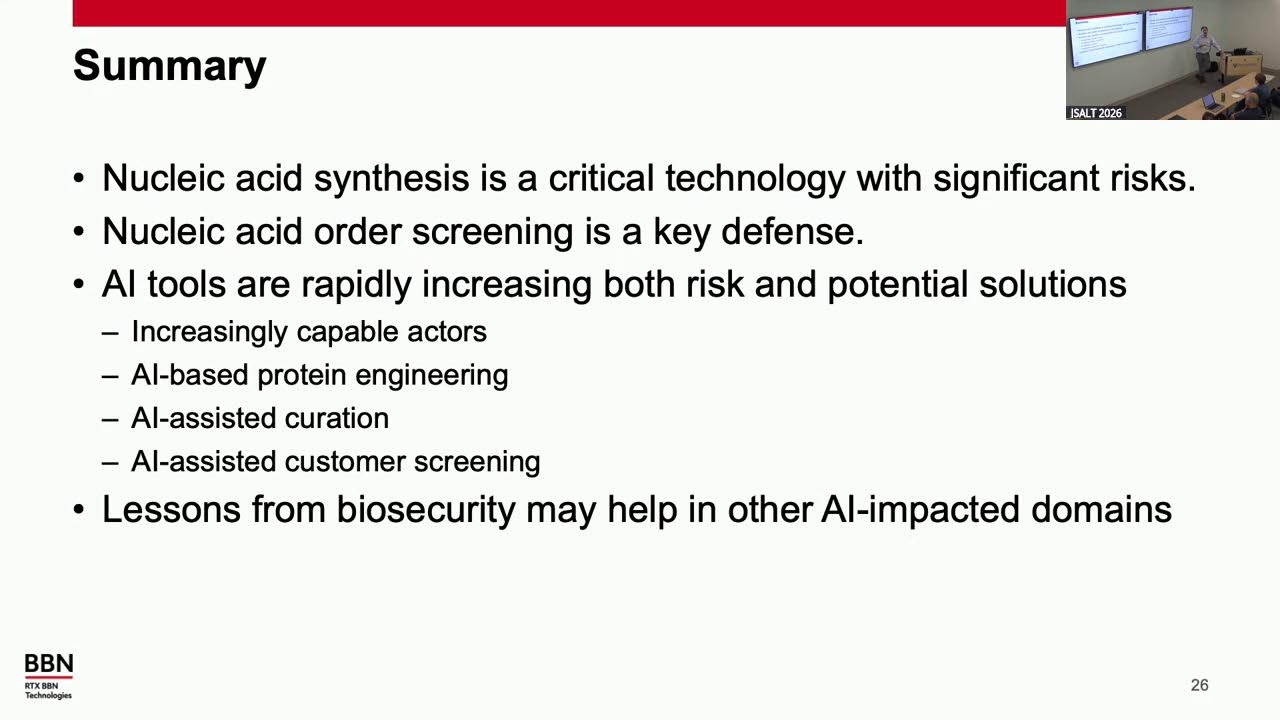
- Speaker begins talk on biosecurity and AI, explaining the importance of DNA screening.
- Discussion of the bioeconomy and the role of engineered nucleic acids.
- Explanation of nucleic acid order screening and its challenges.
- Example of Ebola virus taxonomy change and difficulty in screening.
- Discussion of AI-designed proteins and the 2023 ricin test incident.
- Comparison of cybersecurity and biodefense cultures.
- Impact of AI on lowering expertise barriers and increasing potential actors.
- Discussion of AI in risk assessment and the need for measurement and standards.
Cited Sources
- Secure Bio — Mentioned as an organization conducting evaluations of AI systems for biosecurity risks.
- NCBI — Referenced as the database where Ebola virus sequences are stored, but with taxonomy issues.
- International Gene Synthesis Consortium — Mentioned as an effort to establish international standards for screening.
Concurring Sources
- Secure Bio — The speaker's claims about AI capabilities in biology align with Secure Bio's published evaluations.
Contribution & Novelties
The talk provides an expert perspective on the evolving challenges of biosecurity in the age of AI, highlighting the need for adaptive screening tools and international standards. It offers a unique insider view of the 2023 ricin test incident and the cultural clash between cybersecurity and biodefense.
Pour aller plus loin :
- AI and Biosecurity: A Review — A review of AI applications in biosecurity.
- Synthetic Biology and Biosecurity — A report on the implications of synthetic biology for biosecurity.
- The Biosecurity Threat of AI — A RAND perspective on AI-related biosecurity threats.
93 words
Radar Profile
The radar profile shows high scores in information quantity, quality, and technical level, indicating a dense and expert-level talk. The reliability score is also high, reflecting the speaker's authority and the use of real-world examples. The overall profile suggests a highly informative and credible presentation.
💬 No comments were provided for analysis.