CLSP Summer Program: Plenary Speaker
Keywords
Summary
178 words
Critical Evaluation
Value of the Information & Strength of the Argument
The talk provides valuable insights into the design and training of large audio language models, drawing on the speaker’s extensive experience. The argumentation is coherent, presenting a clear progression from problem statement to proposed solutions. Duraiswami effectively justifies the need for general audio understanding beyond speech, and the curriculum training approach is well-explained. However, the argumentation is largely based on the speaker’s own work, with limited critical evaluation of alternative methods. The claims about model performance are supported by benchmark results, but the talk lacks a detailed comparison with other approaches beyond mentioning Gemini’s superiority. Overall, the information is valuable for researchers in the field, but the argumentation could be strengthened by more independent validation.
Scientific Rigor, Source Quality, Title Accuracy
The talk demonstrates scientific rigor through the presentation of specific models, benchmarks, and training details. The speaker cites numerous papers and models from his lab, and the open-source nature of the work allows for verification. However, the talk does not provide explicit references to external sources, and the claims are primarily based on the speaker’s own research. The title ‘CLSP Summer Program: Plenary Speaker’ is generic but accurately reflects the content. The talk is well-structured and the speaker’s expertise is evident, but the lack of external citations and the focus on personal work slightly reduce the overall rigor.
228 words
Title / Content Match
The title is generic but accurately reflects the content: a plenary lecture at the CLSP Summer Program.
Quality & Reliability
8/10
The speaker is a recognized expert with extensive publications and industry experience. The talk presents a coherent overview of their research, but it is largely a narrative of their own work with limited critical comparison to other approaches. Some claims are anecdotal, but overall the information is credible and well-grounded in the speaker's expertise.
Key Moments
Markers derived by PSI from the transcript: the creator did not define chapters.
- Introduction and announcements about schedule and upcoming speakers.
- Speaker introduction by David, highlighting Ramani Duraiswami's affiliations and achievements.
- Discussion on the promise of large language models for audio understanding and the concept of post-training.
- Overview of the Audio Flamingo family of models and their capabilities.
- Explanation of curriculum training and the progressive fine-tuning approach.
- Discussion on diarization challenges and the development of Audio Flamingo Next.
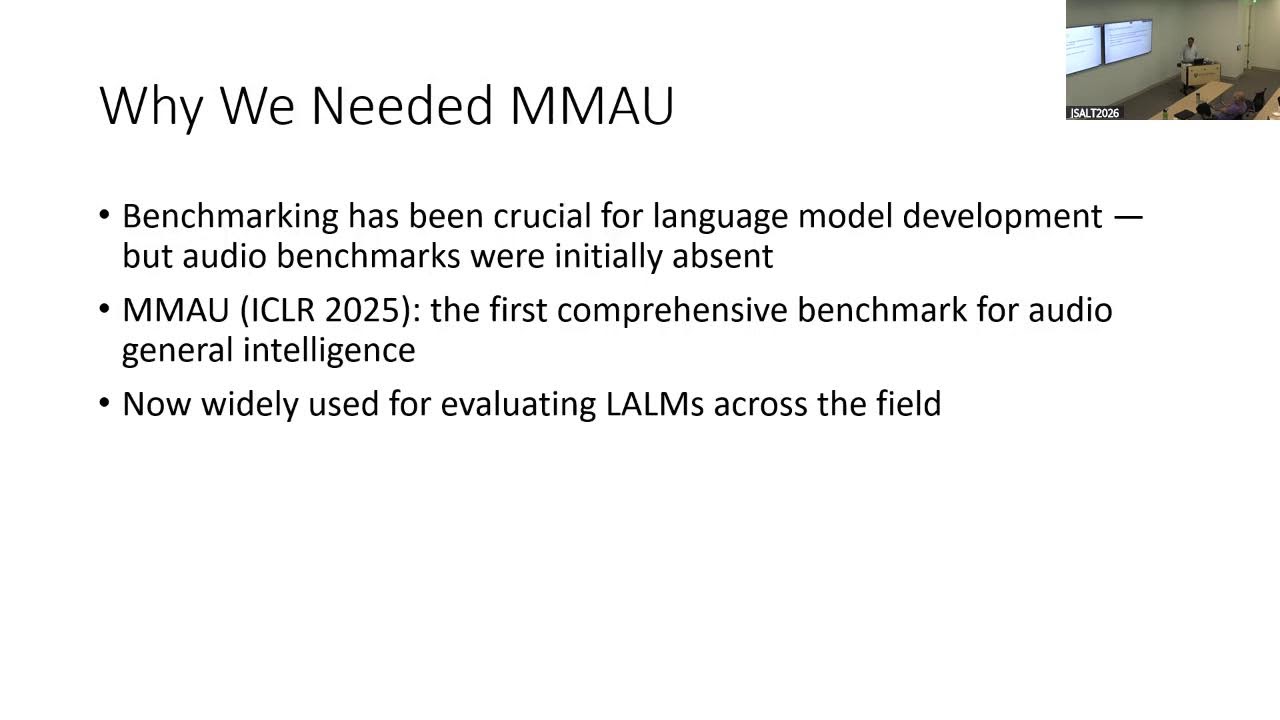
- Presentation of benchmark results and comparison with other models.
- Q&A session addressing questions about music understanding and model limitations.
- Discussion on future directions, including multi-microphone processing and auditory general intelligence.
Cited Sources
- Audio Flamingo 3 — Mentioned as a model developed by the speaker's lab in collaboration with NVIDIA.
- MMAU Pro — Benchmark developed by the speaker's team, used in the CLSP Summer Program.
- Whisper — Mentioned as a specialized speech recognition model used as a base for their encoder.
Concurring Sources
- Audio Flamingo 3 — The model is open-source and has been widely downloaded, indicating community acceptance.
- MMAU Pro — The benchmark is used in the CLSP Summer Program, suggesting its relevance.
Contribution & Novelties
The talk presents the Audio Flamingo family of models, which are open-source large audio language models that integrate speech, music, and general audio understanding. The curriculum training approach is a notable contribution, allowing for progressive fine-tuning and improved performance. The models are state-of-the-art among open-source alternatives, and the benchmarks (MMAU, MMAU Pro) provide standardized evaluation. The talk also highlights the challenge of diarization and the development of Audio Flamingo Next to address it.
Pour aller plus loin :
- Large language model — Background on LLMs.
- Transformer (machine learning) — The architecture underlying these models.
- Speech recognition — Context for the specialized tools mentioned.
103 words
Radar Profile
The radar profile shows high scores in quantity and quality of information, with a slightly lower technical level, indicating that the talk is informative and credible but may require some background knowledge. The overall reliability is high, reflecting the speaker's expertise.
💬 No comments were provided for analysis.