Andrew Gelman: Hierarchical modeling and prior information: an example from toxicology
Keywords
Summary
199 words
Critical Evaluation
Value of the Information & Strength of the Argument
The value of the information is high: it provides a concrete, real-world example of Bayesian hierarchical modeling solving a problem that other methods cannot. The argumentation is solid, as Gelman systematically explains why each alternative approach fails, and then demonstrates how the Bayesian approach succeeds. He also discusses the importance of prior information and model checking, which are often underappreciated. The talk is persuasive and well-structured, though it is an informal seminar rather than a rigorous paper.
Scientific Rigor, Source Quality, Title Accuracy
The scientific rigor is good: the methods are standard and the reasoning is transparent. However, the talk does not provide detailed citations to the literature, and the sources are not explicitly listed. The title accurately reflects the content. The talk is based on a published study from 1993, but the details are not given. The lack of explicit sources is a minor weakness, but the overall rigor is acceptable for a seminar.
164 words
Title / Content Match
The title accurately reflects the content: a demonstration of hierarchical modeling and prior information in a toxicology example.
Quality & Reliability
8/10
The talk is by a renowned statistician, Andrew Gelman, presenting a well-documented case study from his own research. The methods are standard and the reasoning is transparent, though the presentation is informal and lacks detailed citations.
Key Moments
Markers derived by PSI from the transcript: the creator did not define chapters.
- Introduction and discussion of ethics in statistics
- Motivation for the talk: demonstrating Bayesian inference with an example
- Background on perchloroethylene and the study design
- Description of the four-compartment model and its parameters
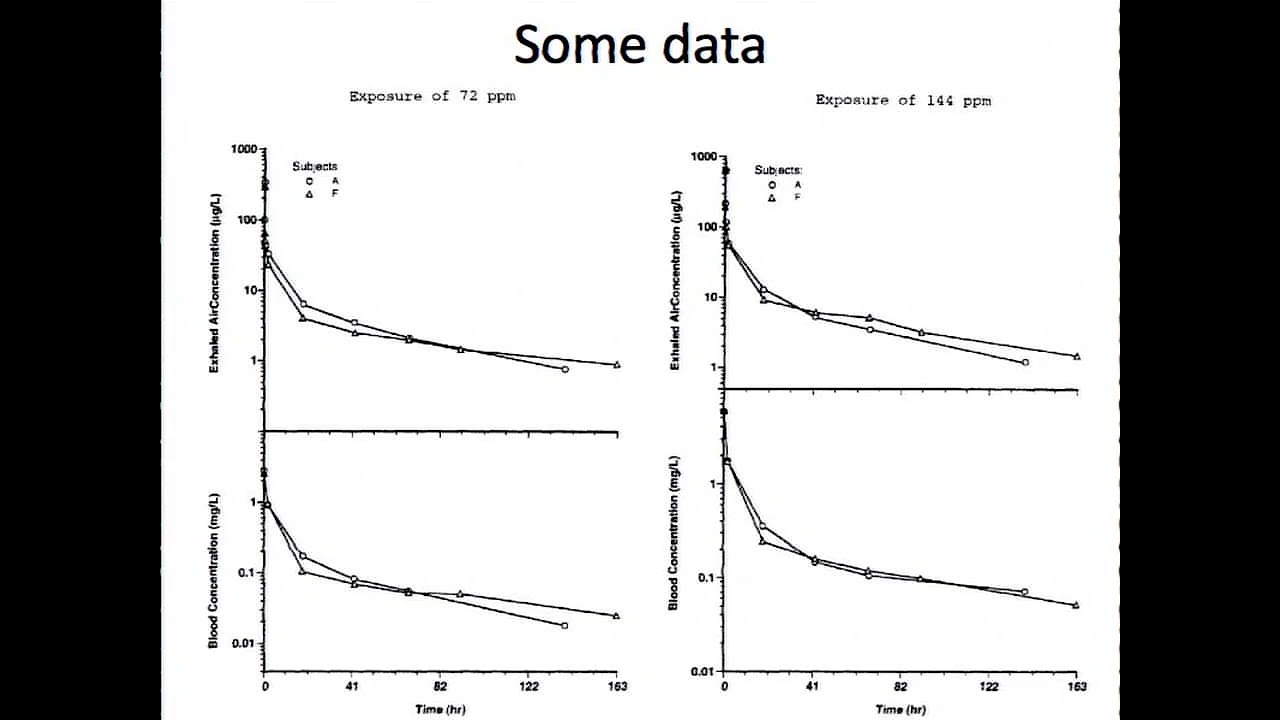
- Data presentation and the need for a hierarchical model
- Why direct fitting, assisted model fit, and simpler models fail
- The role of prior information and the Bayesian approach
- Posterior simulation and the Metropolis algorithm
- Model checking and the responsibility of Bayesian inference
- Conclusion and discussion of implications
Cited Sources
- CLSP Seminar page — The seminar announcement page for this talk, which may contain additional information.
Concurring Sources
- Bayesian Data Analysis — Andrew Gelman's textbook on Bayesian data analysis, which covers hierarchical modeling and prior information.
Contribution & Novelties
The talk provides a clear, accessible example of how Bayesian hierarchical modeling can incorporate prior information to solve a complex problem in toxicology. It demonstrates the practical value of Bayesian methods beyond simple regularization, and highlights the importance of model checking. The example is from the speaker’s own research, adding authenticity.
Pour aller plus loin :
- Bayesian inference — Overview of Bayesian methods.
- Hierarchical Bayesian model — Explanation of hierarchical models.
- Physiologically based pharmacokinetic modeling — Context for the compartmental model used.
- Metropolis–Hastings algorithm — The algorithm used for posterior sampling.
91 words
Radar Profile
The radar profile shows high scores in quality of information and global reliability, with moderate scores in quantity and technical level. This indicates a talk that is scientifically sound but not extremely dense or highly technical, suitable for a general scientific audience.
💬 No comments were provided for analysis.