Efficient Finetuning of Large Language Models via Large-Width Analysis
Keywords
Summary
176 words
Critical Evaluation
Value of the Information & Strength of the Argument
The talk provides valuable insights into the theoretical underpinnings of LoRA finetuning, offering practical guidance for hyperparameter selection. The argumentation is solid, based on mathematical derivations and supported by empirical experiments. The speaker clearly explains the conditions for stability and feature learning, and shows how these lead to specific scaling laws. The presentation is well-structured, with a clear progression from general principles to specific results. The inclusion of empirical validation strengthens the credibility of the theoretical claims. However, some results are conjectural, and the speaker acknowledges limitations, such as the lack of a theoretical explanation for why initialization B often performs better. Overall, the value is high for researchers and practitioners interested in efficient finetuning.
Scientific Rigor, Source Quality, Title Accuracy
The talk is scientifically rigorous, with a clear theoretical framework and empirical validation. The speaker cites relevant work, including the Llama paper and LoRA, and mentions collaborations with other researchers. The title accurately reflects the content, focusing on large-width analysis for efficient finetuning. The presentation is well-organized, with clear definitions and derivations. The speaker also engages with audience questions, clarifying technical points. The sources cited are appropriate and credible, though the talk does not provide a comprehensive literature review. Overall, the scientific quality is high, and the title-content alignment is strong.
221 words
Title / Content Match
The title accurately reflects the content, which focuses on theoretical analysis of large-width models to guide efficient finetuning.
Quality & Reliability
8/10
The talk is given by an expert researcher (Soufiane Hayou) and presents theoretical results with practical implications. The claims are supported by mathematical derivations and empirical experiments, though some results are conjectural. The presentation is rigorous and well-structured.
Key Moments
Markers derived by PSI from the transcript: the creator did not define chapters.
- Introduction to the talk and motivation for efficient finetuning.
- Explanation of the three components of model training: architecture, data, and algorithm.
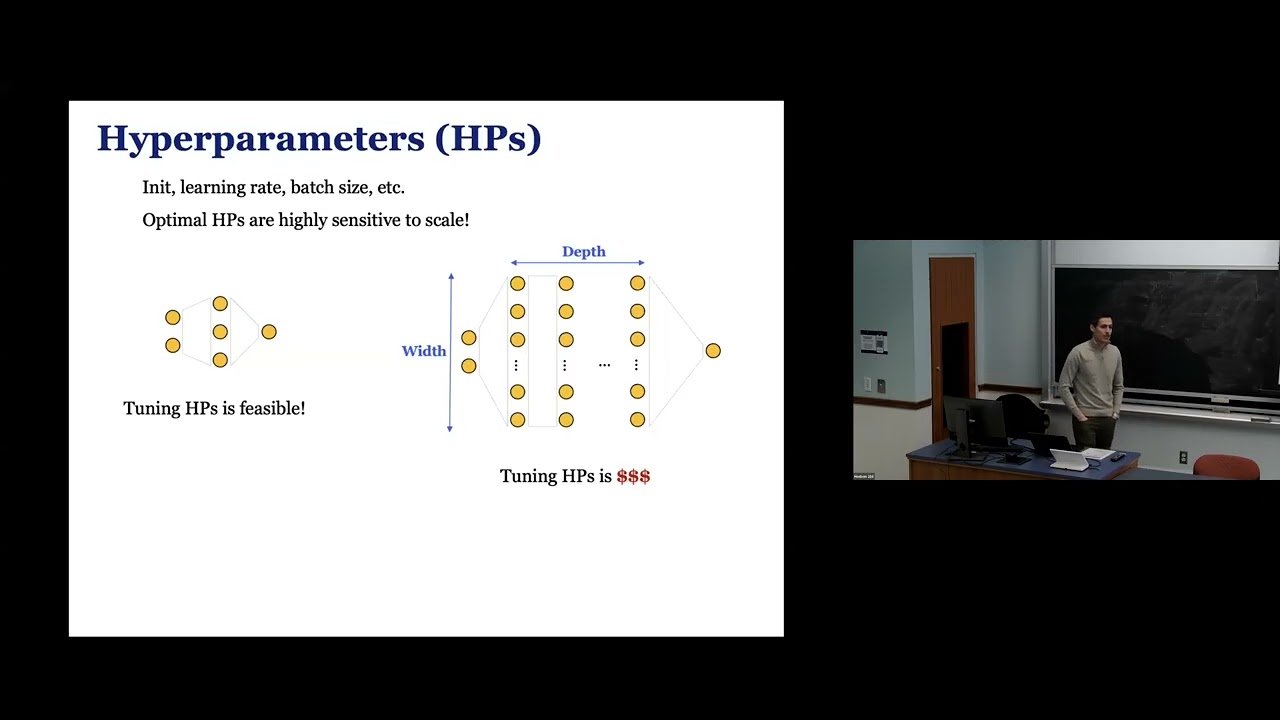
- Discussion on hyperparameter sensitivity to scale and the need for theoretical guidance.
- Introduction to the conditions of stability and feature learning.
- Example of a two-layer MLP showing how initialization scales with width.
- Introduction to LoRA and its parameter efficiency.
- Comparison of two LoRA initializations and theoretical scaling laws for learning rate.
- Empirical results on RoBERTa showing the predicted scaling behavior.
- Theoretical intuition behind the scaling laws, with derivations.
- Discussion of limitations and open questions.
Cited Sources
- Llama paper — Referenced for scaling laws of LLMs.
- LoRA paper — Referenced for low-rank adaptation method.
Concurring Sources
- LoRA paper — Supports the use of low-rank adaptation for efficient finetuning.
Contribution & Novelties
The talk provides a novel theoretical framework for understanding LoRA finetuning, offering practical scaling laws for hyperparameters. It bridges the gap between theory and practice, giving actionable insights for practitioners. The results are original and have implications for efficient finetuning of large models.
Pour aller plus loin :
- LoRA: Low-Rank Adaptation of Large Language Models — The original LoRA paper.
- Scaling Laws for Neural Language Models — Foundational work on scaling laws.
- On the Convergence of Adam and Beyond — Theoretical analysis of Adam optimizer.
85 words
Radar Profile
The radar profile shows high scores in technical level and information quality, reflecting the theoretical depth and empirical validation. The quantity of information is moderate, as the talk focuses on specific results rather than a broad overview. The overall reliability is high, given the speaker's expertise and the rigorous methodology.