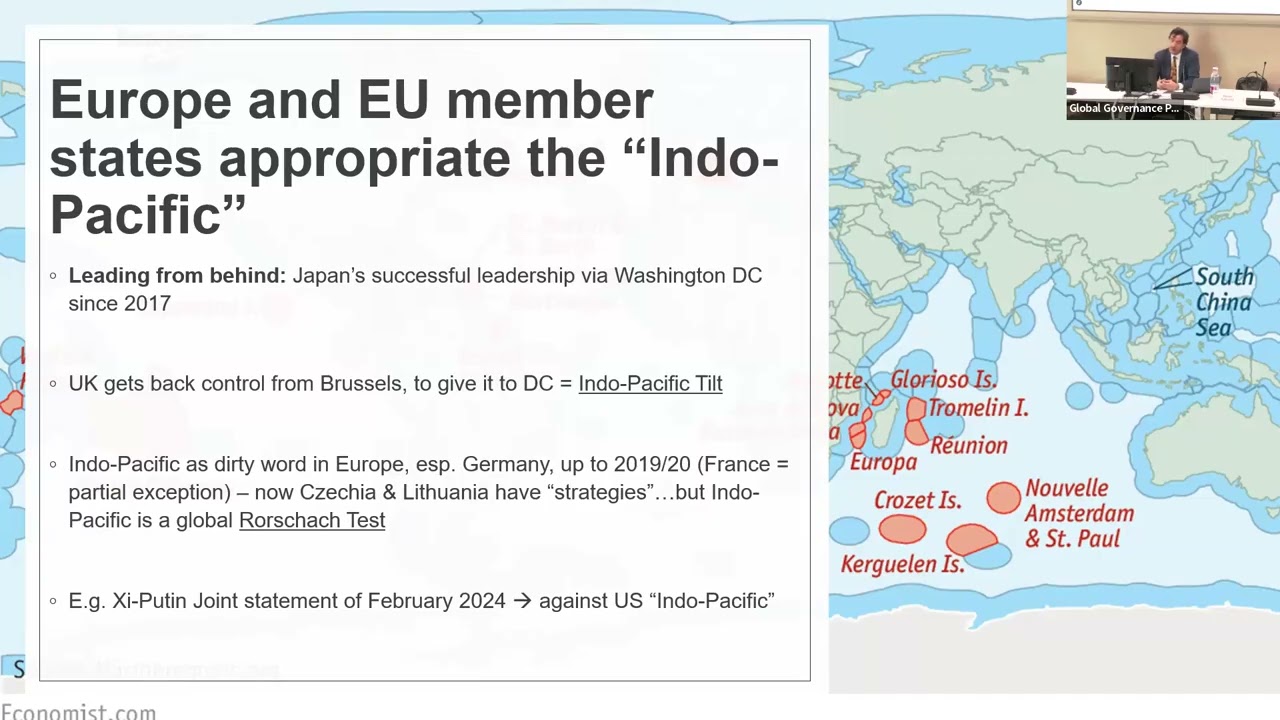
How indivisible are Euro-Atlantic and Indo-Pacific security?
Keywords
Summary
232 words
Critical Evaluation
Value of the Information & Strength of the Argument
The video provides valuable insights into the complex dynamics of Euro-Atlantic and Indo-Pacific security. The first speaker offers a nuanced analysis of European motivations, moving beyond simple US pressure to include economic interests and a desire for strategic autonomy. The argumentation is well-structured, drawing on recent research and historical context. The second speaker brings a fresh perspective by focusing on the Arctic as a nexus of Russian-Chinese cooperation, effectively linking it to the broader Indo-Pacific strategy. The argumentation is persuasive, highlighting the often-overlooked strategic importance of the Arctic. However, the discussion is largely opinion-based, with limited empirical evidence or citations. The panelists’ expertise lends credibility, but the lack of formal sources and the informal nature of the workshop reduce the overall rigor.
Scientific Rigor, Source Quality, Title Accuracy
The video is a workshop discussion, not a formal academic presentation. The speakers reference their own research and general knowledge but do not provide specific citations or sources. The title accurately reflects the content, which directly addresses the question of security indivisibility. The discussion is well-organized and stays on topic. However, the lack of verifiable sources and the reliance on expert opinion rather than empirical data limit the scientific rigor. The video would benefit from references to specific reports, articles, or official documents to support the claims made.
225 words
Title / Content Match
The title accurately reflects the central question of the workshop, which is thoroughly addressed by the panelists.
Quality & Reliability
7/10
The video features expert panelists from academic and policy backgrounds, providing informed analysis. However, it is a discussion/opinion format without formal citations or peer-reviewed sources, and the transcription contains some informal remarks and potential inaccuracies (e.g., 'Max Deber' likely 'Max Weber').
Key Moments
Markers derived by PSI from the transcript: the creator did not define chapters.
- Introduction by Jennifer Hendrickson White, outlining the workshop's focus and introducing the first speaker.
- First speaker begins discussing European drivers for Indo-Pacific engagement, including France's interests and US pressure.
- Discussion of the 'third way' approach and the role of multilateralism in European strategy.
- Analysis of the impact of Russia's invasion of Ukraine on European alignment with the US and the strategic analogy with Taiwan.
- Examination of the Indo-Pacific concept's origins, including Japan's role and varying European definitions.
- Discussion of concrete deliverables at NATO and EU level, including IP4 partnerships and defense industrial cooperation.
- Conclusion of first speaker, identifying obstacles to cooperation and the impact of the new US administration.
- Second speaker, Lisa Lotto Odgard, begins her presentation on the Arctic, arguing that Russia and China are merging the regions.
- Details on Russia's militarization of the Arctic since 2014 and its economic importance.
- Discussion of China's role as a partner in the Arctic, including dual-use capabilities and independent operations.
- Warning about the complex nuclear threat from Russia and the lack of investment in Arctic defense, urging NATO to respond.
Contribution & Novelties
The video offers a timely and insightful analysis of the interconnectedness between Euro-Atlantic and Indo-Pacific security, particularly highlighting the Arctic as a bridge between the two regions. It provides a nuanced view of European motivations, moving beyond simple US pressure to include economic and strategic factors. The discussion of the Arctic’s role in merging the two theaters is a valuable contribution to the discourse.
Pour aller plus loin :
- Indo-Pacific Strategy — Provides background on the concept and its geopolitical implications.
- Arctic Policy of China — Explains China’s interests and activities in the Arctic.
- NATO and the Indo-Pacific — Official NATO page on its engagement with Indo-Pacific partners.
108 words
Radar Profile
The radar profile shows high scores in quantity of information and fiabilité, reflecting the depth of discussion and the expertise of the speakers. The moderate score in niveau technique indicates that while the content is accessible, it still engages with complex geopolitical concepts. Overall, the video is a solid resource for understanding the topic.