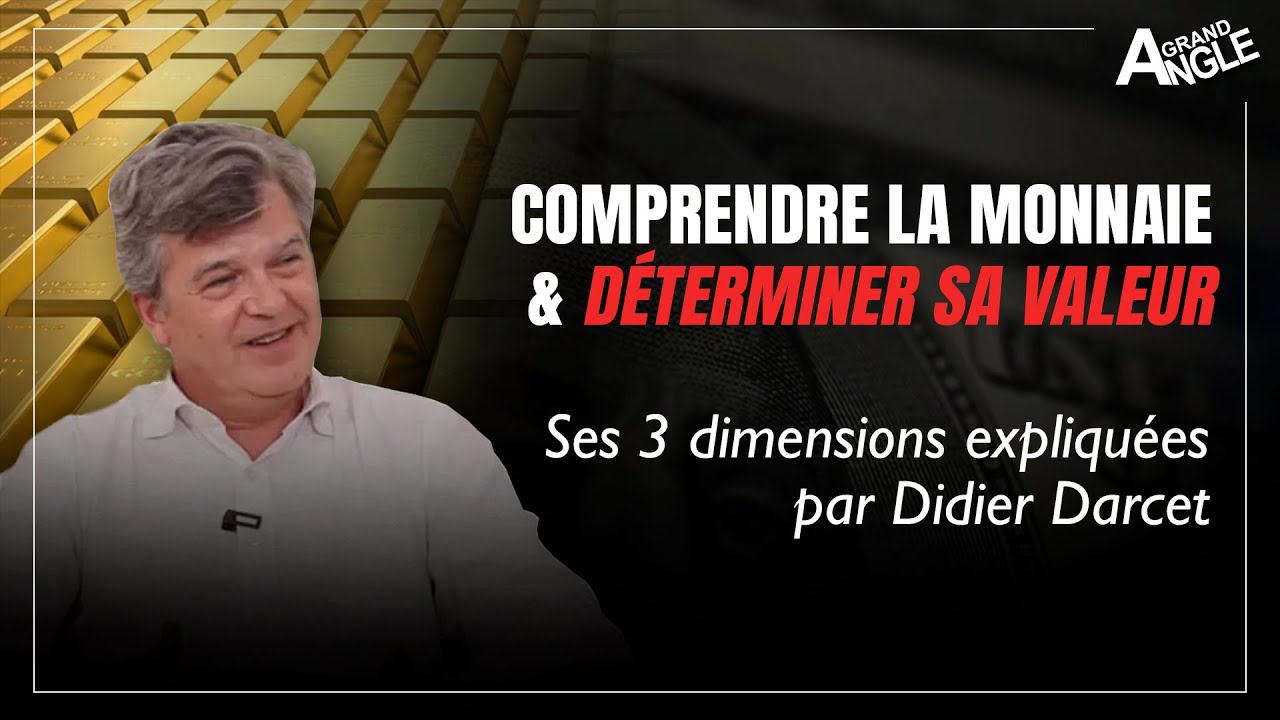
Comprendre la monnaie et déterminer sa valeur. Ses 3 dimensions expliquées par Didier Darcet
Keywords
Summary
155 words
Critical Evaluation
Value of the Information & Strength of the Argument
The video provides valuable insights into the nature of money, challenging conventional wisdom by emphasizing the multidimensionality of monetary functions. Darcet’s argument is well-structured, using historical data and analogies to illustrate his points. He effectively demonstrates that gold has maintained its purchasing power over centuries, and he introduces a novel perspective by linking money to energy. The argumentation is persuasive, though it relies heavily on the speaker’s own research and interpretations, which may not be universally accepted. The discussion of 7-year cycles is intriguing but lacks rigorous statistical evidence, making it more of a hypothesis than a proven theory.
Scientific Rigor, Source Quality, Title Accuracy
The video references an article by Didier Darcet published on Gavekal’s website, which is a reputable source in the financial industry. However, the video does not cite academic or peer-reviewed sources, and the analysis is based on the author’s own data and interpretations. The title accurately reflects the content, focusing on the three dimensions of money and how to assess its value. The video is well-produced and the arguments are presented clearly, but the lack of external validation and the reliance on a single source reduce its scientific rigor.
203 words
Title / Content Match
The title accurately reflects the content, which focuses on explaining the three dimensions of money and how to assess its value, with a strong emphasis on gold as a benchmark.
Quality & Reliability
7/10
The video presents a coherent framework for understanding money through three dimensions, supported by historical data and references to economic theory. However, the analysis is largely based on the speaker's own research and interpretations, with limited peer-reviewed sources, and some claims (e.g., 7-year cycles) are presented without rigorous statistical backing.
Key Moments
Markers derived by PSI from the transcript: the creator did not define chapters.
- Introduction to the three functions of money and the challenge of comparing them.
- Discussion on the historical role of gold and silver as money.
- Presentation of data showing gold's stability as a store of value over 500 years.
- Exploration of the relationship between money and energy, using oil as a proxy.
- Analysis of long-term cycles in the relative value of money, gold, and energy.
- Discussion on the implications of current low energy prices for future monetary trends.
- Conclusion on the dangers of fiat money and the importance of understanding monetary value.
Cited Sources
- Money, Money, Money (French version) — Article by Didier Darcet that forms the basis of the discussion.
Concurring Sources
- Money, Money, Money (French version) — The article by Didier Darcet that the video is based on, providing the data and analysis.
Dissenting Sources
- Bitcoin and the blockchain — The video does not address cryptocurrencies, which some viewers consider relevant to the discussion of money's value.
Contribution & Novelties
The video offers a fresh perspective on the nature of money by integrating its three functions into a multidimensional framework. It provides empirical evidence for gold’s role as a stable store of value over centuries and introduces the concept of energy as a fundamental basis for monetary value. The analysis of long-term cycles in the relative value of money, gold, and energy is a novel contribution, though it remains speculative.
Pour aller plus loin :
- Gold standard — Historical context on gold as a monetary standard.
- Quantity theory of money — Theoretical framework linking money supply to price levels.
- Energy economics — Study of energy as a factor in economic value.
111 words
Radar Profile
The radar profile shows high scores in quantity of information and technical level, indicating a content-rich video with a moderate level of complexity. The quality of information and reliability are slightly lower, reflecting the reliance on a single source and the speculative nature of some claims.
💬 Positive. Sur les 30 commentaires analysés, la majorité exprime une appréciation pour la qualité didactique et la profondeur du contenu, avec quelques critiques sur le rythme et le manque de discussion sur les cryptomonnaies.