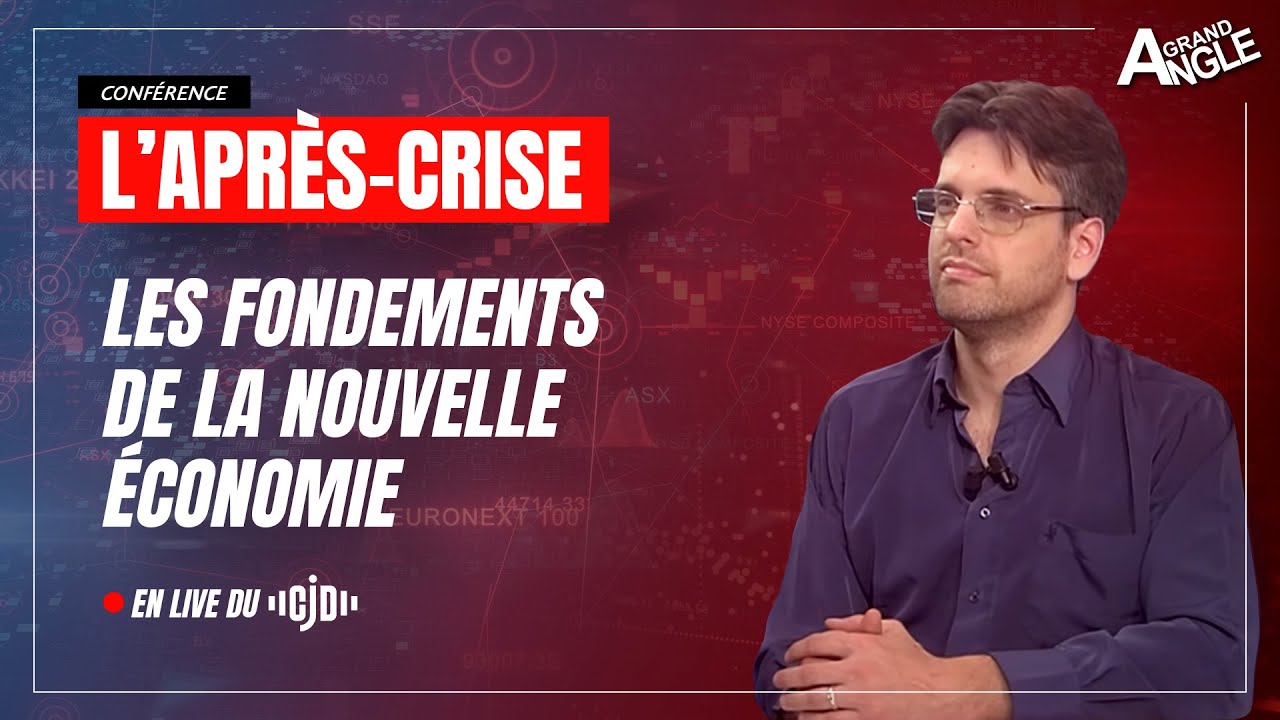
L'après-crise : à quoi va ressembler le monde économique de demain ?
Keywords
Summary
132 words
Critical Evaluation
Value of the Information & Strength of the Argument
The presentation offers a compelling and accessible synthesis of complex economic ideas, using historical analogies and clear metaphors to explain cycles and policy failures. The argumentation is structured and persuasive, though it relies heavily on the speaker’s interpretation and selected examples. The speaker’s passion and clear communication style enhance the value, but the lack of rigorous empirical evidence and the presence of a notable factual error (ASEAN vs. RCEP) weaken the overall argumentative solidity.
Scientific Rigor, Source Quality, Title Accuracy
The speaker references several thinkers and studies (Ibn Khaldun, Ray Dalio, Knut Wicksell, Maurice Allais, Gavekal) but does not provide systematic citations or URLs. The title accurately reflects the content, and the video is a well-structured conference. However, the reliance on personal interpretation and the absence of verifiable sources limit the scientific rigor. The speaker’s correction in the comments about the ASEAN/RCEP error shows some accountability, but it highlights a lapse in factual accuracy.
163 words
Title / Content Match
The title accurately reflects the content, which focuses on the post-crisis economic outlook and the structural challenges facing Western economies.
Quality & Reliability
7/10
The speaker presents a coherent and well-illustrated thesis on economic cycles and the decline of Western economies, drawing on historical and contemporary examples. However, the analysis is largely opinion-based, with some factual errors (e.g., confusing ASEAN with the RCEP) and a lack of systematic citation of sources.
Key Moments
Markers derived by PSI from the transcript: the creator did not define chapters.
- Introduction: the theme of the conference and the metaphor of Ibn Khaldun on cycles.
- Presentation of Ray Dalio's model of the rise and fall of empires, with charts on US GDP and debt.
- Explanation of the role of education, military power, and currency in the cycle.
- Discussion of 'false prices' as a response to decline, focusing on inflation and interest rates.
- Critique of low interest rates and their impact on asset bubbles and the zombification of the economy.
- Analysis of the euro as a political creation that distorts exchange rates and harms Southern Europe.
- Discussion of the need for innovation and a 'revolutionary mindset' to face the future.
Cited Sources
- Ray Dalio - Principles for Dealing with the Changing World Order — Referenced as the source of the model on the rise and fall of empires and economic cycles.
- Ibn Khaldun - Muqaddimah — Referenced for the metaphor on cycles of strength and weakness in civilizations.
- Gavekal Research — Referenced for studies on the cost of the euro and the relationship between gold and monetary policy.
Concurring Sources
- Ray Dalio - Principles for Dealing with the Changing World Order — Supports the cyclical view of economic and political power.
- Ibn Khaldun - Muqaddimah — Historical basis for the idea of cyclical decline.
Dissenting Sources
- Mainstream economic consensus on the euro — Many economists argue that the euro has brought benefits such as price stability and reduced transaction costs, contrary to the speaker's critical view.
Contribution & Novelties
The video provides a clear and engaging synthesis of economic cycle theories, applying them to the current post-COVID context. It offers a critical perspective on monetary policy and the euro, encouraging viewers to question mainstream economic narratives. The speaker’s ability to connect historical patterns with contemporary issues is a valuable contribution to public understanding.
Pour aller plus loin :
- Ray Dalio’s ‘Principles for Dealing with the Changing World Order’ — A comprehensive framework for understanding economic and political cycles.
- Ibn Khaldun’s ‘Muqaddimah’ — The original source of the cyclical theory of history.
- Knut Wicksell’s ‘Interest and Prices’ — A foundational work on the relationship between interest rates and price levels.
110 words
Radar Profile
The radar profile shows high scores in information quantity and technical level, reflecting the dense and detailed nature of the talk. The lower score in reliability is due to the lack of systematic citations and the presence of a factual error. Overall, the video is informative and thought-provoking but should be consumed with a critical eye.
💬 Très positif. Sur les 30 commentaires analysés, les spectateurs expriment une admiration unanime pour la clarté, la pédagogie et la profondeur de l'analyse, saluant la qualité du contenu et la générosité de l'auteur.