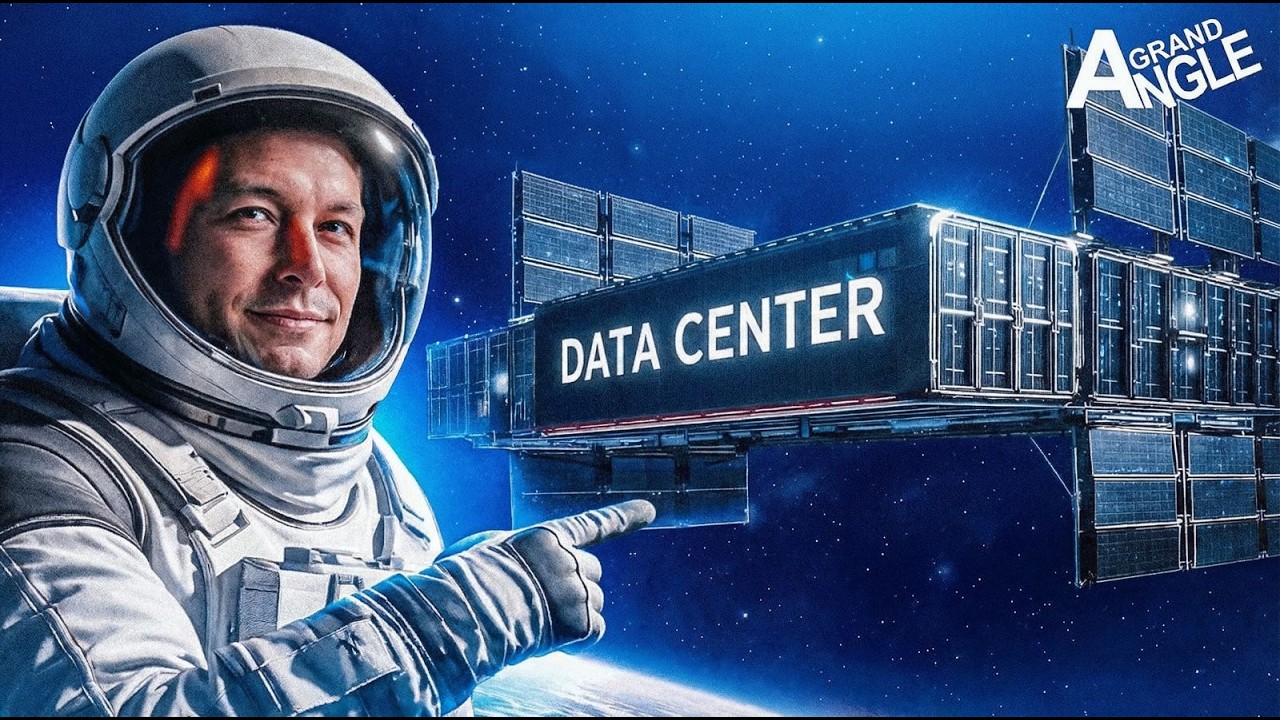
Pourquoi Elon Musk veut mettre des Data Centers DANS L'ESPACE ?
Keywords
Summary
184 words
Critical Evaluation
The video provides a well-structured and engaging analysis of a speculative but timely topic. The presenter demonstrates a clear understanding of the energy and space industries, using concrete figures to illustrate the scale of the challenges. The argumentation is logical: it starts with the energy bottleneck, moves to the US-China competition, and then systematically addresses the technical and economic hurdles of space-based data centers. The use of comparative data (e.g., solar capacity additions, launch costs) strengthens the credibility of the analysis. However, the video relies heavily on estimates and projections, such as the 200 $/kg launch cost for Starship, which is not yet achieved, and the weight estimates for a 1 GW data center, which vary significantly across AI models. The presenter acknowledges these uncertainties but does not always provide clear sources for the figures, which limits the verifiability. The discussion of radiative cooling is technically accurate, but the presenter simplifies some aspects, such as the efficiency of solar panels in space, which could be higher than 20% with advanced technology. The video also touches on geopolitical implications, but these are not deeply explored. Overall, the content is informative and thought-provoking, but it should be viewed as an expert opinion rather than a rigorous scientific study. The title accurately reflects the content, and the video does not overpromise, concluding that the idea is not feasible in the near term but could be by 2035.
234 words
Title / Content Match
The title accurately reflects the content, which explores the motivations and feasibility of Musk's proposal.
Quality & Reliability
6/10
The video presents a reasoned analysis of the feasibility of space-based data centers, citing specific figures for energy capacity, launch costs, and technical challenges. However, it relies heavily on estimates and projections, and the sources are not always clearly identified or verifiable.
Key Moments
Markers derived by PSI from the transcript: the creator did not define chapters.
- Introduction: Musk's visionary track record and the announcement of space data centers.
- The energy bottleneck: global electricity shortage for data centers.
- US-China energy capacity comparison: China adds 250 GW solar vs US 40 GW.
- SpaceX's launch cost revolution: from $13,000/kg to potential $200/kg with Starship.
- Technical challenges: heliosynchronous orbit, solar panels, and radiative cooling.
- Scale calculations: 3 million m² of solar panels for 1 GW, weight estimates.
- Economic feasibility: $40 billion launch cost vs $10 billion terrestrial.
- Latency and communication issues, and final verdict: not 2027, but 2035 possible.
Cited Sources
- Grand Angle Éco Podcast — The channel's podcast platform, mentioned in the description as a source for further content.
Concurring Sources
- SpaceX official website — Provides information on Starship and Falcon Heavy capabilities and launch costs.
Dissenting Sources
- Critique of space data centers — Some experts argue that the latency and maintenance challenges make space data centers impractical compared to terrestrial solutions.
Contribution & Novelties
The video offers a comprehensive and accessible analysis of a speculative concept, synthesizing technical, economic, and geopolitical factors. It provides a clear framework for evaluating the feasibility of space-based data centers, including specific calculations of scale and cost. The discussion of radiative cooling and the comparison of launch costs are particularly insightful.
Pour aller plus loin :
- Space-based solar power — Relevant to the idea of generating energy in space.
- Radiative cooling — Explains the physics behind heat dissipation in vacuum.
- Heliosynchronous orbit — The orbital type mentioned for continuous sunlight.
91 words
Radar Profile
The radar profile shows high scores in quantity of information and technical level, but moderate scores in quality and reliability, reflecting the speculative nature of the topic and the reliance on estimates.
💬 Positif. Sur les 30 commentaires analysés, la majorité exprime un intérêt et une approbation pour l'analyse, avec quelques réserves techniques sur la latence et la faisabilité.