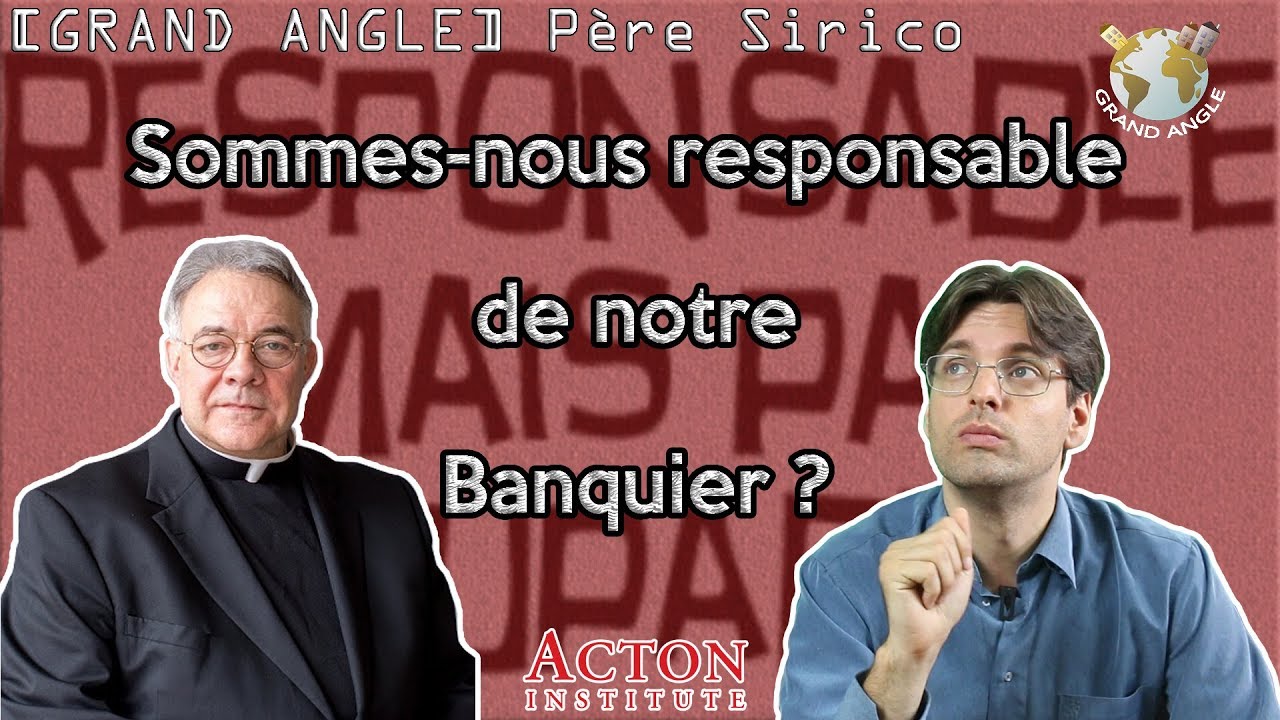
Sommes nous responsable de notre banquier ?
Keywords
Summary
197 words
Critical Evaluation
Value of the Information & Strength of the Argument
The video offers a clear and structured ethical framework for investors, based on the concept of ‘proximate moral responsibility’. The argument is built progressively, using a concrete example (the baker) to illustrate the abstract principle. The distinction between intrinsic evil and contextual responsibility is relevant and nuanced. The critique of the ’legal = moral’ equation is well-founded and invites deeper reflection. The discussion on the precautionary principle and intuition adds a practical dimension. However, the argumentation remains at the level of opinion and does not rely on empirical data or case studies, which limits its demonstrative power.
Scientific Rigor, Source Quality, Title Accuracy
The video is an interview with an expert, Father Robert Sirico, co-founder of the Acton Institute, which gives it a certain authority in the field of economic ethics. However, no specific sources are cited during the interview, and the description only mentions the book ‘Catholic and Liberal: The Moral Reasons for a Free Economy’. The title accurately reflects the content. The absence of citations and the lack of confrontation with other perspectives reduce the scientific rigor. The video is more of an opinion piece than a rigorous academic analysis.
201 words
Title / Content Match
The title accurately reflects the central question of the video, which is the moral responsibility of investors regarding the use of their money by financial intermediaries.
Quality & Reliability
7/10
The video is an interview with an economist/theologian, presenting a coherent ethical framework for investment. The reasoning is structured and illustrates concepts with examples, but the claims are not backed by empirical data or citations. The source is an opinion expert, which limits its scientific rigor.
Key Moments
Markers derived by PSI from the transcript: the creator did not define chapters.
- Introduction: the question of moral responsibility of investors and presentation of Father Sirico.
- First question: the complexity of the financial system and the difficulty of knowing how money is used.
- Father Sirico's response: complexity is often increased by regulation, but it does not remove moral responsibility.
- Introduction of the concept of 'proximate moral responsibility' in theology.
- The baker example: the more we frequent a business, the more we must question its practices.
- Application to investment: primary responsibility to avoid intrinsically evil investments, and growing responsibility with proximity and amount.
- Critique of the equation 'legal = moral' and of political correctness in ethical investment.
- Discussion on the precautionary principle and the importance of intuition and the 'little voice'.
Cited Sources
- Catholic and Liberal: The Moral Reasons for a Free Economy — Mentioned in the video description as the book by Father Sirico being presented.
Concurring Sources
- Acton Institute — Think tank co-founded by Father Sirico, promoting a free economy rooted in moral principles.
Contribution & Novelties
The video provides a clear and accessible introduction to the ethical reflection on investment, based on the concept of ‘proximate moral responsibility’. It offers a nuanced position between total ignorance and extreme precaution, emphasizing the importance of intuition and the amount invested. The interview format allows for a dynamic exchange and concrete examples.
Pour aller plus loin :
- Acton Institute — Official website of the think tank co-founded by Father Sirico, offering resources on free economy and ethics.
- Catholic social teaching — Wikipedia article on the principles of Catholic social doctrine, which underlies the discussion.
- Precautionary principle — Wikipedia article on this philosophical and political principle, discussed in the video.
- Ethical investing — Wikipedia article on ethical investment, providing an overview of the field.
124 words
Radar Profile
The radar profile shows a balanced video, with slightly higher scores in information quality and technical level, but lower in quantity and reliability. This reflects an opinion-based interview with a clear ethical framework but lacking empirical support.
💬 No comments were provided for analysis.