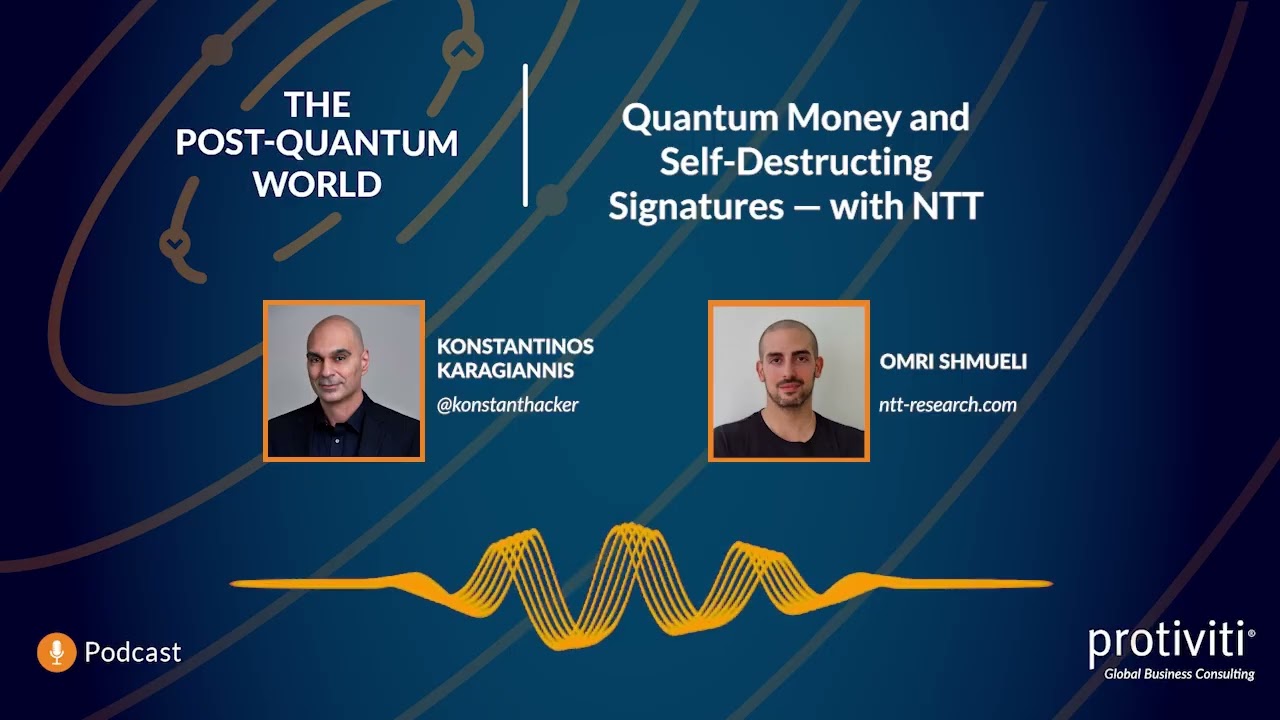
Quantum Money and Self-Destructing Signatures — with NTT | Ep. 122
Keywords
Summary
185 words
Critical Evaluation
Value of the Information & Strength of the Argument
The value of the information is high, as it provides a clear and accessible explanation of a cutting-edge cryptographic concept. The argumentation is solid, grounded in established principles like the no-cloning theorem and recent research. The guest, Omri Shmueli, is a co-author of a paper that won best paper at Crypto 2025, lending credibility. The discussion is well-structured, moving from basic definitions to applications and implications. The host asks pertinent questions that help clarify complex points, such as the difference between post-quantum and quantum cryptography. The episode also addresses practical considerations, like the need for quantum hardware and potential scalability solutions, making the argumentation comprehensive.
Scientific Rigor, Source Quality, Title Accuracy
The scientific rigor is good, with references to peer-reviewed work and established concepts. The guest cites specific papers and authors, such as Wiesner’s 1969 work and the 2020 paper on one-shot signatures. The quality of sources is high, as the guest is a researcher in the field. The title accurately reflects the content, focusing on quantum money and one-shot signatures. The episode does not delve into detailed technical proofs but provides a high-level overview suitable for an informed audience. The presence of a sponsor (Protiviti) is mentioned but does not affect the content’s integrity. Overall, the sources are credible and the title is appropriate.
224 words
Title / Content Match
The title accurately reflects the content, focusing on quantum money and one-shot signatures.
Quality & Reliability
7/10
The episode features a postdoctoral researcher discussing a peer-reviewed paper (Crypto 2025). The content is technically accurate and well-explained, but it is a podcast interview with limited depth and no formal verification of claims.
Key Moments
Markers derived by PSI from the transcript: the creator did not define chapters.
- Introduction and welcome to Omri Shmueli
- Explanation of one-shot signatures and their self-destructing nature
- Discussion on the no-cloning theorem and its role in quantum cryptography
- Overview of Wiesner's 1969 quantum money scheme
- Introduction to indistinguishability obfuscation and learning with errors
- Application of one-shot signatures to blockchain scalability
- Discussion on quantum money without a blockchain
- Unclonable quantum keys and proof of sole possession
- Research environment at NTT and future directions
Cited Sources
- NTT Research — Mentioned as the research institution where Omri Shmueli works
- Protiviti Quantum Computing Services — Sponsor and host's employer, mentioned in description
Concurring Sources
- No-cloning theorem — Supports the impossibility of cloning quantum states, a key premise of one-shot signatures.
- Quantum money — Historical context for the applications discussed in the episode.
Contribution & Novelties
The episode provides an accessible explanation of one-shot signatures, a recent advancement in quantum cryptography. It highlights the potential for quantum money and blockchain scalability, offering a novel perspective on how quantum properties can be leveraged for cryptographic applications. The discussion with a researcher directly involved in the work adds depth and credibility.
Pour aller plus loin :
- No-cloning theorem — Foundational principle behind one-shot signatures.
- Quantum money — Historical concept dating back to Wiesner.
- Indistinguishability obfuscation — Cryptographic tool used in the construction.
- Learning with errors — Computational problem central to post-quantum cryptography.
94 words
Radar Profile
The radar profile shows a balanced performance across all dimensions, with slightly higher scores in quality of information and technical level, indicating a well-explained and technically sound episode. The lower score in quantity of information reflects the concise duration and focused scope.
💬 No comments were provided for analysis.