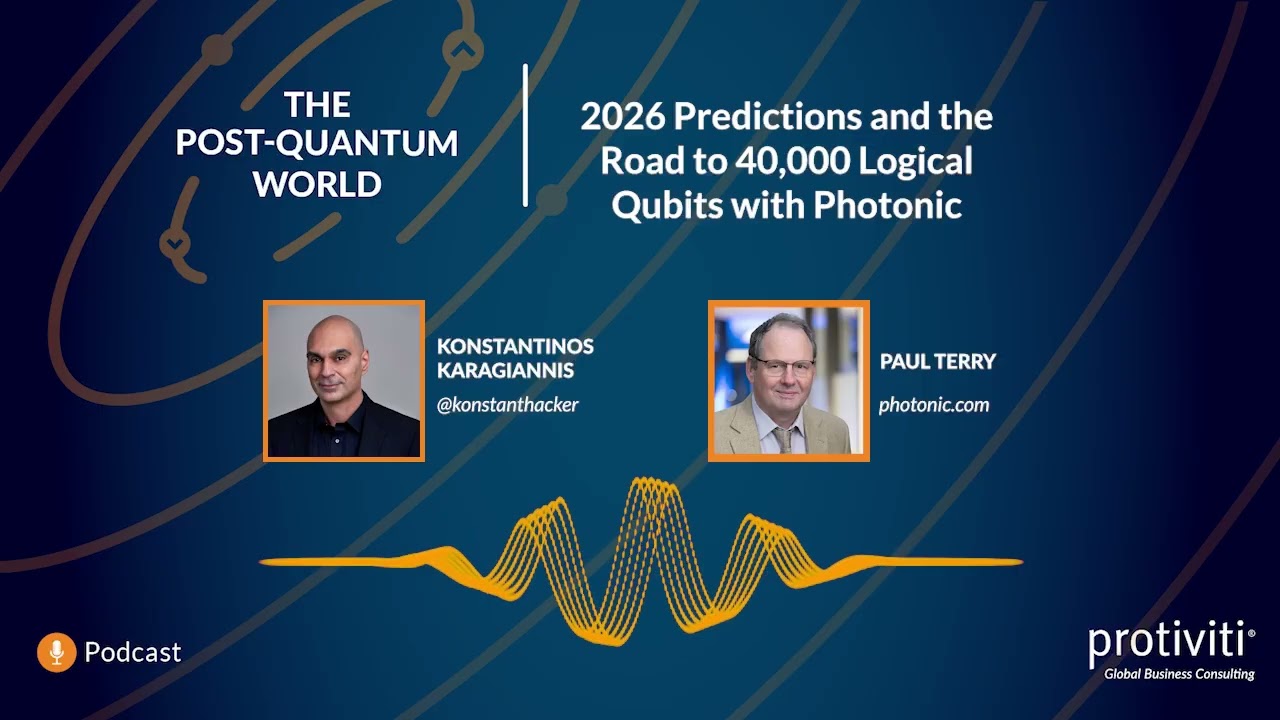
2026 Predictions and the Road to 40,000 Logical Qubits — with Photonic | Ep. 119
Keywords
Summary
163 words
Critical Evaluation
Value of the Information & Strength of the Argument
The value of the information is high for those interested in the strategic direction of quantum computing, as it provides insights into DARPA’s QBI program and Photonic’s specific approach. The argumentation is coherent and well-structured, with Terry explaining technical concepts in an accessible manner. He supports his claims with references to industry trends, such as the move to LDPC codes and the recognition of networking as key to scaling. However, the discussion is largely promotional, focusing on Photonic’s strengths and predictions without critical examination of potential drawbacks or competing approaches.
Scientific Rigor, Source Quality, Title Accuracy
The scientific rigor is moderate: the content is based on expert opinion and company-specific claims, not peer-reviewed research. The sources cited are limited to Photonic’s website and Protiviti’s services page, which are not primary scientific sources. The title accurately reflects the content, and the discussion is internally consistent. The lack of external references and the promotional nature of the conversation reduce the overall rigor. No comments were provided for analysis.
175 words
Title / Content Match
The title accurately reflects the content: a discussion of 2026 predictions and Photonic's roadmap to 40,000 logical qubits.
Quality & Reliability
7/10
The content is an expert interview with the CEO of Photonic, providing informed opinions and company-specific claims. While the speaker is credible, the discussion is largely forward-looking and promotional, with limited independent verification. The technical explanations are coherent but not peer-reviewed.
Key Moments
Markers derived by PSI from the transcript: the creator did not define chapters.
- Introduction to the episode and guest Paul Terry, CEO of Photonic.
- Explanation of DARPA Quantum Benchmarking Initiative (QBI) and Photonic's selection for Stage B.
- Discussion on the shift from noisy qubits to logical qubits and the bronze/silver/gold classification.
- Explanation of Photonic's entanglement-first distributed architecture and its advantages.
- Discussion on the challenges of interconnecting quantum computers and the importance of native telecom integration.
- Introduction of LDPC error correction codes and their impact on reducing physical qubit overhead.
- Photonic's goal of 40,000 logical qubits in service by 2030 and the definition of 'in service'.
- Discussion on the number of logical qubits needed for practical applications (100-2000) and the role of AI.
- Predictions for 2026: focus on business cases, AI as programming interface, and government funding.
- Closing remarks and call to action for listeners.
Cited Sources
- Photonic — Company website mentioned in the description for more information.
- Protiviti Quantum Computing Services — Sponsor's services page mentioned in the description.
Concurring Sources
- Quantum error correction — General reference on error correction, consistent with the discussion.
- Low-density parity-check code — Reference for LDPC codes mentioned in the episode.
Contribution & Novelties
The episode provides an insider perspective on Photonic’s strategy and the broader quantum industry’s shift towards fault-tolerant logical qubits. It highlights the importance of distributed architectures and LDPC error correction, offering a roadmap for scaling quantum computers. The discussion also introduces the concept of ‘gold standard’ logical qubits and predicts a timeline for practical applications.
Pour aller plus loin :
- Quantum error correction — Overview of error correction techniques in quantum computing.
- Low-density parity-check code — Explanation of LDPC codes used in error correction.
- Quantum entanglement — Fundamental concept underlying Photonic’s architecture.
- DARPA Quantum Benchmarking Initiative — Official program page (if URL is correct).
104 words
Radar Profile
The radar profile shows high scores in quantity of information and technical level, reflecting the detailed discussion of quantum computing concepts. The lower scores in reliability and quality suggest that the content is opinion-based and promotional, with limited independent verification.