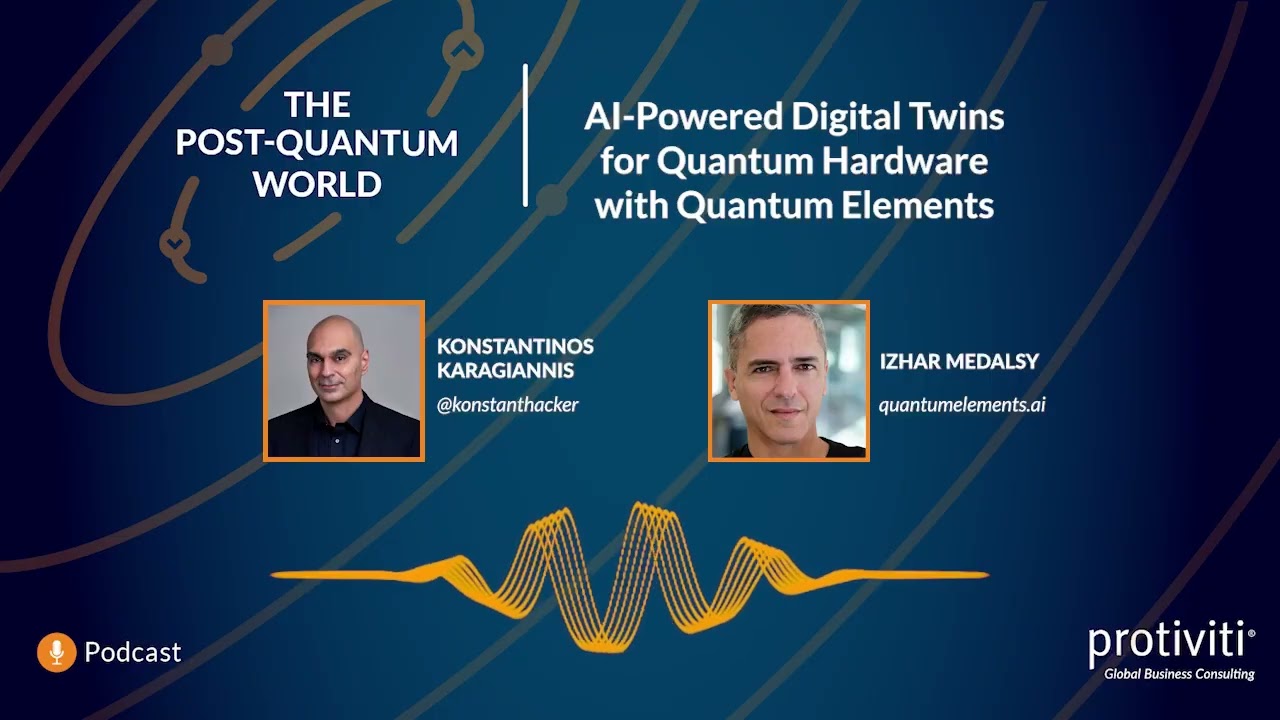
AI-Powered Digital Twins for Quantum Hardware — with Quantum Elements | Ep. 120
Keywords
Summary
174 words
Critical Evaluation
Value of the Information & Strength of the Argument
The value of the information is high for professionals in quantum computing, as it provides insights into a commercial platform that addresses real challenges in quantum hardware development. The argumentation is coherent, with the CEO explaining the technical approach and its benefits, supported by examples like the Shor’s algorithm demonstration and error suppression techniques. However, the discussion is promotional and lacks independent validation, with claims about scalability and performance not backed by published benchmarks.
Scientific Rigor, Source Quality, Title Accuracy
The scientific rigor is moderate; the methods are described at a high level without detailed technical explanation or references to academic papers. The sources cited are limited to the company’s website and a consulting firm’s page, which are not primary scientific sources. The title accurately reflects the content, and the discussion stays on topic. No comments were provided for analysis.
149 words
Title / Content Match
The title accurately reflects the content, focusing on AI-powered digital twins for quantum hardware as discussed with Quantum Elements.
Quality & Reliability
7/10
The discussion is based on the expertise of the CEO of Quantum Elements and includes specific technical details about stochastic compression and digital twins. However, it is a promotional interview with limited independent verification and no peer-reviewed sources cited.
Key Moments
Markers derived by PSI from the transcript: the creator did not define chapters.
- Introduction of the guest and the Constellation platform.
- Explanation of digital twins and their advantages over traditional simulation.
- Discussion on stochastic compression and breaking the 50-qubit barrier.
- Use cases for hardware optimization and error suppression.
- Integration of AI copilot and its role in troubleshooting and code generation.
- Future plans for scaling to logical qubits and lowering entry barriers.
Cited Sources
- Quantum Elements official website — Company website providing information about the Constellation platform and services.
- Protiviti Quantum Computing Services — Sponsor's page offering quantum computing consulting services.
Concurring Sources
- Quantum Elements official website — Company website providing information about the Constellation platform and services.
Contribution & Novelties
The episode introduces a commercial approach to quantum hardware simulation using stochastic compression, which is a novel method to overcome the scalability limits of traditional state vector simulations. The integration of AI as a copilot for troubleshooting and code generation is also a distinctive feature. The discussion provides practical insights into how digital twins can accelerate quantum hardware development.
Pour aller plus loin :
- Quantum error correction — Relevant to the discussion of error correction strategies.
- Tensor network — Related to alternative simulation methods mentioned.
- Shor’s algorithm — Referenced in the episode for factoring demonstration.
95 words
Radar Profile
The radar profile shows high scores in information quantity and technical level, reflecting the detailed discussion of quantum simulation methods. The lower score in reliability is due to the promotional nature and lack of independent verification.